Reading Guqin Inscriptions and Seals: Names, Dates and Provenance
读懂古琴铭款与印章:琴名、年代与流传
Turn a guqin over and its lower board may resemble a small archive. An instrument name can sit above the long sound hole; a maker’s seal or date may occupy another panel; poems, ownership notes and records of discovery or repair may accumulate around them. These words matter, but they do not all describe the same moment. A carved date is not automatically the date of the wooden body, and a collection seal does not by itself authenticate an instrument.
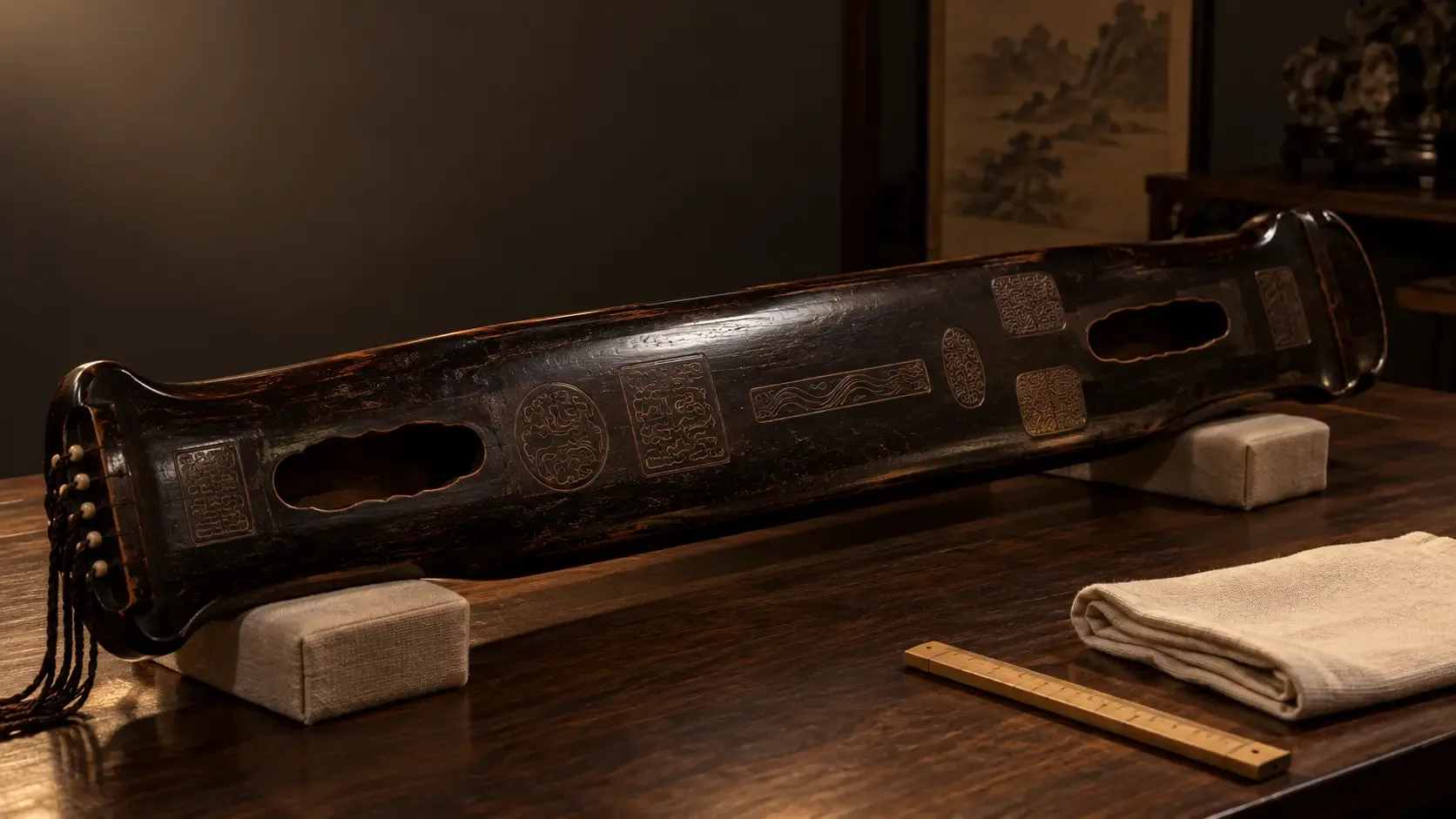
This guide presents a cautious way to read that archive. It builds on the site’s introductions to guqin structure, guqin history and lacquer and repair evidence. It is a method for looking and researching, not a substitute for palaeography, conservation or professional appraisal.
Begin with a map, not a translation
Record location and layout
Before trying to identify a character, record where each inscription appears. On the lower board, the larger sound opening is commonly called the dragon pool (longchi) and the smaller one the phoenix pond (fengzhao). Names may appear above an opening; seals, poems and later notes may sit below it or extend along either side. Location does not settle authorship, but it helps distinguish separate groups of writing.
Describe orientation, number of lines, script type if known, carving depth, fill colour and relationship to the lacquer. Do not silently join two panels into one text. A museum record, scale photograph and object number should remain attached to every transcription so that another reader can return to the same object.
Separate historic marks from modern identifiers
A museum accession or inventory number is a modern collection identifier, not one of the instrument’s historical seals. The Palace Museum explicitly explains that its object number is a unique registration identifier and that catalogue titles may change as research develops. Keeping these systems apart prevents a modern database label from being mistaken for evidence carved on the qin.
The distinction also works in reverse: a poetic instrument name does not guarantee that every catalogue has used the same title. Search by institution and object number whenever possible. Names are meaningful, but numbers often provide the more stable route back to a record.
Different inscriptions do different jobs
Names, workshop marks and serial information
An instrument name can express literary taste without naming a maker. A workshop or maker’s seal, a cyclical date, a princely mark and a serial number make different claims and should be transcribed separately. The Metropolitan Museum of Art’s Prince Lu guqin, dated 1634 and numbered 18, is especially instructive: the museum records a Princedom of Lu inscription and number, while the back also bears a maker’s seal and date, the words “Capital Peace,” and a poem. Those elements form a coordinated programme, not a single interchangeable signature.
Comparison matters. The Met notes that other surviving Prince Lu qin are likewise numbered. A repeated format across related instruments can strengthen an attribution, but it still belongs beside evidence from construction, materials, provenance and later alteration.
Poems and dedicatory writing
A poem may praise sound, friendship or cultivated listening. It may have been composed when the instrument was made, presented, collected or reinterpreted much later. Read its authorial claim, literary references and placement, then ask whether carving and colour belong to the same physical campaign as nearby marks.
The Palace Museum’s “Radiance of Moon and Sea” qin makes the problem visible. Its catalogue dates the instrument to the Southern Song, yet the lower board also carries a Qianlong imperial collection seal and poems by several Qing court figures. The older body and the later court inscriptions can both be historically valuable; they simply answer questions about different episodes.
Ownership, discovery and restoration notes
Some inscriptions speak in the first person about finding, receiving or repairing a qin. The Met’s mid-nineteenth-century “Xiangpu’s Treasure” includes one inscription referring to its owner’s discovery of the instrument in 1872 and its restoration, another evoking the story of Zhong Ziqi and Yu Boya, and a seal bearing the instrument’s name. Together they document how a later owner understood the object. They do not turn every statement into an independently verified manufacturing history.
Copy the wording faithfully, but classify the claim: observation, memory, dedication, acquisition, restoration or attribution. Then look for external support such as dated photographs, sale records, collection inventories and conservation files.
An inscription is not automatically a manufacture date
One object can carry several chronologies
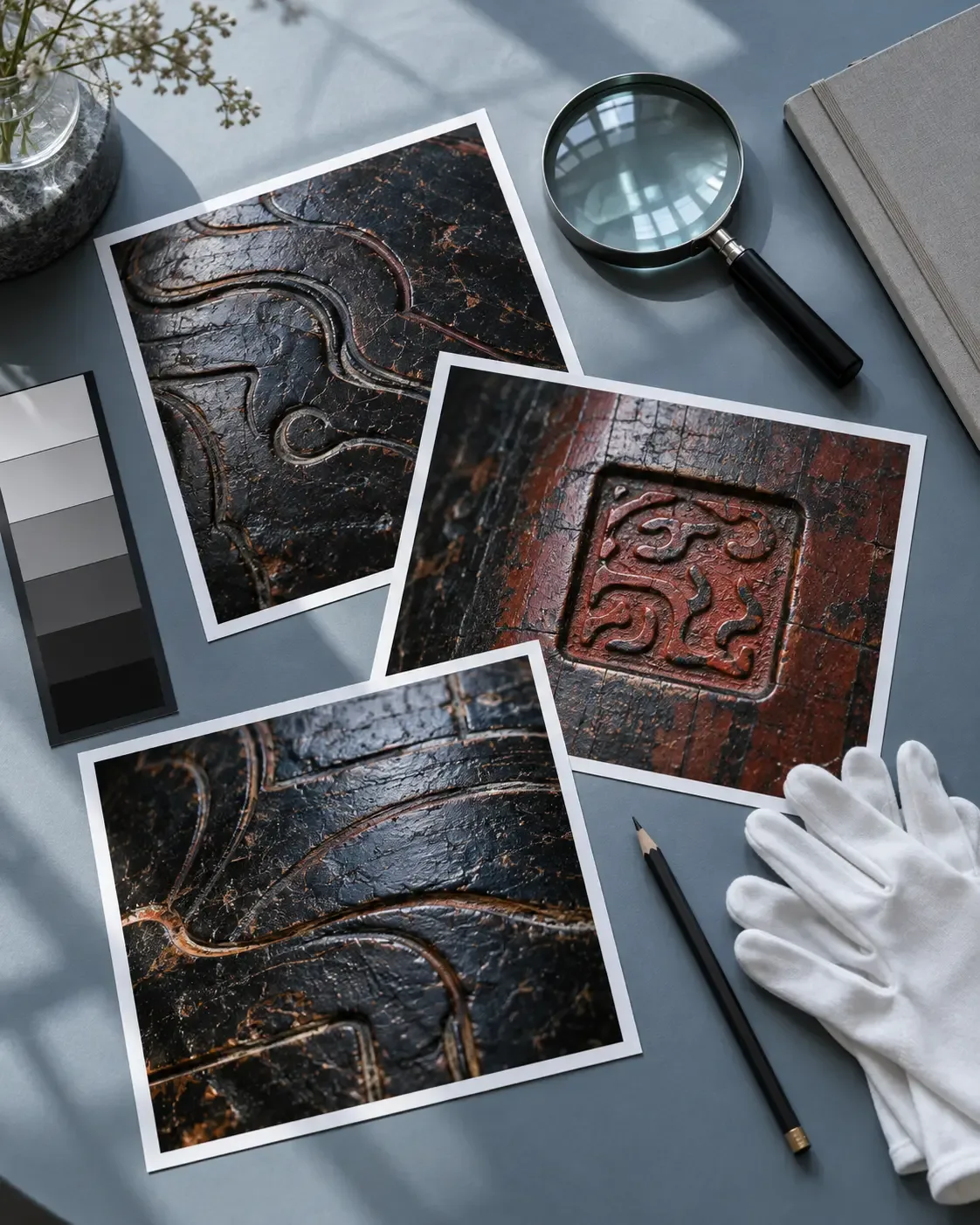
The wooden body, ground and lacquer may already have a history before a name is carved. A later owner can add a poem; a repairer can recut lost characters; a collector can add a seal; an older text can be copied onto a newer surface. Even apparently coherent lettering may therefore belong to a later phase.
Ask which material physically carries the mark. Is it cut through a topcoat, filled with pigment, placed over a repair or partly concealed beneath later lacquer? These are specialist questions, and photographs often cannot answer them, but they keep the reasoning honest. The nearby guide to guqin lacquer explains why a surface can contain more than one date.
Wording expresses a claim, not its proof
A date formula tells us what the inscription says. Establishing when it was carved requires further work: script and language, tool marks, fill material, wear, relationship to coatings, comparison with secure examples and documentary provenance. A prestigious name or reign period deserves the same testing.
Responsible catalogue language often preserves uncertainty. “Attributed to,” “possibly,” “appears to read” and “later inscription” are not signs of failure. They identify where the evidence ends. A useful reader keeps those qualifications instead of editing them away.
When the characters are difficult to read
Transcribe uncertainty
Do not force worn or unusual forms into familiar characters. The Palace Museum’s entry for a Qing stone qin describes two back seals with the cautious wording “appears to be” and says that their unusual forms are difficult to identify. A transcription can mark missing, doubtful or supplied characters; a translation should not pretend to be more certain than the reading beneath it.
Record the lighting and image used. Raking light from more than one direction can reveal shallow carving, while ordinary diffuse light may show fill colour more clearly. Do not make rubbings, apply chalk, wet a surface or trace directly on an object. Those interventions can stain, abrade or detach fragile material.
Technical imaging can recover information, not certainty
The Smithsonian’s National Museum of Asian Art reports that a difficult interior inscription in the qin called “Dragon’s Moan” was examined with infrared technology and seems to contain a date corresponding to a year in the 1008–1017 reign period. The museum’s wording is exemplary: imaging made evidence more legible, yet the conclusion remains qualified.
Infrared, ultraviolet, reflectance transformation imaging and other methods answer different questions. They should be planned and interpreted by qualified staff, with original files and processing steps retained. Enhanced contrast is an analytical aid, not permission to invent a complete character from a partial stroke.
Provenance is a chain, not a single story
Keep separate claims in separate columns
Build a chronology with at least four columns: the claim, its source, the date of that source and the confidence level. An inscription that says “restored in 1872” is one source. A dealer’s later description is another. A museum acquisition file, historic photograph or conservation report may support, refine or contradict them.
Use precise verbs: “the inscription states,” “the catalogue attributes,” “the photograph documents,” “the analysis suggests.” Avoid collapsing these into “the qin proves.” The same discipline helps distinguish an owner from a maker, an owner’s acquisition date from the instrument’s construction date, and documented custody from a legendary association.
Test the chain against the physical object
Names in a sequence are useful only if the links are clear. Check whether dimensions, shape, repairs, fittings and inscription layout remain consistent across records. Replaced pegs or strings do not erase an object’s history, but they should not be described as original without evidence. Gaps should remain gaps.
No inscription alone establishes authenticity, sound quality, a continuous teaching lineage or the religious identity of every owner. A careful provenance is often modest: a series of dated, checkable links with uncertainty stated between them.
A six-pass method for museum records
Move from identification to interpretation
- Fix the identity. Record institution, object number, current title, dimensions and the date you consulted the record.
- Map every mark. Note its exact location, orientation, line count, relationship to sound holes and nearby repairs.
- Transcribe before translating. Preserve doubtful and missing characters; keep a photograph tied to each reading.
- Classify the claim. Separate name, maker or workshop mark, date, serial number, poem, collection seal, ownership note and restoration record.
- Build the chronology. Compare script, carving, fill, lacquer layers and documented events without assuming they are contemporary.
- Check outward. Test the reading against catalogues, accession files, conservation records, historical photographs and securely related instruments.
Know where looking must stop
For a visitor, the safest tools are patience, a catalogue and permitted photography. For a collection professional, examination may include microscopy or technical imaging under an approved plan. Neither situation justifies cleaning, rubbing, chalking, scraping or lifting a loose surface to expose writing.
The aim is not to make every mark yield a decisive answer. It is to let names, dates, poems, seals and repairs retain their proper place in the instrument’s biography. Continue with the guqin handbook for a wider route through reading tablature, comparing editions and reconstructing music.
Sources and object records
- The Metropolitan Museum of Art, Prince Lu Guqin, 1634, object 1999.93a-b.
- The Metropolitan Museum of Art, “Xiangpu’s Treasure” Guqin, object 2016.179.1.
- The Palace Museum, “Radiance of Moon and Sea” qin, object 故00169256.
- The Palace Museum, Confucian-style stone qin, object 故169253.
- Smithsonian National Museum of Asian Art, “Dragon’s Moan” qin, accession F1915.100.