Guqin Strings: Silk, Modern Composites and How Material Changes Playing
古琴琴弦:丝弦、现代复合弦与材质如何改变演奏
Strings belong to an instrument, a player and a room
Do not turn material into a quality ladder
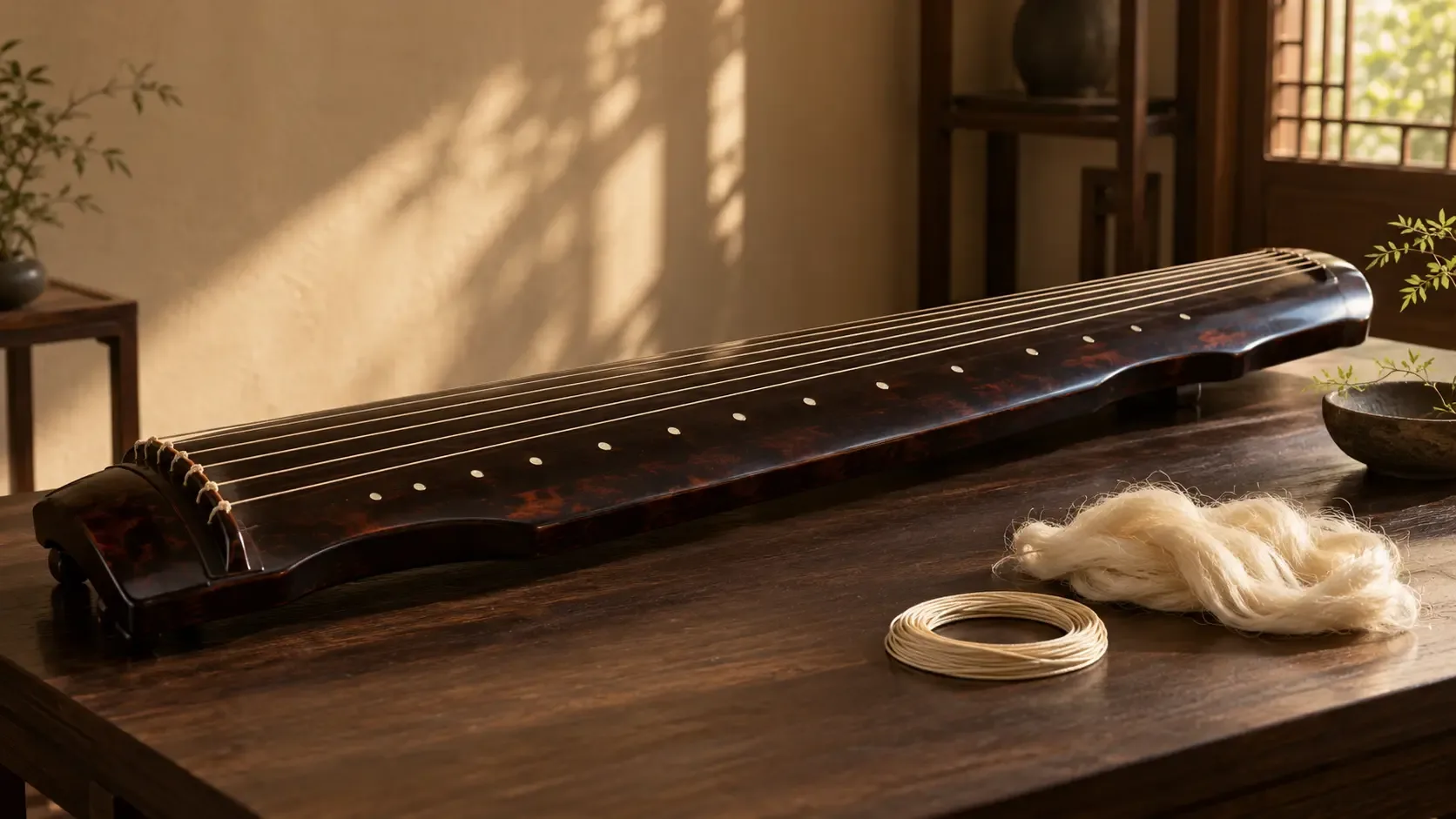
A guqin string works with the instrument’s arch, lacquered surface, nuts, cords, tuning, the player’s touch and the listening space. Silk, nylon-wound metal and other composite constructions do not carry a fixed rank outside that system. Start with the visible route of the seven strings in our guqin anatomy guide, then ask what a material enables, demands and changes on one identified instrument.
A comparison needs controlled conditions
Two recordings are not evidence about string material alone if instrument, player, pitch, microphone, room or processing also changes. The performance-practice study by Hoh Chung Shih places silk and steel-string acoustics beside technique and aesthetic choices rather than treating timbre as a property of a cord in isolation. Listen comparatively, but record the conditions before declaring one sample warmer, brighter, quieter or more authentic.
Museum strings are often replacements, not a preserved original setup
Read the catalogue field before the photograph
The National Museum of Asian Art catalogues the qin Dragon’s Moan with silk strings while explicitly identifying its pegs, keys and strings as replacements. That distinction matters: the object can document body, lacquer, inscriptions and later museum history without proving which strings it carried in every earlier period.
One record can describe a present configuration
The same museum’s Spring Breeze record describes seven silk strings and their route over the instrument. It is useful evidence for how that catalogued qin is now presented. It is not a licence to assume that every old qin retains ancient strings, or that a current string determines the date of the body. Separate the object, the fitted string set and the date of each.
Silk strings are engineered cords
Twist and gauge come before romance
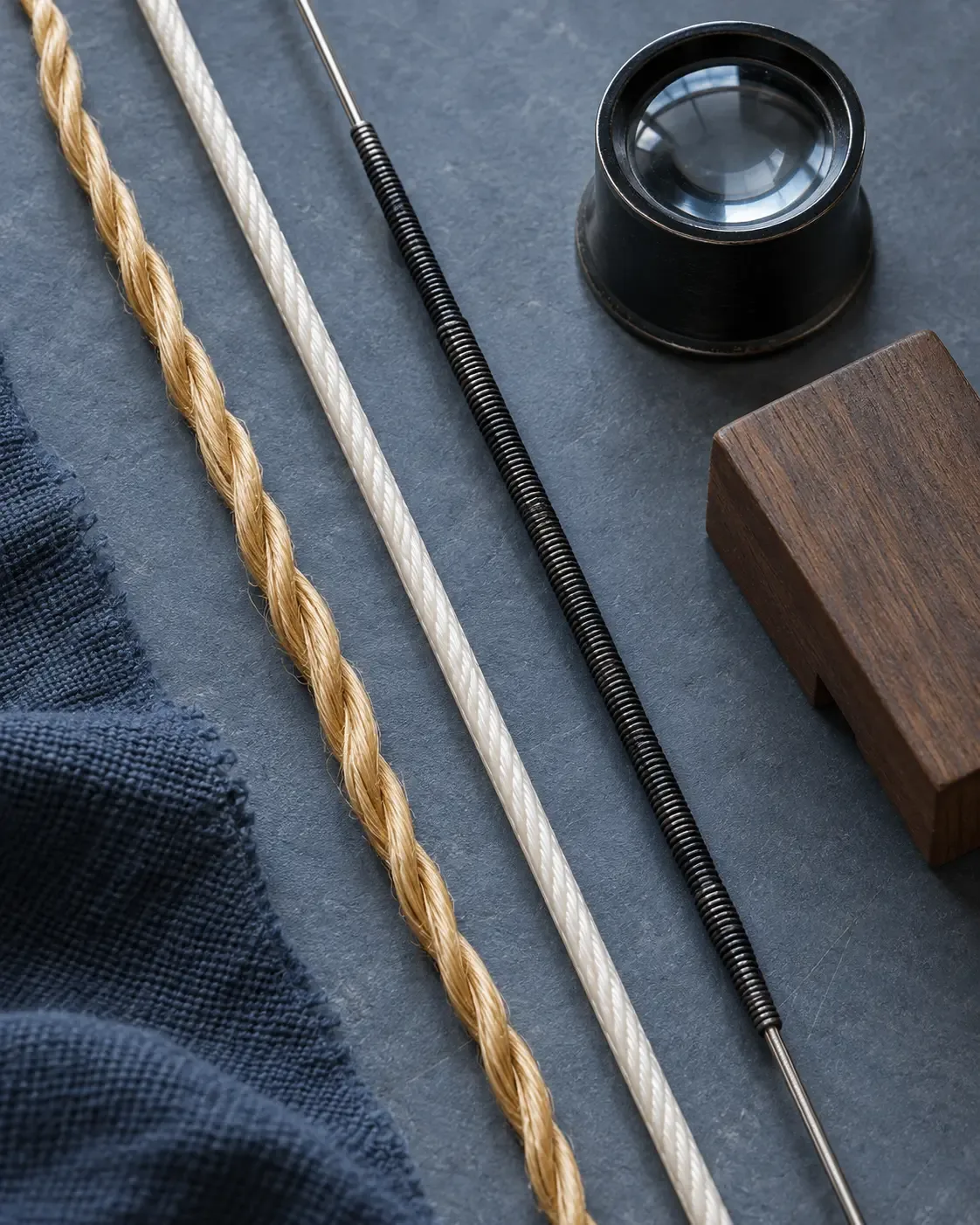
The Metropolitan Museum’s overview of the qin describes the established seven-string form with twisted silk strings of different thicknesses. A silk string is therefore not a single raw filament: many filaments are selected, combined and twisted; thicker strings may receive an additional wrapping. Gauge, twist and finishing affect mass, feel and response.
Historic recipes are material evidence, not instructions for home conservation
A 2023 technical review of guqin materials compares written recipes with scientific knowledge and notes collagen, starch and plant-derived components in historical silk-string coatings. Formulae vary by text and workshop. The finding explains why the cord’s surface is made, not merely grown; it does not justify applying an old recipe to an instrument or museum object without a qualified maker or conservator.
Modern labels need to be unpacked
‘Metal string’ usually names a construction, not a bare wire
Modern guqin strings are commonly described as a metal core with a synthetic winding, while other products use polymer or hybrid cores and windings. English, Chinese and commercial names are not perfectly consistent. Ask for the core, outer winding, gauge, intended pitch and maker’s compatibility guidance instead of relying on ‘steel,’ ‘nylon,’ ‘composite’ or ‘silk-like’ as complete descriptions.
The twentieth-century transition was uneven
An acoustics study from the Helsinki University of Technology and partner institutions reports that silk was traditional and that steel–nylon strings became predominant after the 1950s; its measured instrument used one specified modern set. That is evidence for a major change, not a single overnight replacement everywhere. Workshops, teachers, regions and individual players adopted materials at different times, and renewed silk-string making belongs to the continuing story.
Material changes touch as well as tone
Open, stopped and harmonic tones meet the string differently
Guqin playing combines open strings, pressed or stopped tones and harmonics. The right hand excites the string while the left hand may press, slide and shape pitch on the lacquered surface. The acoustic modelling study treats slides and harmonics as central expressive events. Surface texture, tension and mass can therefore alter attack, resistance, sustain and the audibility of contact, but the player adapts technique in response.
Sliding sound is not automatically a defect
On the guqin, movement between pitch positions can make the travelling hand audible. That sound may be structurally and aesthetically meaningful, although unwanted scratch, buzz or impact can also signal a technical or setup problem. Learn the gesture through our playing and notation guide and a teacher; do not diagnose a string solely from an isolated close-miked noise.
Sound claims need a method
A laboratory result describes its test system
The published physical model measured a 1999 guqin with a named steel–nylon string set under controlled conditions. Its spectra and models illuminate attack, decay, inharmonicity and gesture for that system. They do not rank all strings or predict how another body, set, pitch or room will sound. Technical precision begins by preserving the boundaries of the experiment.
A listening test should change one variable at a time
If practical circumstances allow, compare the same instrument, player, passage, tuning, room and microphone position before and after a documented string change. Allow for settling and retuning, and write down what the player feels separately from what listeners hear. Volume, sustain, tactile resistance, sliding noise and tuning stability are different observations; combining them into one word such as ‘better’ hides useful evidence.
Historically informed choice is still an interpretation
Old material does not recreate an old performance by itself
Using silk may be appropriate for a historically informed project, especially when tablature, period writings, technique and instrument are studied together. It does not recover a lost performance automatically: historical gauges, pitch levels, recipes, rooms and individual touch are incompletely documented. Our guide to handbooks, tablature and dapu explains why reconstructing sound from notation requires explicit choices.
Practitioner testimony should remain identified as testimony
Player-researcher John Thompson’s comparative string work combines measurement with decades of silk- and metal-string experience. It is valuable precisely because its standpoint and instruments are stated. Read preferences about refinement, damage, projection or technique as situated expert testimony, then compare them with catalogue records, technical studies and other players rather than turning one experience into a universal law.
Choose and change strings responsibly
Compatibility comes before fashion
Before buying a set, identify the instrument’s maker, present setup, condition, current pitch, playing environment and teacher’s method. Ask whether the proposed tension, gauge and attachment method suit that specific qin. Climate and use affect tuning and wear, but no material is maintenance-free. For the support beneath the instrument, consult our guqin tables and playing spaces guide.
Do not experiment on an old or fragile qin
Replacement strings can change loads and contact on the lacquered surface. An antique, cracked, repaired or poorly documented instrument needs assessment by a qualified guqin maker or musical-instrument conservator before restringing. Museum objects are evidence, not practice equipment. Do not add coatings, adjust structural parts or test higher tension as a casual experiment.
Use a seven-question string record
Write observations before conclusions
For any set, record: (1) stated core material; (2) outer winding or coating; (3) gauge and intended pitch; (4) maker and date; (5) instrument and setup; (6) room, microphone and repertoire used for comparison; and (7) what changed in touch, tuning and sound. Unknown is an honest entry. This record makes later comparison more useful than a verdict based on memory.
Continue from material to music
Place strings within the wider guqin learning route: begin with history, examine lacquer and repair, and listen through the further-study guide. UNESCO’s guqin heritage record concerns a living musical practice; strings matter because people make, fit, touch, hear and teach them.