Gongfu Tea at Home with What You Already Have
在家泡功夫茶:用你已有的东西
You like tea, you own a mug, a kettle and maybe a small teapot, and you have read that gongfu tea needs a tray, a set of tiny cups and a long list of tools. It does not. Gongfu brewing is an idea about leaf, water and time, and you can try it this evening with what is already in your kitchen. This page explains the idea first, then walks you through one session, then names the one thing worth buying.
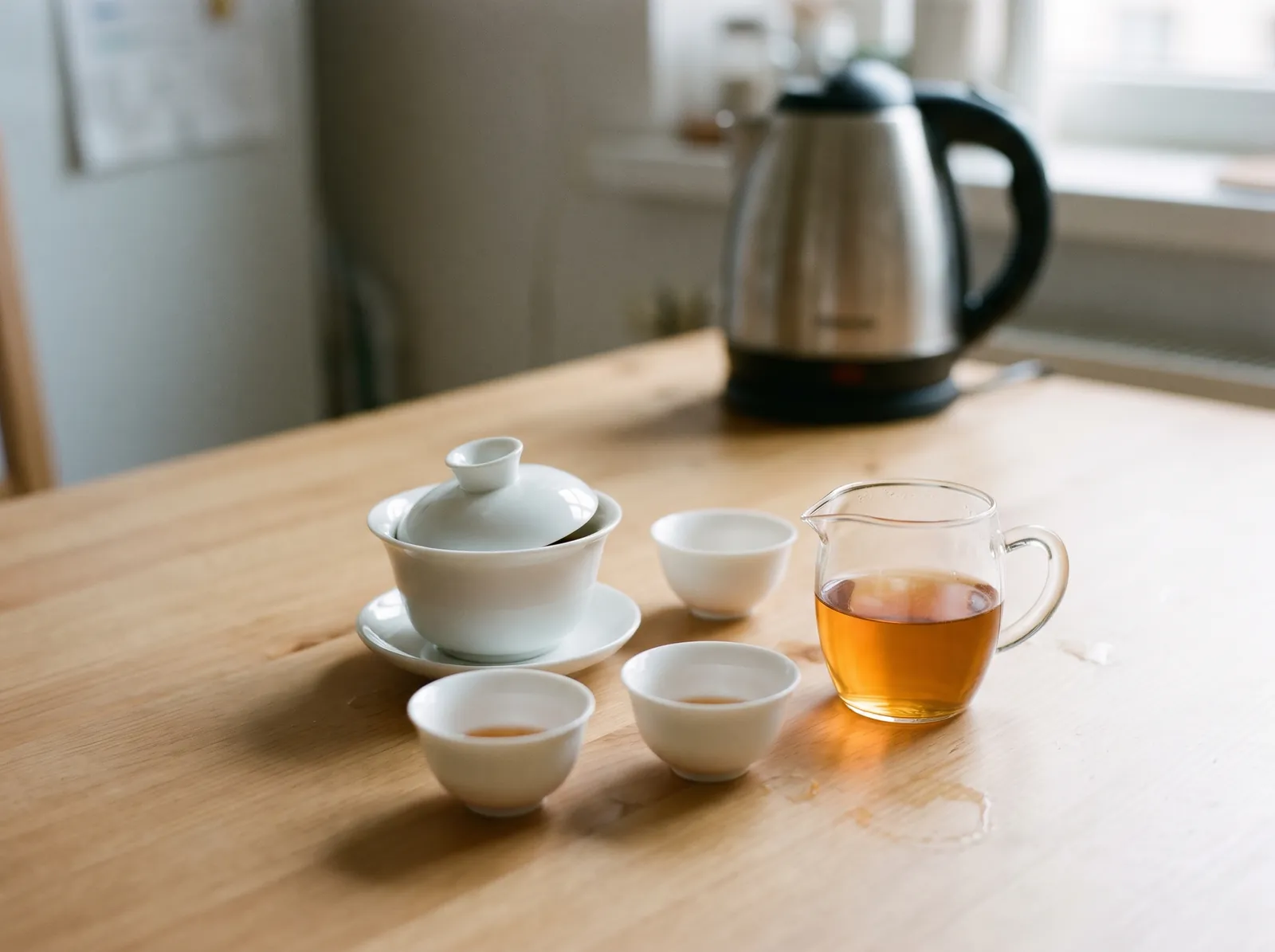
Everything here is ordinary kitchen kit except the gaiwan, the one thing worth buying first.
The one idea: more leaf, less water, short steeps
A mug brew is one long steep: a few leaves, a lot of water, several minutes. Everything the leaf gives up arrives in a single cup, and the last sips are often bitter. Gongfu turns this around. You use more leaf for the amount of water, you pour the water off after a short time, and you steep the same leaves again and again. This is the gongfu method described on our page on utensils and gongfu method: a small vessel, repeated infusions, close attention.
Why does it work? Short steeps keep each cup close to a single moment in the leaf's life. The first round tastes of the opening leaf, the fourth of the leaf at full stretch, the seventh of the leaf running out. Instead of one averaged cup you get a sequence, and you can taste the tea change. That is also why you can learn so much from a single handful of leaf.
What you need from your kitchen
You need five ordinary things:
- a small cup or bowl with a capacity of about 100 to 150 ml (a rice bowl or a small ceramic cup) as your brewing vessel;
- a saucer or small plate that sits on top as a lid;
- a tea strainer, or a fine sieve;
- a jug, glass or heatproof, to receive the tea so every cup tastes the same;
- a kettle, and a few small cups to drink from.
Plain white or glass vessels are best at the start because you can see the colour of the tea. Do not buy anything yet. Brew with this, notice which part is awkward, and let that tell you what a better tool would fix.
Choose a tea and set the water
Start with an oolong, for example a rolled ball-shaped or a lightly roasted one. Oolongs are forgiving: they tolerate hot water, they survive a slightly long steep and they last through many rounds. Our page on types of tea and their character explains the families and how they are made.
Water temperature depends on the kind of tea. As a general guide, oolong, black and dark teas are commonly brewed with water just off the boil, roughly 90 to 100 degrees Celsius. Green and white teas are commonly brewed cooler, roughly 75 to 85 degrees, because very hot water can make them taste harsh. These are starting points, not rules; the tea's own packaging or the seller may suggest something different. If you have no thermometer, boil the kettle and let it stand a few minutes for the cooler teas; how fast water cools depends on how much there is and what it is in. Clean, fresh-tasting water matters too; see water for Chinese tea.
Your first session, step by step
The numbers below are a common starting point, not rules. Change them as you learn what you like.
- Warm the vessel. Pour hot water into your bowl or cup, swirl it, and pour it into the jug or sink. A cold vessel takes heat from the tea.
- Add the leaf. A common starting point is about 4 to 6 grams of oolong for a 100 to 150 ml vessel, which usually fills the bottom third to half of the vessel when the leaves are dry. If you have no scale, use that as a rough guide; tightly rolled and loosely twisted leaves fill different amounts.
- Rinse, if you like. Pour water over the leaf and pour it off straight away. Many people do this to wake the leaf and wet it evenly. Smell the damp leaf; this is your first aroma.
- First steep. Fill the vessel with hot water, put the saucer on as a lid, and wait about 15 to 25 seconds.
- Pour off completely. Hold the strainer over the jug and pour out every drop. Water left on the leaf keeps steeping and spoils the next round.
- Share and taste. Pour from the jug into your small cups. Drink slowly.
- Repeat. For each following round add 5 to 10 seconds, so a typical sequence runs about 20, 25, 30, 40 and 50 seconds, and later rounds may need a minute or more. Many oolongs give five to eight good rounds.
Caution: boiling water and hot porcelain can burn. Hold a gaiwan by the rim of the bowl with a finger on the lid, and an improvised bowl by its rim with the saucer-lid held firmly, never by the sides, pour away from your body, and keep children well away from the table while the kettle is out. Tea contains caffeine; if it affects your sleep, drink less of it late in the day.
What to notice from round to round
This is the part that turns a drink into a practice. Use the same few questions every round:
- Colour: pale, gold, amber? Does it deepen or lighten?
- Aroma: smell the empty warm cup, then the lid or the wet leaf. Is it flowery, grassy, toasty?
- Taste and texture: thin, round, sharp? What stays in your mouth after you swallow?
- The fade: at which round does the tea start to thin? That tells you the leaf is nearly spent.
You do not have to find the right words. A few notes in a notebook, such as "round 3, sweetest, long finish", are enough, and in a few sessions you will start to see your own pattern.
What beginners get wrong
- A first steep that is too long. With a mug habit, it is natural to wait a minute or more. With this much leaf, that can give a bitter cup. Begin short; you can always steep longer next round.
- Scalding fingers. A small vessel full of hot water has hot sides. Rim and lid only.
- Judging the tea by the first cup. The first round is often the least typical, because the leaf is still closed. Wait until the third or fourth round before deciding what you think.
- Leaving water on the leaf. Pour off fully each time.
The one thing worth buying first
If you buy one thing, make it a gaiwan: a lidded porcelain bowl, usually 100 to 150 ml, often sold with a saucer. It is what you were improvising with the bowl and the saucer, made properly. The lid fits, so it holds the heat and keeps leaf back as you pour; the porcelain is smooth and easy to clean; and the shape lets you smell the lid and watch the leaf open. A plain white one is not expensive and works for every kind of tea. A teapot, a tray and a tea-pet can wait until you know what you miss.
Tea as a way of paying attention
Gongfu is often said to mean skill earned through time and care. In a short-steep session you cannot walk away or look at your phone; the tea asks you to watch the clock, the colour and the cup. Some people find that is the point: for ten or fifteen minutes there is one small task, done carefully and repeated. Our page on the Chinese tea ceremony shows how varied the traditions around tea really are.
Try this: brew the same oolong tomorrow with the same leaf amount, but change only one thing, such as the first steep going from 15 to 30 seconds. Taste the two side by side and write one sentence about the difference. That is gongfu: not special kit, but one change at a time and a cup to answer you.