Six Chinese Tea Families: Processing and Taste
六大茶类:从制法到品饮
Chinese tea is commonly grouped into six processing families: green, white, yellow, oolong, black and dark tea. These names offer a useful starting point, but they are not six fixed flavours or six grades of quality.
Begin with two questions: how were the leaves made into tea, and what do you notice in the cup? This guide connects the processing vocabulary with a simple way to compare teas, without turning tasting into a test.
1. Processing is more than an oxidation scale
Withering allows picked leaves to lose moisture while their chemistry changes. Rolling or bruising disrupts leaf tissue; heat treatment can limit the activity of the leaf's oxidative enzymes. Drying, roasting and, in some teas, microbial fermentation contribute further changes. Their sequence matters as much as any single step.
Tea makers often use “fermentation” in a broad traditional sense, including the enzymatic oxidation involved in black tea. Here, “oxidation” describes that leaf chemistry, while “microbial fermentation” makes the role of microorganisms explicit. Neither word alone explains every tea.
2. Green tea: early heat treatment
Green tea processing uses an early heating step, often called fixation or shaqing, to limit enzymatic oxidation. The leaves are then shaped and dried through methods that vary by tea. A green tea is therefore a processed product, not simply a fresh leaf put into water.
When tasting, ask whether the aroma reminds you of fresh vegetation, cooked greens or toasted food. These are prompts, not flavours every green tea must have. Record the tea's actual name and preparation rather than assuming that its country of origin explains everything you taste.
3. White tea: the importance of withering
Traditional white-tea manufacture centres on withering and drying rather than the early fixation used for green tea. Withering is an active stage of flavour development: an experimental comparison found different grassy and floral aromas under different withering treatments. Few processing stages do not mean that nothing changes in the leaf.
Give a quiet aroma time to become familiar. Compare the dry leaves, the warm infusion and the cup after drinking. If the first brew seems faint, note your preparation before deciding that all white tea is weak. One cup cannot stand for a whole family.
4. Yellow tea: a distinct yellowing stage
Yellow tea has a characteristic yellowing stage, known as menhuang, involving warmth and moisture after fixation. Research on yellowing shows that temperature and humidity influence its aroma. It is not simply green tea that happens to look yellow in the cup.
For a useful comparison, taste a yellow tea beside a green tea and describe any differences you find in aroma, texture and finish. Do not feel obliged to call the yellow tea sweeter or better. The category explains a manufacturing approach; your notes describe the particular samples.
5. Oolong: processing and cultivar together
Oolong involves partial oxidation, with processing choices and the tea cultivar jointly shaping its aroma. Anxi Tieguanyin is one established oolong tradition. In experiments on light, aromatic styles of oolong, turning the leaves was particularly important for aroma development.
A useful next step is to compare two clearly described oolongs, noting the producer's information about processing and roasting. Keep roast character separate in your notes from floral or fruity impressions. Avoid using a single dark leaf, pale cup or familiar tea name as a complete description.
6. Black tea: hongcha, not heicha
The tea called “black tea” in English is hongcha (红茶) in Chinese. Its manufacture encourages extensive enzymatic oxidation before drying. Transformations of leaf compounds contribute to its colour and flavour. The English word “black” should not be confused with the separate Chinese category heicha (黑茶), translated here as “dark tea”.
Use the name on the packet alongside the category. In a comparison, ask whether the aroma seems floral, fruity, malty or something else entirely, then describe how the infusion feels. A family name is not a promise of strength, bitterness or a particular colour.
7. Dark tea: microbial transformation
Microbial fermentation is important in dark-tea processing. A study of Qingzhuan tea from Hubei followed changing microbial communities and leaf compounds during pile fermentation. This illustrates why dark tea cannot be explained simply as black tea taken further along the same oxidation scale.
Ask for the producer's processing and storage information, especially when an age claim is central to a tea's description. Treat a date as something to document, not a guarantee of quality. If exploring pu'er, seek the specific product description rather than relying on that name or the infusion's darkness alone.
8. Scented tea: read the base and the ingredients
A scenting description adds another layer to the processing family. Jasmine scenting, for example, has been studied with yellow tea as well as with green tea. “Jasmine” does not by itself tell you which base tea is inside the packet.
Check whether a product contains tea leaves, flowers, other plants or added flavouring. When comparing a scented tea with an unscented one, write that difference down. If you want to explore the base tea, choose a comparison that makes the ingredients clear rather than asking every floral cup to answer the same question.
9. A small, repeatable tasting exercise
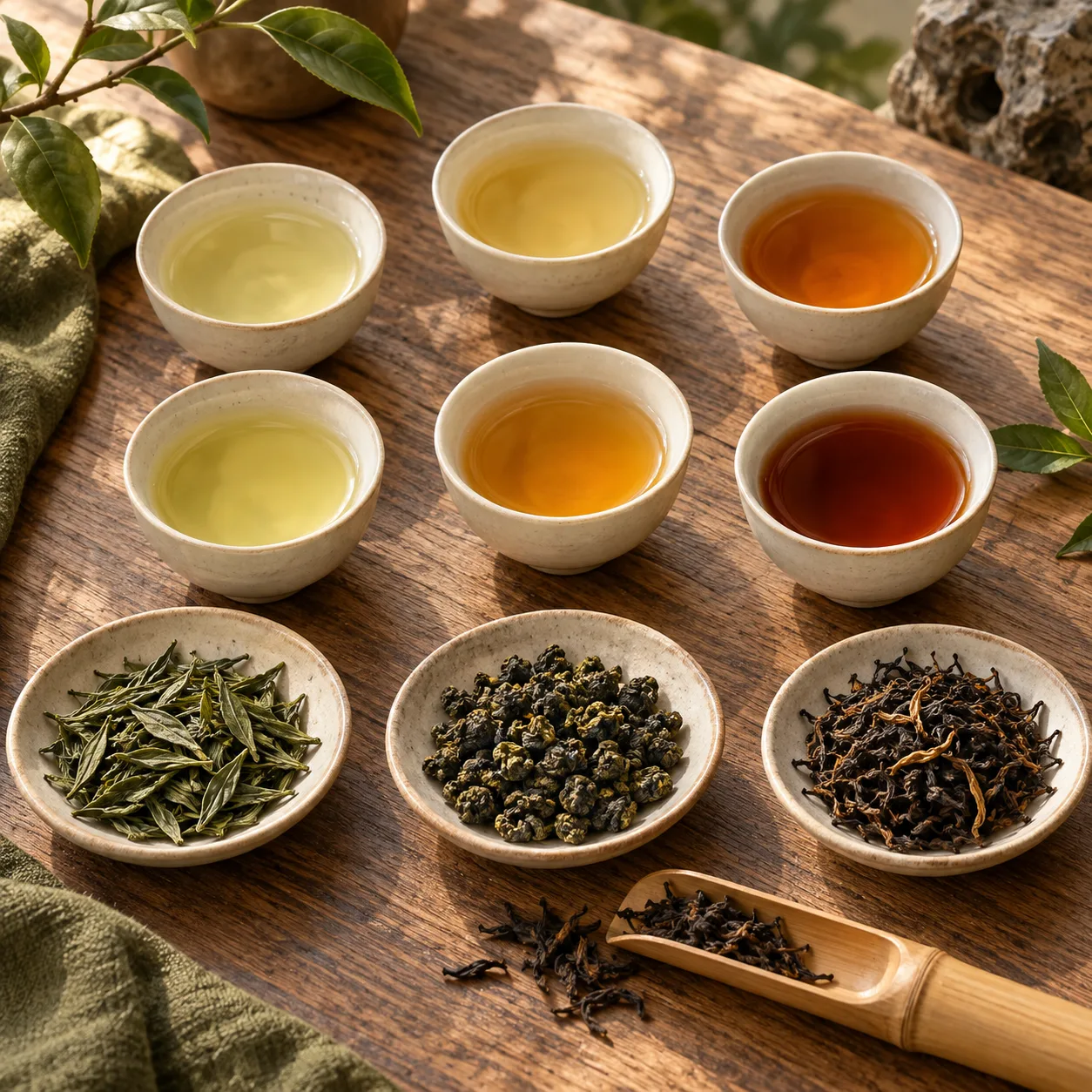
Choose two teas and use matching cups, the same water and a measured amount of leaf. Start with each producer's preparation guidance. For a more controlled comparison of similar teas, keep leaf amount, water volume, temperature and infusion time the same, and record them. This is a learning exercise, not a claim that one recipe suits every tea.
Write three short observations: what you smell, how the tea feels in the mouth, and what remains after swallowing. Distinguish “bitter” from “drying” and “I like this” from “this reminds me of toasted grain”. In a second trial, change one preparation variable. Keep the result as a description of that trial, not a rule for the entire category.
10. Choose a question, then continue
You do not need to collect all six families at once. A pair of clearly labelled samples can support a better question: what changes between these two white teas, or how do two oolongs differ? Keep the name, source, purchase date and brewing notes together so you can return to the comparison.
Return to Chinese Tea Culture for the wider reading path, or continue with The Way of Tea for attention, hospitality and everyday practice. The aim is a more attentive cup, not a hierarchy of supposedly superior teas.