Origins and History of Chinese Tea Culture
中国茶文化的源流与历史
Tea history is not a single invention story. It is a long record of plants being gathered and cultivated, leaves being processed in changing ways, and people giving tea new social meanings. Archaeological residues, transmitted texts, excavated vessels, paintings and trade records answer different questions; none of them alone describes how everyone drank.
This guide follows those layers rather than forcing them into one straight line. It begins with material evidence, moves through Tang and Song textual and object cultures, then considers later loose-leaf methods, regional craft, commerce and modern revival. For a broader map of present-day practice, begin with Chinese Tea Culture.
1. Start with the kind of evidence
An excavated plant residue can show that tea reached a place by a certain period, but it rarely reveals the exact recipe, occasion or meaning. A court text records elite ideals and regulations, not every household habit. A painting can document vessels, posture and setting while still arranging them for an artistic purpose.
Good tea history therefore asks three questions: what survives, when was it made or copied, and whose practice does it represent? When sources disagree, the responsible answer is often a range or a qualified claim. This is more useful than treating a later legend as an eyewitness report.
2. Plants, residues and early use
Tea comes from Camellia sinensis, a plant with deep botanical roots in parts of southwest China and neighbouring regions. Human use developed over a long period. At the Han imperial mausoleum complex of Yangling, researchers identified ancient tea remains dating to roughly 2,100 years ago; related evidence from the Tibetan Plateau shows that tea also travelled far from producing regions at an early date.
These finds establish presence and movement, not a complete brewing manual. Early leaves may have entered food, medicinal preparations or drinks, and practices almost certainly varied by place and community. Claims that one named ruler suddenly “discovered tea” belong to later cultural memory, not securely dated contemporary evidence.
3. From scattered references to a drink culture
Early Chinese writings use changing names and contexts for tea. Some passages associate bitter plants or infusions with diet and materia medica; later records increasingly show tea as a prepared drink, a commodity and an item of hospitality. Because many texts survive in later editions, their wording and dates need to be handled with care.
By the centuries before and during the Tang dynasty, cultivation, processing and trade were expanding in several regions. Tea could circulate through households, monasteries, markets and official networks without being identical in each setting. The history is one of overlapping uses rather than medicine simply giving way to leisure overnight.
4. Lu Yu and the Tang textual record
Lu Yu's Classic of Tea (Chajing), composed in the eighth century, is the earliest surviving systematic work devoted to tea. It discusses origins, tools, manufacture, preparation, water and customs. Its importance lies not in inventing tea, but in organising existing knowledge and giving later readers a powerful vocabulary for judging materials and practice.
The work also shows the limits of a famous source. Lu Yu wrote from particular regional and learned contexts, and the received text has its own transmission history. It is best read beside Tang objects, poems and administrative records, not as a universal rulebook followed unchanged across China.
5. Song powdered tea and the dark bowl
In elite and monastic settings of the Song period, processed tea could be ground finely, combined with hot water and whisked to form pale foam. Dark-glazed Jian bowls made that foam easy to see and became prized objects. Poems, paintings and surviving ceramics preserve evidence for preparation, appreciation and competitive tea gatherings.
This is a major chapter, not the timeless essence of all Chinese tea. Brewing leaves in other ways continued, and regional habits were diverse. The familiar contrast between “Song powdered tea” and “later steeped tea” is helpful only when treated as a shift in prominence, not a total replacement on a single date.
6. Late-imperial change and loose leaves
During the Ming period, court policy and changing tastes helped move elite attention away from tribute cakes toward processed loose leaves. A well-known 1391 order concerning Jianning tribute is one marker of that change, but it did not instantly transform every producer or drinker. Compression, roasting, grinding and steeping had always depended on region, product and purpose.
Loose-leaf infusion encouraged new relationships among leaf shape, water, vessel and timing. Teapots and smaller cups became increasingly important in some settings, while bowls remained useful elsewhere. The scene pictured here deliberately combines objects from different eras: it is a reading aid, not a reconstruction of one historical table.
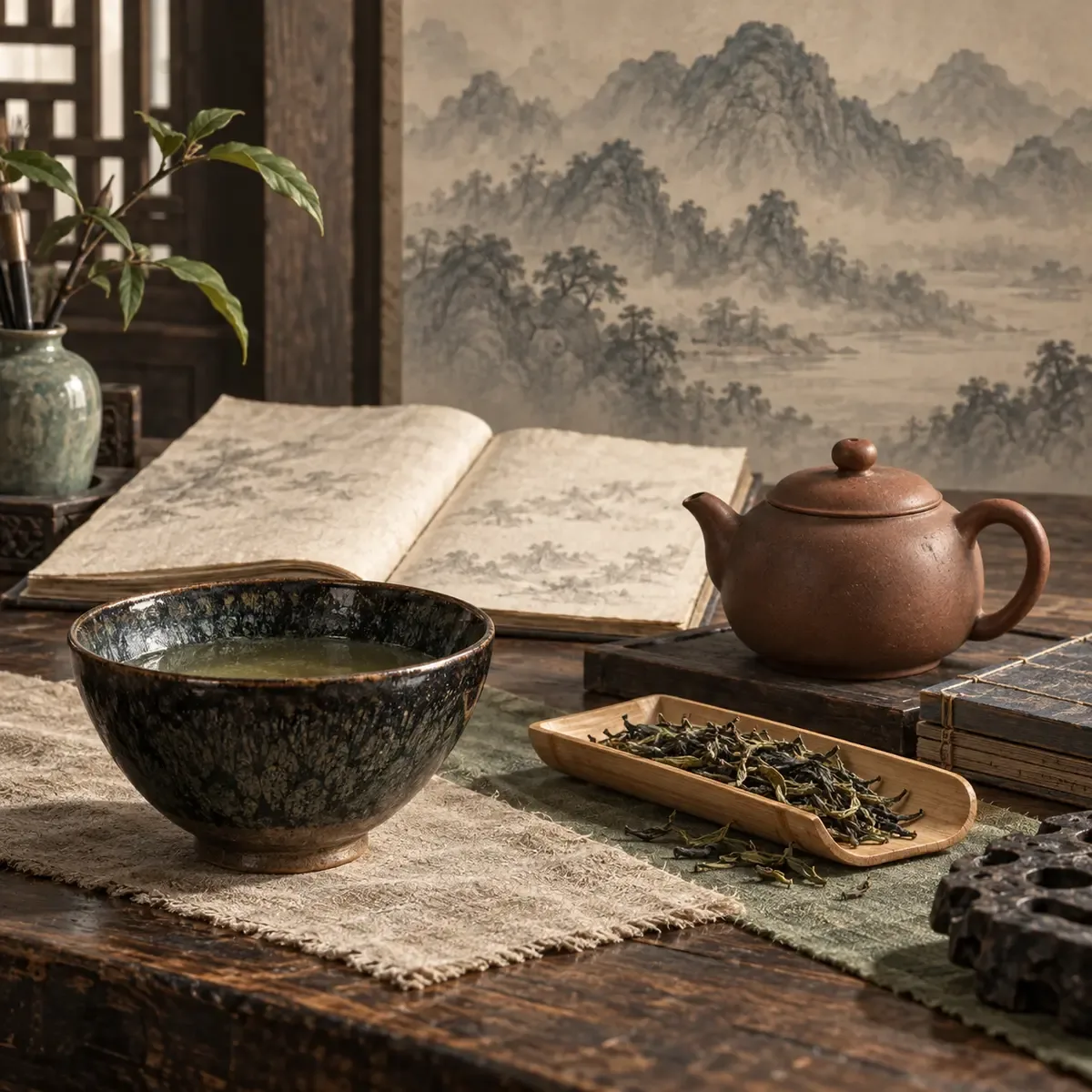
An interpretive study scene combining objects from different periods. AI-generated for Wudang.Org; not a historical reconstruction.
7. Regional craft and named teas
Tea categories emerged through local ecologies and skilled labour: cultivar, altitude, season, withering, heating, rolling, oxidation, roasting and storage all matter. What is now grouped as green, white, yellow, oolong, black or dark tea was not created as one centrally planned system. Techniques and names stabilised at different times.
Fujian, Anhui, Zhejiang, Yunnan, Sichuan, Hunan and other regions developed distinctive products and markets. A famous name can refer to a place, a processing style, a cultivar, a grade or a later commercial standard. The guide to tea types and character is most useful when read as orientation rather than a claim that every tea fits a rigid box.
8. Tax, frontiers and trade
Tea was also revenue, transport and diplomacy. States taxed and regulated it; merchants moved it along river, road and maritime networks; frontier exchange linked tea to horses and other goods. These systems connected producers and drinkers while exposing them to official monopolies, price changes and political disruption.
Long-distance trade transformed taste in both directions. Packing and durability influenced processing, while foreign demand encouraged new grades and production scales. Yet “the tea trade” was never one route: domestic markets, Inner Asian exchange, Southeast Asian circulation and maritime export operated with different participants and pressures.
9. Export, empire and changing production
From the early modern period onward, growing European demand drew Chinese tea into expanding commercial and imperial systems. Merchants classified teas for distant buyers, coastal ports concentrated exchange, and knowledge of plants and manufacture became strategically valuable. Later cultivation in British-ruled India and elsewhere altered global supply and competition.
This history should not reduce Chinese tea to a backdrop for European consumption. Producers, brokers, port workers and regional firms adapted actively, while wars, unequal treaties and colonial expansion reshaped the conditions of trade. Objects in museums and labels in archives can reveal those networks, but their catalogues may also preserve outdated spellings and market categories.
10. Disruption, revival and living traditions
Twentieth-century war, political change, collectivisation, industrial production and market reform affected regions differently. Some workshops closed or reorganised; some techniques continued within families, farms and state institutions; others were reconstructed or newly standardised. Taiwan and overseas Chinese communities also became important sites for tea production, connoisseurship and new forms of tea art.
Today's tea culture is therefore both inherited and creative. UNESCO's 2022 inscription recognises knowledge, skills and social practices across many Chinese communities, not one compulsory ceremony. Continue with The Way of Tea for values and hospitality, Tea Utensils and Gongfu Method for practical choices, or Further Reading and Practice for a study path.