Learning Chinese Tea: Reading and Practice
学茶入门:阅读与品饮练习
A useful tea study session can begin with one cup and one question. What changes when you shorten the infusion? What can an old tea bowl tell you? Which details support a seller’s account of a tea’s origin? Reading and brewing offer different ways to investigate these questions.
This guide offers a flexible starting point for curious readers. You do not need a collection of expensive utensils or a fixed year-long curriculum. Choose one thread, keep a few observations, and let the next question grow from what you notice.
1. Begin with a question
Choose whether today’s question concerns taste, technique, history or social practice. A brewing demonstration can help with pouring; a dated object can help with historical context. Neither automatically answers a question about the origin of the leaves in your packet.
Keep the question small enough to explore in one session. ‘What happens if I shorten this infusion?’ gives you a clearer task than ‘How do I make perfect tea?’ Write down what you would need to observe before reaching a conclusion.
2. Separate observations from claims
In your notes, distinguish what you can observe from what someone tells you. You can describe the colour of an infusion or record the wording on a label. A harvest date, named mountain or producer attribution needs supporting information beyond the taste of a cup.
When reading, record the author or institution, title, date and relevant page or object number. Mark a passage as a historical quotation, a modern interpretation, a seller’s description or your own observation. These labels help you return to the evidence without treating every statement as the same kind of fact.
3. Read a classical text in context
Lu Yu’s Chajing, usually translated as The Classic of Tea, is an entry into Tang tea culture. Read it with attention to its own setting.
Choose an edition that identifies its translator and explains unfamiliar terms. Ask which vessels and preparation stages a passage assumes. Record the edition and page beside your notes: a modern paraphrase can be useful, but it should not become an unattributed quotation from the original.
4. Let museum objects complicate the story
The National Palace Museum’s Tasting Tea exhibition discusses both boiling and whisking in Song tea preparation. Its objects offer a reminder that historical practice need not fit a single sequence of neatly separated stages.
Choose one bowl, pot or painting and read its catalogue label before interpreting its use. Separate its date, material and attribution from a curator’s suggested function. If a label says an object ‘might’ have been used in a particular way, preserve that uncertainty in your own account.
5. Follow a religious and cultural history
James A. Benn’s Tea in China: A Religious and Cultural History (2015) offers a route into tea’s connections with religious and cultural change. Its publisher describes a study drawing on several kinds of historical material.
Use this as a focused reading path, not as a requirement to finish a whole book before brewing. Pick a question about a community or period, consult the relevant chapter, and note which source supports the argument. Distinguish the historical setting from claims about a present-day practice.
6. Explore how value is made
Jinghong Zhang’s Puer Tea: Ancient Caravans and Urban Chic (2013) offers an anthropological path into production, trade, consumption and changing ideas of authenticity. It is a different kind of resource from a brewing manual.
Ask who is describing a tea’s value and for whom. A producer, trader, collector and casual drinker may be answering different questions. You can enjoy a cup while leaving an origin claim unresolved; liking a tea does not require endorsing every story attached to it.
7. Keep a notebook you will actually use
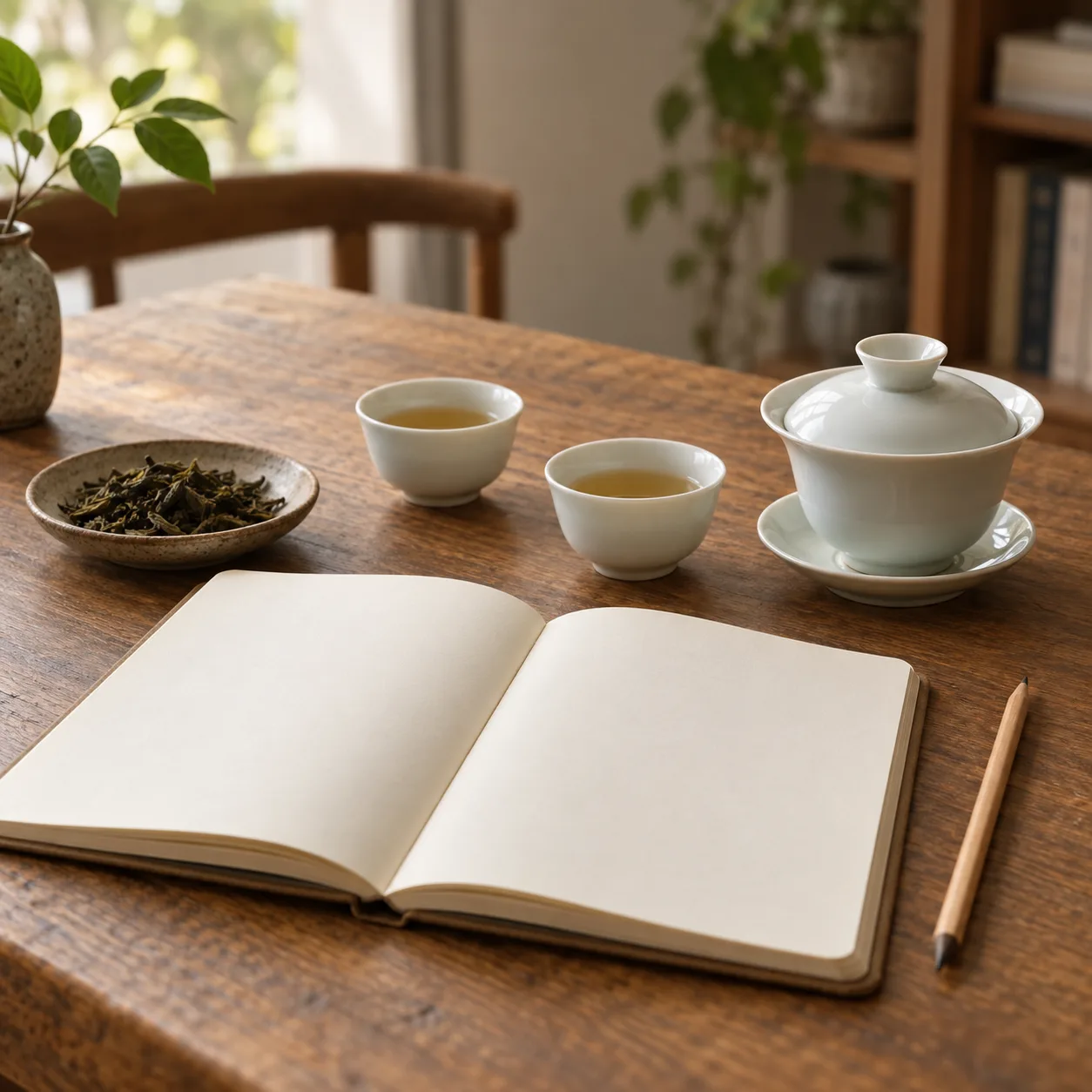
Record the tea label, date, vessel, leaf quantity, water quantity, water source, temperature if measured, and infusion time. Then add a few plain descriptions: floral aroma, drying finish, light body, or simply ‘I preferred the shorter infusion.’ Mark estimates as estimates.
Keep observation and preference separate. ‘The second cup tasted more bitter to me’ describes an experience; ‘I liked the first cup better’ records a preference. Neither needs elaborate vocabulary. Leave space for questions and for a later session that may change your view.
8. Change one thing for a comparison
For an informal comparison, use the same tea and vessel and alter one chosen setting, such as infusion time. Keep the other recorded settings as similar as practical. If possible, compare fresh portions of the same leaf; successive infusions also differ because the leaves have already been brewed.
Treat the result as a useful observation, not a laboratory conclusion. Water, temperature, measuring error and expectations can all complicate a home comparison. Repeat on another day if the distinction matters to you. The aim is to learn an adjustment you can describe and reproduce.
9. Buy and visit with clear expectations
Set a budget before looking at teas or utensils. If small quantities are available, choose an amount you expect to use. Ask what the seller can document about origin, processing and storage, and distinguish those details from a product’s name or promotional story.
Before attending a tasting or visiting a producer, confirm the fee, booking requirements, language, access and photography rules. Do not assume sampling is free or that production will be visible on your visit. For tea you buy, retain the label and follow its storage instructions; seek product-specific guidance before attempting long-term ageing.
10. Try four sessions, then choose your direction
Session one: brew a familiar tea and record a baseline. Session two: repeat it with one adjustment. Session three: read one museum label or a short passage and note a question it raises. Session four: share a brew with someone, or review your notes alone, and decide what to explore next. This is a suggested exercise, not a traditional syllabus.
Return to the Chinese Tea Culture gateway for the wider context, or use Six Chinese Tea Families to choose a processing family to explore. A sustainable routine can be brief. Stop when you have a useful observation; there is no need to turn every cup into a test.