Yixing Teapots: Clay, Form and Reading the Maker’s Mark
宜兴紫砂壶:泥料、器形与款识
Yixing teapots are often introduced through colour, clay names and famous potters. Museum objects suggest a better starting point: identify what the catalogue actually calls the material, trace how body, lid, spout and handle work together, and keep marks separate from proof of authorship. “Yixing,” “zisha,” “red stoneware” and “unglazed” overlap, but they are not interchangeable labels.
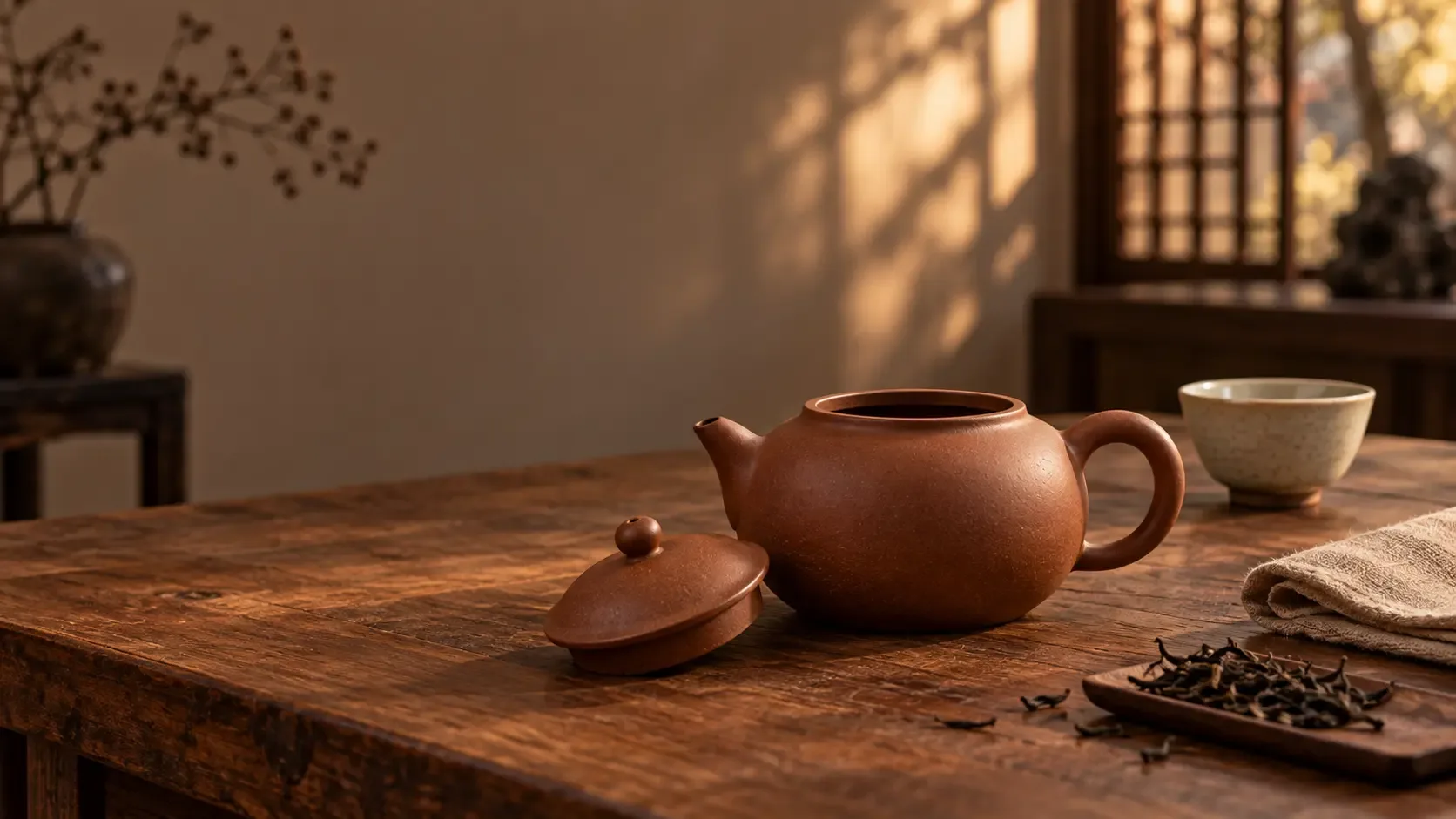
This guide complements the site’s introductions to Chinese tea ware, gongfu tea and the history of Chinese tea culture. Its method is for looking, cataloguing and comparing. It cannot authenticate a pot from photographs or guarantee how an untested modern vessel will behave with food and hot water.
Start with the catalogue term
Yixing is a place and a ware category
Yixing is a production centre in Jiangsu. Museums commonly catalogue its ceramics as stoneware or pottery and may add “Yixing ware,” zisha or a colour description. The Metropolitan Museum records objects in red, brown and speckled stoneware; the British Museum describes tan zisha as well as Yixing stoneware encased in pewter. A purple-sand name therefore does not mean every object looks purple.
Nor is every Yixing object a plain unglazed teapot. Museum collections include glazed vessels, enamelled teapots, brush objects and other forms. Read the medium line for the specific object instead of turning one familiar appearance into a universal definition.
Why the teapot matters
A vessel for steeped leaves
The Met cautiously says that the invention of the teapot is often credited to Yixing potters in the sixteenth century and that wine-ewers may have been adapted for drinkers using steeped leaves rather than powdered tea. The qualifications matter. This is a historical explanation in a museum record, not permission to assign every small clay ewer to one inventor or exact year.
The early-seventeenth-century plum-blossom pot attributed to Shi Dabin offers a secure object around which to study this shift. Its date, material, dimensions and attribution belong together. The flower form should not be detached from that record and used to date any similar modern pot.
Read body, lid, spout and handle as a system
Profile before decoration
Begin with the body: round, compressed, cylindrical, square, faceted or modelled. Then examine the height and direction of the spout, the angle and grip of the handle, the size of the mouth and the way the lid meets its collar. Measure total height, width from spout to handle and base diameter when the catalogue provides them.
A close-fitting lid may support controlled pouring, but a photograph does not reveal leakage, flow rate or thermal behaviour. Likewise, neat symmetry does not by itself prove wheel throwing, hand building, moulding or a named workshop. Those questions require tool marks, seams, interior views and technical examination.
Condition can change the reading
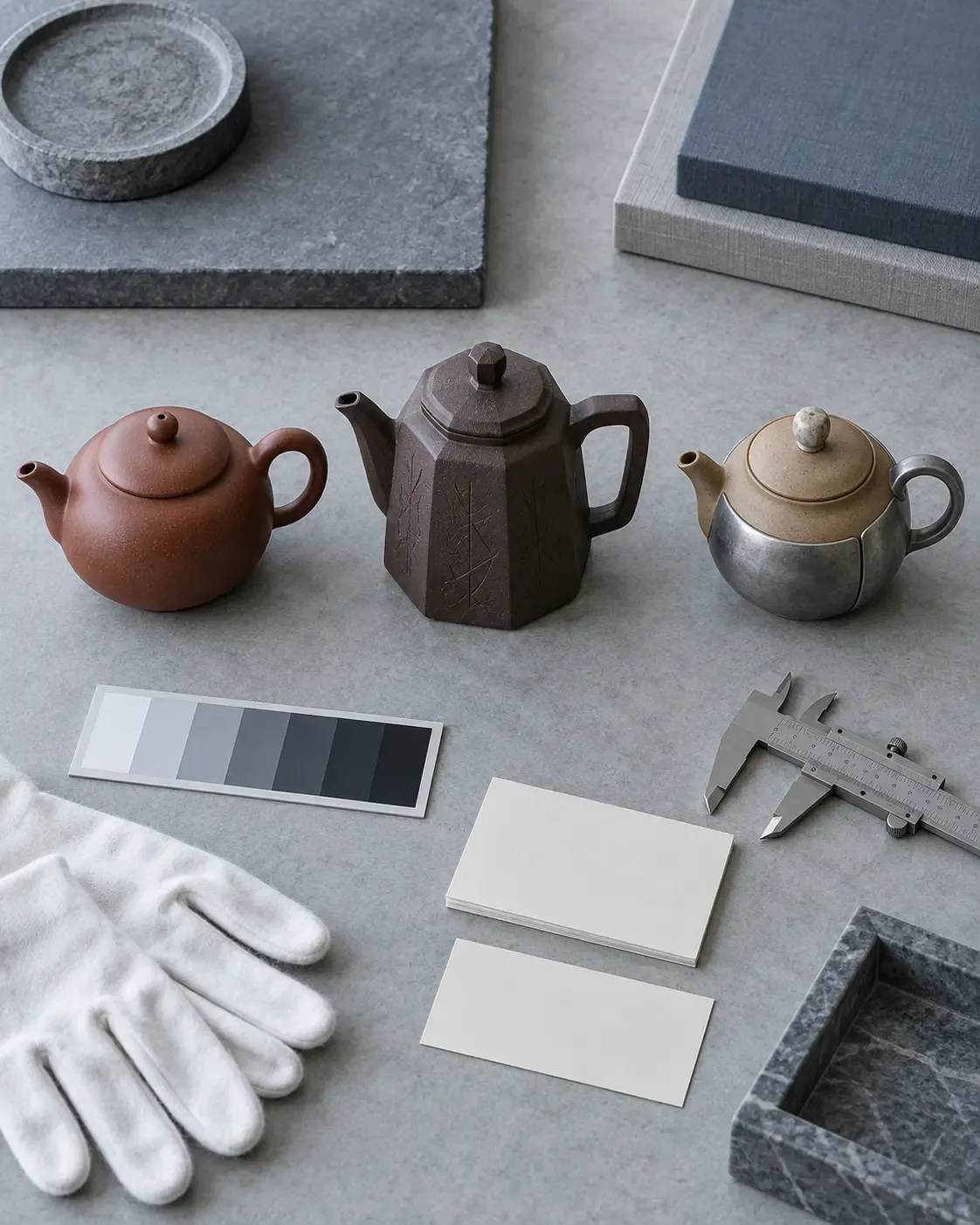
Lids, handles and spouts are vulnerable. A replacement lid can fit without being original; a repaired spout can alter silhouette and balance. The British Museum’s pewter-encased example also shows how later or intended metalwork can cover the stoneware body while jade forms the handle, spout and knob. Describe what is visible before assuming an untouched all-clay vessel.
Surface and colour are evidence, not a recipe
Red, brown, tan—and altered surfaces
Catalogues use colour descriptively: red stoneware, brown stoneware, tan zisha and speckled brown stoneware all occur. Lighting, firing, inclusions, wear, coatings and photography affect appearance. A colour word in a sales listing cannot establish a precise clay source, geological recipe or date.
Surface treatment also varies. Relief, incision, slip, enamel and metal casing appear in museum records. The National Palace Museum’s enamelled Yixing-bodied pots are particularly useful reminders that a Yixing body need not present as bare monochrome clay. Record body, coating and mount separately.
Marks, inscriptions and named makers
A mark is a claim tied to an object
A pot may carry a seal beneath the base, a mark inside the lid, an incised poem or a separate calligrapher’s inscription. The British Museum’s barrel-shaped pot records an inscription by Zi Ye and identifies Yang Youlan as the potter discussed in its curatorial note. That division of labour is more informative than treating every name as “the maker.”
Attribution still needs comparison. The National Museum of Asian Art catalogues one Qing Yixing teapot with a spurious mark of Chen Gongzhi. A prestigious seal can be later, copied or deliberately misleading. Script, placement, clay, construction, documented provenance and secure comparanda must agree before a name carries historical weight.
Preserve museum qualifications
“Attributed to,” “signed,” “marked,” “inscribed by” and “spurious mark” answer different questions. Keep those verbs when translating a record. Do not promote “marked” into “made by,” and do not turn a catalogue date range into an exact production day.
Yixing beyond China
Export, mounting and imitation
Yixing pots travelled. Some received metal and hardstone mounts; others became models for European red earthenware. The Met’s Dutch teapot from the factory of Arij de Milde records the demand for Chinese redware and the creation of Delft imitations in the late seventeenth and early eighteenth centuries. Similarity is evidence of reception, not proof that a European pot is Yixing.
Catalogue place, body material and maker before visual resemblance. This distinction connects the pot to histories of trade and imitation without erasing where an object was actually made.
A six-pass method for a museum teapot
Move from identity to attribution
- Fix the record. Note institution, object number, title, date range, dimensions and consultation date.
- Read the material line. Separate stoneware body, glaze, slip, enamel, metal mounts and hardstone fittings.
- Trace the form. Compare body, mouth, lid, knob, spout, handle, foot and their proportions.
- Check condition. Look for missing or replaced lids, repaired spouts, worn rims and later mounts.
- Map every mark. Record seals and inscriptions by location, technique, script and claimed role.
- Compare cautiously. Use securely catalogued objects, provenance and technical evidence; retain every institutional qualification.
Separate museum study from modern brewing
Do not brew in an antique or museum object. For a modern pot, seek reliable maker and material information and follow current food-contact and care guidance. Claims that one colour, ringing sound, pore pattern or absorption test proves “genuine Yixing” are not substitutes for provenance or laboratory analysis. If comparing taste, use the same water, tea, temperature and timing, and describe the result as a personal tasting rather than a health effect.
Sources and object records
- The Metropolitan Museum of Art, teapot in the shape of a plum blossom, attributed to Shi Dabin.
- The British Museum, barrel-shaped inscribed Yixing teapot, Franks.2450.
- The British Museum, Yixing teapot encased in pewter with jade fittings.
- National Museum of Asian Art, Yixing ware teapot with a spurious Chen Gongzhi mark.
- National Palace Museum, Yixing-bodied loop-handle teapot with painted enamels.
- The Metropolitan Museum of Art, Dutch red earthenware teapot made in imitation of Yixing ware.
- Asian Civilisations Museum, enamelled Yixing stoneware teapot.