Whisked Tea in Song China: Powder, Bowls and Foam
宋代点茶:茶末、茶盏与汤花
Whisked tea was one of the most visually distinctive ways of drinking tea in Song China. Finely prepared tea, hot water and vigorous agitation met inside a bowl, where colour, surface and texture could be observed. The method helps explain why Song writers discussed powder, water and foam together, and why dark-glazed bowls became so closely associated with tea.
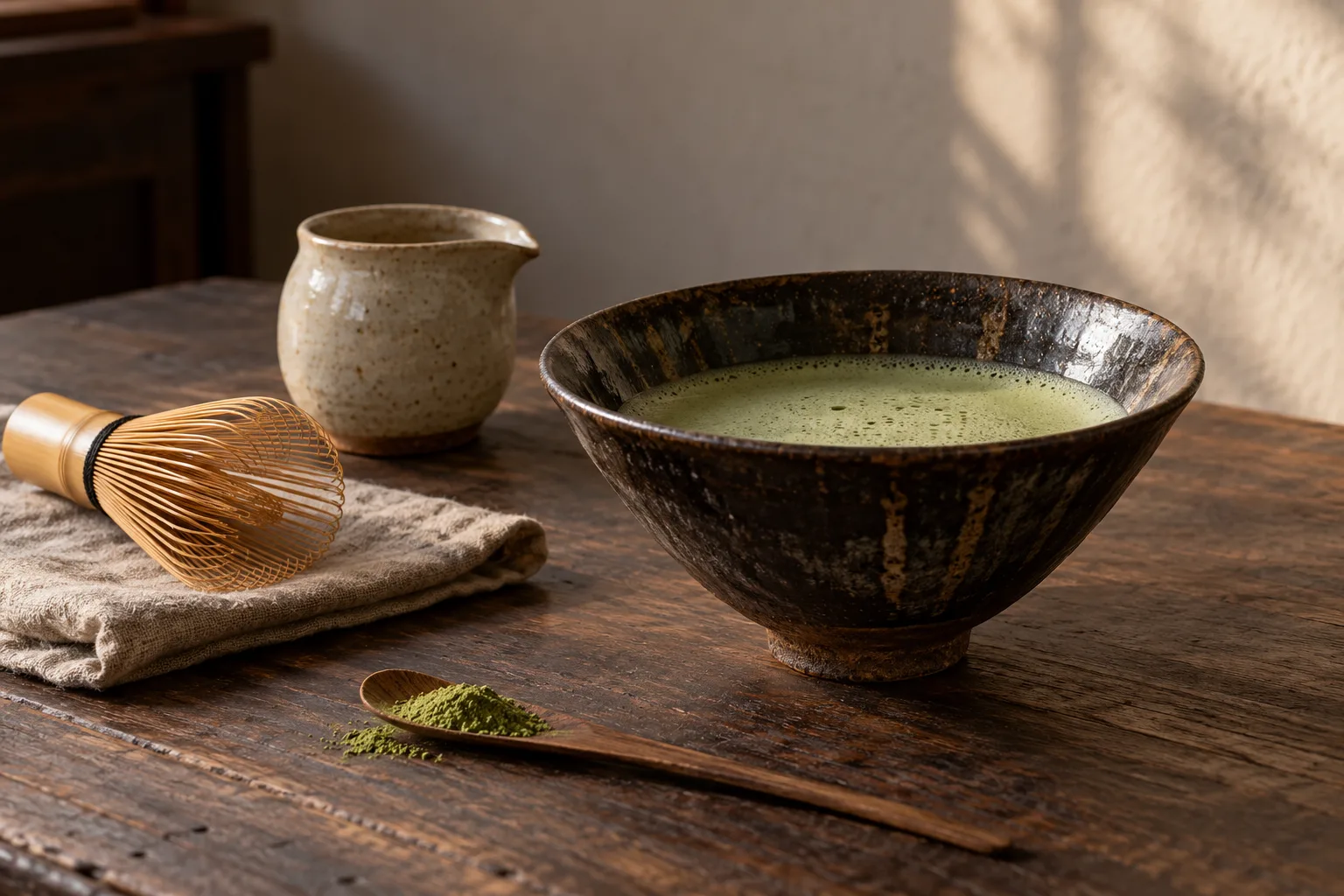
This guide adds a focused historical pathway to Wudang.Org’s Chinese Tea Culture cluster. It does not present one timeless “Song tea ceremony.” Instead, it compares dated texts, excavated or collected objects and later reception. Each source reveals part of the practice, while none stands for every household, region or century.
Read the method through dated evidence
Whisked tea was important, but not the only tea
The Song dynasty lasted from 960 to 1279, across major political, economic and regional changes. Tea was widely consumed, but its forms, grades and settings varied. Whisked powdered tea is especially visible in elite manuals, tribute systems, images and surviving bowls; that visibility should not turn it into the single drink of all Song people.
The wider history of Chinese tea places this method between earlier boiling practices and the growing importance of steeped loose leaves in later centuries; the guide to six modern tea families explains why today’s processing vocabulary should not be projected backwards unchanged. Those categories overlap rather than replace one another overnight. A dated text or object is evidence for its own context before it becomes evidence for a whole period.
Cake, grinding and sieving came before the bowl
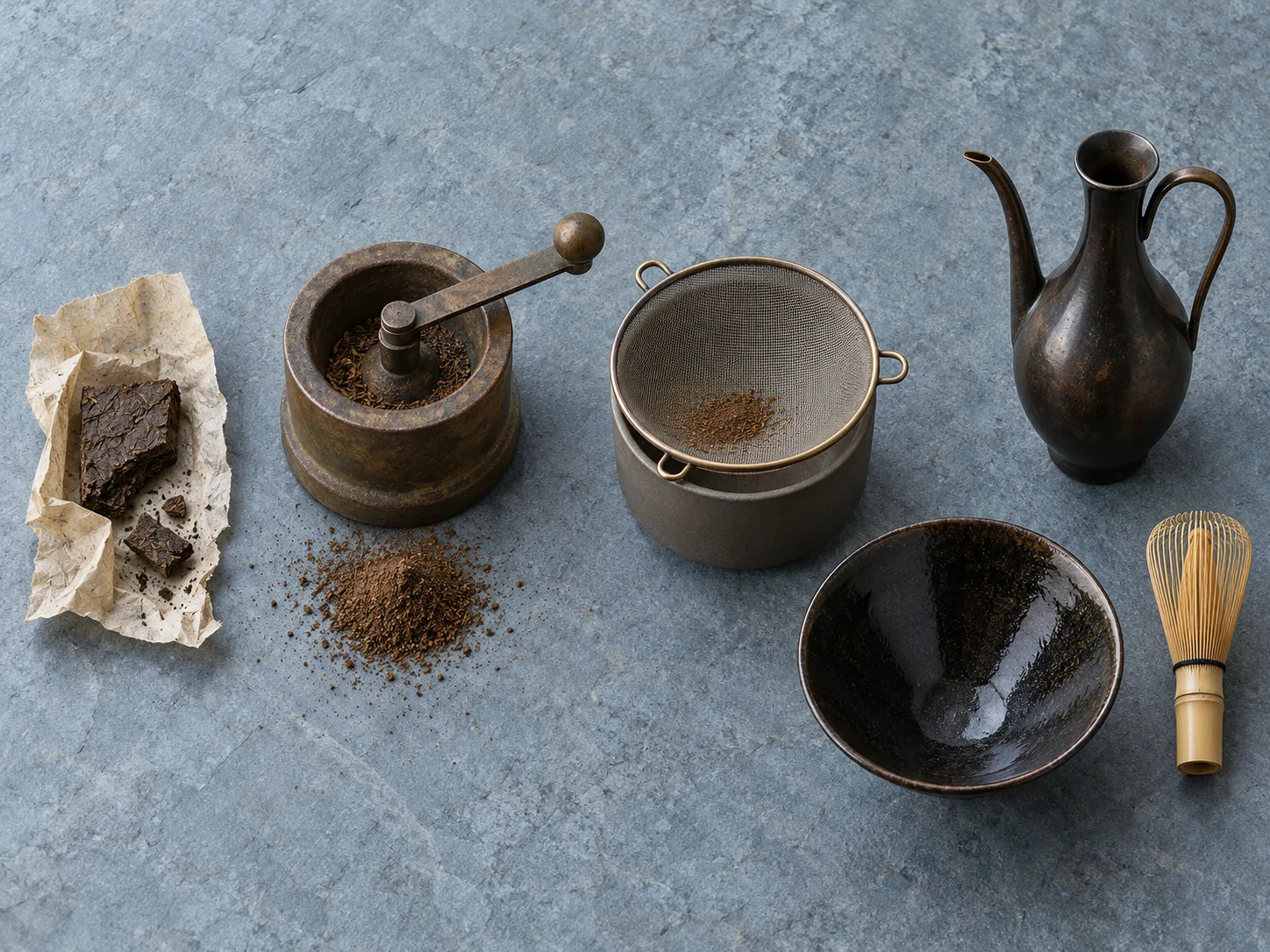
Cai Xiang’s Record of Tea (Chalu), written in the mid-eleventh century, discusses tea quality and a sequence of utensils that includes storage, crushing, grinding and sieving. Its detailed vocabulary shows that the powder in the bowl was the end of considerable preparation, not simply loose leaf stirred into water. Consult the Chinese text of Cai Xiang’s Chalu.
A recent scholarly study of Beiyuan tea treats this northern Fujian origin not merely as soil and climate, but as a place shaped through court supply, writing, reputation and social distinction. That approach helps separate the material leaf from the prestige attached to its name. Read Xiaolin Duan’s study of tea and place in Song China.
Water was added and worked, not merely poured once
In the preparation often called diancha, a small amount of hot water first helped combine powder into a paste; further additions and whisking or beating then dispersed the tea and developed its surface. The Palace Museum’s exhibition guide sets out crushing, grinding, sieving, warming the bowl, adding water and agitating as distinct operations. See its illustrated account of making whisked tea and tea pictures.
That sequence explains why water, powder size, temperature, bowl warmth and hand movement all mattered, but it does not supply one universal recipe. The companion guide to water for Chinese tea offers a modern comparative tasting method; it should not be confused with a reconstruction of Song court or connoisseur practice.
Let the bowl answer material questions
Dark glaze made the tea surface easier to judge
Cai Xiang praised dark Jian’an bowls in relation to pale tea. A Song tea bowl in the Metropolitan Museum of Art is dated to the eleventh or twelfth century and made in Jian ware with a “hare’s-fur” glaze. The museum explains that bowls of this kind served tea whisked into pale foam, whose colour stood out against the dark surface. Examine the Met’s Jian tea bowl.
Contrast is only one part of the object. Look at the bowl’s conical profile, foot, wall thickness, rim and iron-rich glaze together. The site’s broader guide to Chinese tea ware explains why clay, glaze and form should be read as a working combination rather than as a simple ranking of materials.
Jian ware was prominent, not the only possible vessel
Dark Jian bowls became celebrated, yet Song tea bowls also survive in other dark wares, celadons and lighter ceramics. The Palace Museum notes both black-glazed bowls favoured for tea contests and green or bluish-white bowls of related form. A single prized ware should not erase the larger ceramic landscape.
A Palace Museum record for a Song black-glazed bowl from the Fuqing kilns relates the form to tea competition and explains several names used for crystalline effects in Jian-type glazes. It is evidence for the spread of dark-bowl aesthetics, not proof that every black bowl came from Jian or served the same setting. See the museum’s Fuqing kiln black-glazed bowl.
Glaze names describe effects, not fixed recipes
“Hare’s fur” and “oil spot” name visual effects produced through body, glaze chemistry and firing. They are useful descriptive terms, but colour alone cannot authenticate a kiln, date a bowl or prove how it was used. Profile, clay body, foot treatment, firing evidence, provenance and specialist examination still matter.
A Southern Song oil-spot bowl in the British Museum also carries the later Japanese label “Temmoku.” Its record shows how a Chinese object acquired another history through appreciation in Japan. Read the British Museum oil-spot tea bowl without treating the later name as a complete account of its Song manufacture or use.
Place foam inside social history
Beiyuan tea joined production to courtly reputation
Beiyuan in northern Fujian supplied famous tribute teas, but its reputation was made through more than geography. Production, court demand, named grades, official writing and comparison turned place into cultural value. The Cambridge study therefore reads “terroir” as both material environment and historical discourse.
This distinction connects tea powder with the site’s guide to Chinese tea caddies: storage vessels, labels and provenance can carry prestige, yet they do not reveal the taste of their former contents by themselves. Place names and imperial associations must remain attached to recoverable records.
Tea contests made the surface public
In the practice known as doucha, participants compared tea and preparation. Palace Museum material describes the colour of the tea and how long the foam or water marks held against the bowl as criteria. Its exhibition page pairs this explanation with a Song-period image called Doujiang tu; see the museum’s introduction to tea competition.
Competition magnified visible qualities, but it should not define every act of drinking tea. Hospitality, monastic life, travel, trade and daily refreshment created other settings. The site’s Way of Tea and tea and meditation guides accordingly treat attention and care as adaptable relationships, not a claim that modern service reproduces a single medieval contest.
Chinese bowls acquired later lives in Japan
Song and Yuan objects, paintings and ideas travelled to medieval Japan and were collected, classified and reinterpreted. The National Museum of Asian Art describes how such Chinese arts contributed to later Japanese practices including chanoyu. Read its exhibition overview, Zen, Tea, and Chinese Art in Medieval Japan.
Transmission is not a frozen copy. Japanese names, collections, repairs and tea institutions created new meanings around Chinese bowls. A modern whisked-tea practice may illuminate certain actions, but it is not direct proof of exactly how an eleventh-century Fujian tea maker moved, measured or tasted.
Use a six-step reading method
Move from object to procedure and context
When you meet a Song tea bowl, text or image, use the same sequence:
- Identify the source. Is it an excavated object, collection record, painting, poem, manual, later copy or modern demonstration?
- Date and locate it. Record dynasty, narrower date, kiln or place, present collection and provenance limits.
- Describe before naming. Note profile, foot, rim, body, glaze, marks and wear before assigning a ware or function.
- Reconstruct only supported steps. Separate crushing, grinding, sieving, warming, adding water, agitating and drinking when the source does.
- Name the social setting. Ask whether the evidence concerns tribute, court, connoisseurship, contest, monastery, market or daily life.
- State confidence. Distinguish visible fact, curatorial identification, textual instruction, comparison and unresolved inference.
Modern comparison needs ordinary safety
Do not use an antique or museum-type bowl for food or drink. Unknown glazes, repairs, residues and prior use may make an old object unsuitable. For a present-day comparison, use modern food-safe utensils, clean water and tea intended for consumption, and follow the maker’s instructions.
The site’s flexible gongfu tea method belongs to a different preparation family. Comparing its leaf expansion, steeping and small cups with grinding, sieving and whisking can clarify historical change, provided neither method is declared the only authentic Chinese tea.
Keep text, object and performance in dialogue
A manual tells us what one author chose to prescribe. A bowl preserves material and traces of manufacture. A painting selects visible gestures. An archaeological context can link objects more securely than a later collection, while a modern demonstration tests feasibility rather than proving continuity.
Whisked tea becomes richer when those sources remain distinct. Begin with powder, water, bowl and surface; then ask whose tea, in which place, at what date and for what purpose. The site’s tea reading and practice guide can extend that source-aware habit. This method keeps Song tea culture historical and plural while making its extraordinary material intelligence easier to see.