Gongfu Tea: Utensils and a Flexible Method
工夫茶:茶具与灵活冲泡法
Gongfu-style brewing uses a small vessel, repeated infusions and close attention to what changes in the cup. It can be simple: leaves, hot water, a gaiwan or teapot, and a cup are enough to begin.
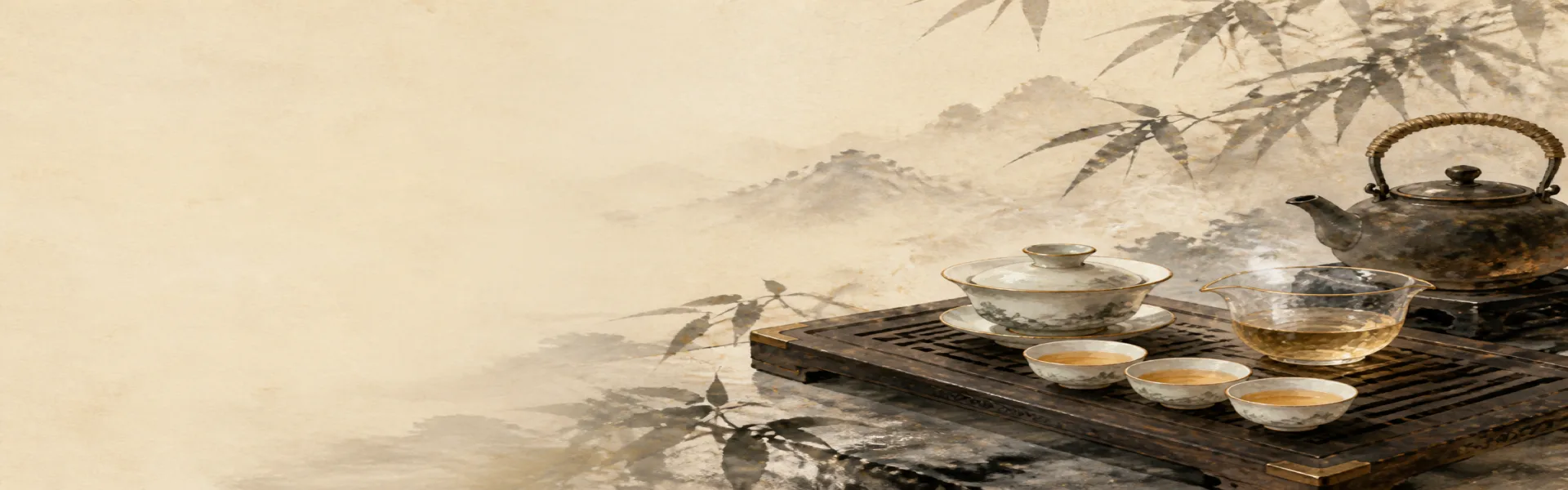
This guide explains what each common utensil does and offers a flexible working sequence. It is not a universal ceremony, a shopping list or a test of authenticity. Regional, household and contemporary tea-room practices differ.
1. Gongfu means care in the making
In this tea context, gongfu points to time, attention and developed skill. The useful question is not whether a table looks elaborate, but whether the brewer can repeat a choice, taste its result and adjust with care.
Small vessels make those adjustments easy to notice. They hold less water, encourage complete decanting and let several short infusions reveal how a tea changes. Larger pots and mug infusers remain valid when they suit the tea, the company or the time available.
2. Begin with a minimal set
The minimum practical set is a brewing vessel, cups, tea, suitable water and a safe way to heat it. A scale or measured scoop helps record the leaf quantity; a timer can help while learning. Neither needs to remain on the table once the method becomes familiar.
A tray is useful where spills are expected, but a dry table with a small bowl for discarded water works too. Before buying a coordinated set, brew with what you already have and notice which task actually needs a better tool.
3. Choose a gaiwan or teapot by function
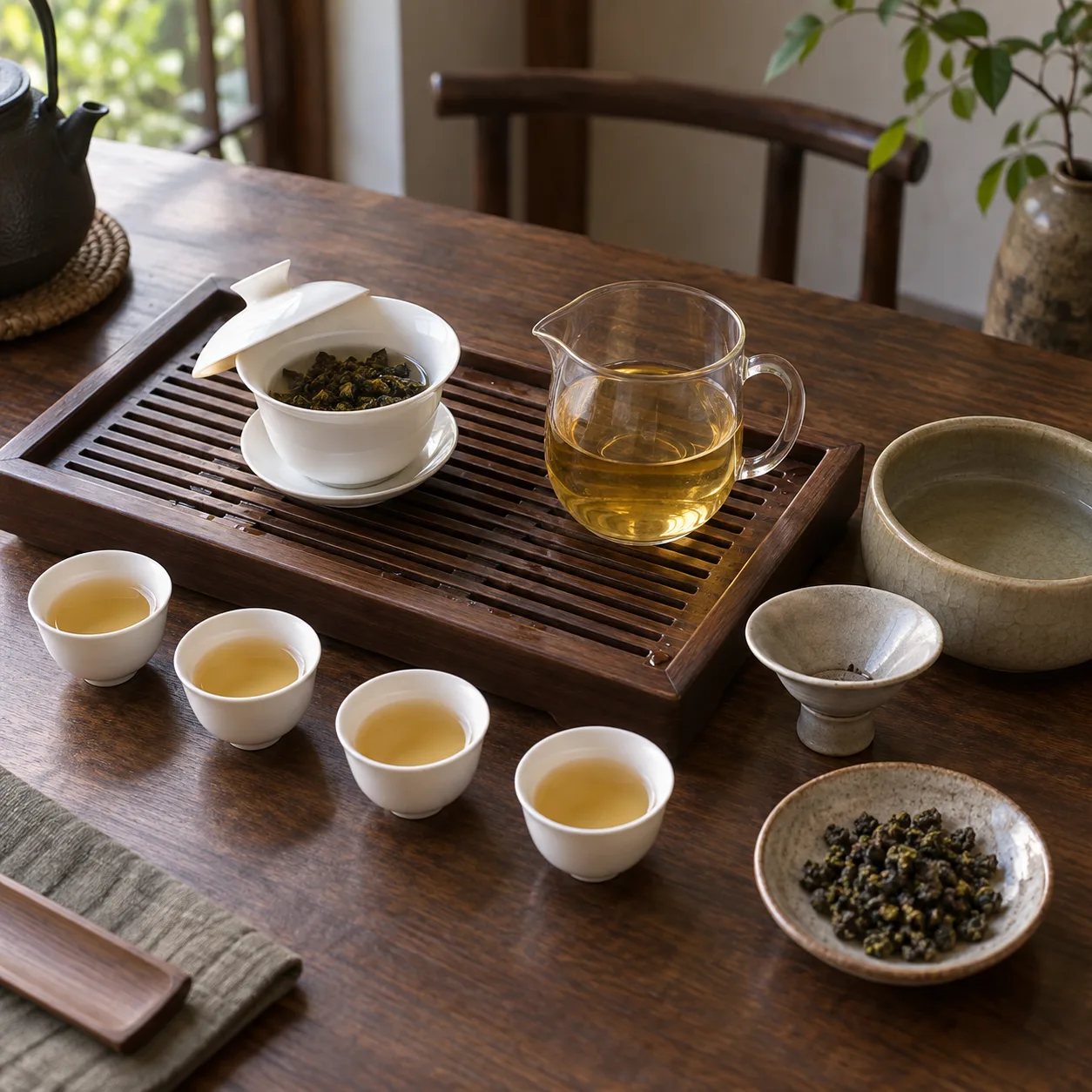
A porcelain gaiwan is easy to inspect and clean. Its lid can hold back many leaves while pouring, and its glazed surface makes it practical for comparing different teas. Choose one that feels stable in your hand and pours without requiring your fingers to approach the hot rim.
A small teapot offers a handle and a contained pour. Check its true capacity, lid fit and flow before deciding whether it suits your leaves. Unglazed clay can retain traces of previous brews, so use and clean it according to the maker’s guidance rather than assuming that price, age or a famous clay name guarantees better tea.
4. Add only the tools that help
A fairness pitcher receives the whole infusion before it is divided among cups, helping each guest receive a similar mixture. A strainer can catch fine fragments, but it is optional. Fine mesh may also slow the pour or retain aromatic oils, so compare with and without it.
Tongs, tea picks, display vessels and cloths may support a particular host or setting; they are not admission requirements. A waste-water bowl is useful for a dry table. On a draining tray, confirm where the water goes and keep the hose or reservoir secure.
5. Measure a starting point
Measure the vessel’s working capacity with cool water. Begin from the producer’s guidance when it is available, record the leaf quantity and water temperature, and leave enough room for the leaves to open. A repeated baseline is more useful than a supposedly perfect universal ratio.
Warm the vessel only if doing so serves a purpose and can be done safely. Add the leaves, smell them if you wish, then pour steadily. Keep the lid, handle and serving path clear so the sequence remains calm rather than theatrical.
6. Treat rinsing as a choice
A quick first pour may be used to loosen tightly compressed tea, warm vessels or follow a producer’s recommendation. It is not mandatory for every tea, and it should not be presented as a reliable way to remove pesticides, caffeine or other unwanted substances.
If you rinse, record it as part of the preparation and discard the liquid safely. If you do not rinse, begin with the first infusion and observe it. Compare both approaches with the same tea before turning a preference into a rule.
7. Decant fully, then taste
Pour the infusion into a pitcher or directly into the cups, emptying the vessel as consistently as you can. Water left among the leaves continues extracting and makes the next comparison harder. Count the pour as part of the infusion time when the vessel drains slowly.
Taste after the liquid has cooled enough to drink comfortably. Note aroma, texture, bitterness, drying sensation and finish in ordinary words. Do not promise a fixed number of good infusions: leaf, processing, storage, quantity, water and personal preference all affect when a session feels complete.
8. Change one variable at a time
If the cup is stronger or more bitter than you want, shorten the next infusion, lower the temperature, use less leaf or increase the water—but change one variable first. A weak cup can be explored in the opposite direction. The cause is not always obvious from one attempt.
Research on tea infusions confirms that time, temperature, leaf-to-water ratio and water composition can change what enters the cup. That does not produce one ideal recipe. It gives you a controlled way to learn what works for this tea and this water.
9. Care for the ware and the people
Use food-contact vessels that are intact and appropriate for hot water. Follow the maker’s cleaning instructions, especially for porous clay, metal fittings and delicate glazes. Do not use staining alone to diagnose safety, and retire cracked ware when its integrity is uncertain.
Place the kettle on a stable surface, route cords away from hands and edges, and keep the pour path clear. Let a beginner practise the movement with cool water. Guests who are children, older adults or anyone with limited grip should not be expected to handle a hot gaiwan.
10. Let hospitality shape the method
Ask what guests enjoy and how much tea they want. Offer water or a lighter infusion, explain hot vessels without fuss, and allow people to observe rather than participate. A good session is not measured by silence, specialised vocabulary or the value of the teaware.
Return to Chinese Tea Culture for the wider reading path, or compare leaf families in Six Chinese Tea Families. Skill grows through clear observation, careful repetition and considerate sharing.