Before you open this book, it helps to know what it is and why it matters. The Zhouyi cantong qi (周易参同契), often translated “The Seal of the Unity of the Three, in Accordance with the Book of Changes”, is the oldest Chinese book on the elixir to have come down to us, and nearly every later work of alchemy, outer and inner, treats it as its ancestor. A Song-dynasty poem by Gao Xiangxian (高象先), quoted in the postface to an edition of 1245, names it with two related texts as “king of the elixir books for ten thousand ages” (万古丹中王). Today you will usually meet the phrase quoted as 万古丹经王; notice the one character that has changed.
Start with the author, and hold the story lightly. Tradition names him as Wei Boyang (魏伯阳), a recluse of Shangyu in Kuaiji, in today’s Zhejiang, under the Eastern Han, in the second century. Peng Xiao’s preface, drawing on the Biographies of Divine Immortals, says he showed the book to a Mr Xu of Qingzhou, who wrote a commentary without signing it, and later passed it to Chunyu Shutong of his own district. How much of this is history is uncertain. The text itself is layered: verses of four and five characters alternate with prose, and around 1300 the commentator Yu Yan (俞琰) already suspected that the words of Wei, Xu and Chunyu had been mixed together. Most modern scholars read a Han-dynasty core with later layers.
The title tells you what the book sets out to do, so read it slowly. The “three” are named in the text itself: the nature of the Book of Changes, the practice of Huang-Lao (the Taoism of the Yellow Emperor and Laozi), and “the work of the furnace”; and “the three ways come from one” (三道由一). Qi (契) is a tally, a token cut in two whose halves fit together. Keep that image in mind: cosmology, self-cultivation and alchemy are presented as parts of one seal, all written in the trigrams and hexagrams of the Changes.
You will find your way more easily if you know the plan first. Zhu Xi (朱熹), the great Neo-Confucian, summed it up: first Qian, Kun, Kan and Li, the vessel and its contents; then the other sixty hexagrams, two for each day, beginning with Zhun and Meng, to time the work of a day; then six trigrams for the phases of the moon, to time a month; then twelve hexagrams for the year. Among its many commentaries are Peng Xiao’s (彭晓, preface dated 947), whose division into chapters is the Taoist Canon text used here; Zhu Xi’s own textual study, the Kaoyi (1197), which he signed with a pen name, “Zou Xin, Taoist of Kongtong” (空同道士邹䜣), a pun on his own name; and the readings of Chen Zhixu (陈致虚) and Yu Yan, which treat it as a book of inner alchemy. Whether it describes chemistry, inner cultivation or both has been argued for a thousand years; you do not need to settle that question to begin.
This page gives you four passages, each in Chinese with a plain English reading and a note. Read them as symbolic language, not as instructions. The figure after the second passage shows the cosmic scheme they share, so come back to it as you read.
1. The gate of change: Qian, Kun, Kan and Li
Classical text
乾坤者,易之門戶,眾卦之父母。坎離匡郭,運轂正軸。牝牡四卦,以為橐籥。覆冒陰陽之道,猶工御者,準繩墨,執銜轡,正規矩,隨軌轍,處中以制外。
English reading
Qian and Kun are the gate and door of change, father and mother of all the hexagrams. Kan and Li are the frame around them, turning the hub and keeping the axle true. These four, female and male, serve as the bellows. Covering and holding the way of yin and yang, it is like a skilled charioteer: true to the line and the ink, holding bit and reins, setting compass and square, following the ruts of the road, keeping to the centre to govern what is outside.
Notice first that the opening line is borrowed. It comes from the Great Commentary to the Changes, which calls Qian and Kun “the gate of change”. In the alchemists’ reading Qian, heaven, and Kun, earth, are the vessel, crucible above and furnace below; Kan ☵ and Li ☲, water and fire, moon and sun, are what moves inside it. The bellows (橐籥) come from Tao Te Ching (Dao De Jing) chapter 5, where the space between heaven and earth is “like a bellows: empty yet never exhausted”. Then look at the charioteer, who gives the book’s method: the work is timed and measured, and it is governed from the centre. Beginners often take the four trigrams as four separate things. Read them as one frame instead, two that hold and two that move. Try this: draw the four trigrams on a page, Qian above, Kun below, Kan and Li between, and see how the picture already forms a vessel.
2. The six phases of the moon
Classical text
三日出為爽,震受庚西方。八日兌受丁,上弦平如繩。十五乾體就,盛滿甲東方。……十六轉受統,巽辛見平明。艮直於丙南,下弦二十三。坤乙三十日,東北喪其朋。節盡相禪與,繼體復生龍。
English reading
On the third day the moon comes out as a sliver: Zhen receives geng, in the west. On the eighth day Dui receives ding: the first quarter, level as a rope. On the fifteenth the body of Qian is complete, full and bright at jia, in the east. … On the sixteenth the rule turns over: Xun and xin appear at dawn. Gen stands at bing, in the south: the last quarter, on the twenty-third. Kun and yi on the thirtieth: in the north-east it loses its companions. When the phases are done they hand over to one another, and the succession gives birth to the dragon again.
Before you read these lines a second time, go outside on the third evening after a new moon and look west just after sunset. You will see a thin sliver, low in the sky. That is what the text means by Zhen ☳: one yang line, a single thread of light, beneath two yin lines of darkness. Watch for five more evenings and the sliver widens to a half moon: that is Dui ☱, on the eighth. Wait until the fifteenth and the full moon rises in the east: Qian ☰, all yang. Notice what you have just done: you have read a trigram off the sky.
The scheme has a name, najia (纳甲), “taking in the stems”: each phase of the moon is matched with a trigram and with one of the ten Heavenly Stems, which stand for directions. In the second half of the month yin enters from below: Xun ☴ on the sixteenth, setting in the west at dawn; Gen ☶ at the last quarter; Kun ☷, all yin, at the dark of the moon. The line “loses its companions in the north-east” quotes the judgment of the Kun hexagram; Zhu Xi read 朋 here as 明, “its light”. The alchemists read the month as a model of the rise and fall of yang in the body, the “fire times” of the work, and the reborn dragon, Zhen, as the start of the next cycle. A common mistake is to treat these pairings as a code to crack. Read them first as something to observe: this month, note the date of each phase you see and find its trigram in the figure below.
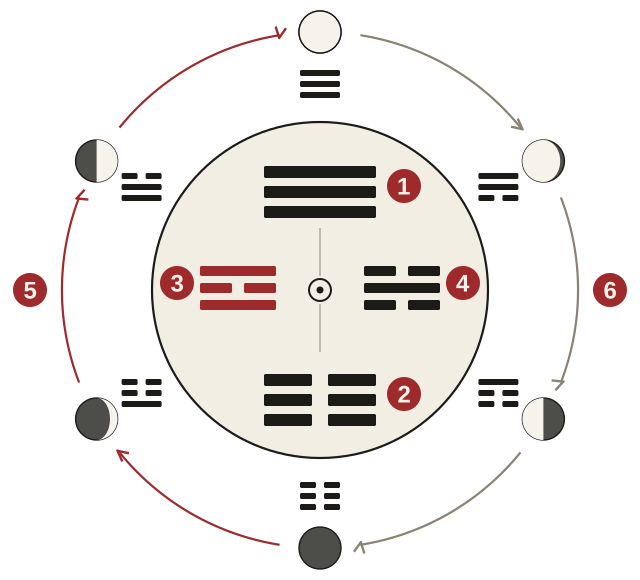
The cosmic vessel and the moon’s six phases, as the first two passages describe them, with the hub turning at the centre. A schematic drawing of symbolic language.
- Qian ☰, heaven: the vessel above, the crucible
- Kun ☷, earth: the vessel below, the furnace
- Li ☲, fire and the sun: inside the frame
- Kan ☵, water and the moon: inside the frame
- The waxing moon (cinnabar): Zhen ☳ on the 3rd day, Dui ☱ on the 8th, Qian ☰ full on the 15th
- The waning moon (grey): Xun ☴ on the 16th, Gen ☶ on the 23rd, Kun ☷ dark on the 30th
3. Not these: the side doors
Classical text
是非歷藏法,內視有所思。履行步斗宿,六甲以日辰。陰道厭九一,濁亂弄元胞。食氣鳴腸胃,吐正吸外邪。……諸術甚眾多,千條有萬餘。前卻違黃老,曲折戾九都。
English reading
Not this: the method of passing through the organs, inner gazing with something held in thought; pacing the stars of the Dipper, timing by the six jia days; the yin way, wearying oneself on nine and one, muddying and disturbing the original womb; swallowing breath until the stomach rumbles, breathing out the true and breathing in outside harm. … The arts are very many, a thousand branches and ten thousand more. Going forward or back, they go against the Yellow Emperor and Laozi; twisting and turning, they stray from the Nine Capitals.
Read this list slowly: what a book rejects tells you what it values. Here the Cantong qi names what it turns away from: visualising the spirits of the organs one by one, fixed inner visualisation, ritual pacing of the Big Dipper, almanac timing, sexual techniques (the “yin way”, with its counts of nine and one), and breath-swallowing. The lines that follow add sleepless vigils, altars and sacrifices to spirits, and visions in dreams, ending in early death. Now notice what is not on the list. The target is not stillness or meditation as such, but piecemeal technique pursued for long life without the principle that unites it; beginners often miss this and read the passage as a rejection of all practice. The “Nine Capitals” (九都) is an obscure term that commentators read in different ways, so build nothing on it. Some of these methods are honoured in the Huangting Jing, whose organ spirits this passage seems to dismiss: the two books show an argument inside Taoism that ran for centuries, and it is one reason why later inner alchemy, from the Wuzhen Pian on, puts the whole before the parts. For the different practice of inner observation (neiguan), see its own page. To reflect on: when you gather methods, ask what single principle, if any, holds them together.
4. The signature: a riddle
Classical text
委時去害,依託丘山。循遊寥廓,與鬼為鄰。化形而仙,淪寂無聲。百世一下,遨遊人間。陳敷羽翮,東西南傾。湯遭厄際,水旱隔并。柯葉萎黃,失其華榮。吉人相乘負,安穩可長生。
English reading
Putting aside his time and leaving harm behind, he entrusted himself to the hills and mountains; wandering the vast void, he made the ghosts his neighbours. His form transformed, he became an immortal, sunk in stillness without a sound. A hundred generations, one below, he roams the human world. Spreading out his feathered wings, he leans east, west and south. Tang meets the brink of disaster: flood and drought come by turns. Branches and leaves wither yellow, losing their flowers and glory. Fortunate people ride on one another: safe and secure, they may live long.
The book ends with a puzzle, and it asks you to read it two ways. Read as a story, it tells of the author’s withdrawal from the world and his life as an immortal. Read as a riddle, it signs the book. To follow the riddle you need the traditional forms of the characters, and that is how the Yuan commentator Yu Yan explains it: “ghost” (鬼) joined to “entrust” (委) makes 魏, Wei; “hundred” (百) with its top stroke, “one”, taken down gives 白, which joined to “person” (人) makes 伯, Bo; “Tang” (湯) in a drought, without its water, leaves 昜, and the edge of “disaster” (阨) gives 阝: together, 陽, Yang. “Riding on one another” is the instruction to join them: Wei Boyang. Ancient writers often hid their names this way. Note that Yu Yan’s edition words the last line differently from Peng Xiao’s, which is followed here. Try this: write out 委, 鬼, 百, 人, 湯 and 阨 by hand and assemble the name yourself.
Reading it today
The Cantong qi is the hardest text in this library, and it was written to be hard, so do not be discouraged if it resists you. Read it first as history and as literature, and three things stand out.
- One pattern for everything. Heaven and earth, the moon’s month, the body and the furnace follow the same rhythm of yin and yang, written in the trigrams of the Changes. As you read, watch for the same pattern at each scale.
- Timing matters. Much of the book is about when: the day, the month, the year. The “fire times” of later inner alchemy begin here.
- The whole before the parts. It rejects techniques collected for their own sake, and asks you to look for the principle that unites them.
Its language is symbolic, and it has also been read as chemistry. Never take metals, minerals or cinnabar as an “elixir”. Many people died of such elixirs, emperors among them. If you want to take up practices drawn from the book, learn them from an experienced teacher, not from a text alone.
Further in the library
- The Classical Library: the complete texts collected on this site.
- The Wuzhen Pian: Zhang Boduan’s poems of inner alchemy, which inherit the Cantong qi’s language.
- The Huangting Jing: the Yellow Court and its body spirits, the other side of the argument in the third passage.
- The eight trigrams: the symbols the whole book is written in; keep them open as you read.
- The Heavenly Stems and Earthly Branches: the stems the moon “takes in”.