The Huangdi yinfu jing (黄帝阴符经), usually shortened to the Yinfu jing (阴符经), is only a few hundred characters long, and Taoist teachers often name it in one breath with the Tao Te Ching (Dao De Jing) and the Qingjing jing as the essential short classics. Its title is translated “Classic of the Hidden Talisman” or “Classic of Hidden Correspondence”. Start with the word fu (符): a tally split in two, whose halves proved their match by fitting together. Keep that image, because the whole text is about such a fit, between the hidden pattern of heaven and the actions of a person.
It is attributed to the Yellow Emperor, but it first comes into view in the Tang dynasty. Li Quan (李筌, 8th century), a Taoist who also wrote a treatise on warfare, the Taibai yinjing, said he found it in a stone chamber on Mount Song, in a copy sealed by the Taoist master Kou Qianzhi, and that an old woman of Mount Li explained its meaning to him. Many scholars think Li Quan or his circle shaped or even composed the text; others argue for an older core. A copy in the hand of the calligrapher Chu Suiliang (褚遂良, 596–658) would place it earlier still, but that attribution is debated. Later readers include a commentary attributed to Zhang Guo (张果), the Tang recluse later counted among the Eight Immortals; the Song philosopher Zhu Xi, who wrote a critical study of it; and the Longmen master Liu Yiming (刘一明, 1734–1821), whose commentary reads the whole text as a guide to inner cultivation.
That double reading is why the text has lasted. Its vocabulary of triggers, thieves, armies and decline reads outwardly as a teaching on timing in strategy and government, and inwardly as a teaching on the senses, the heart-mind and qi. Hold both; beginners often keep one and drop the other. The text comes down in two versions: a shorter one of about 300 characters and a longer one of about 400, which adds a few lines on how people misjudge the sage and a closing passage on stillness and the Book of Changes. This page gives the longer version in seven sections, each with an English reading, and marks what it adds. Many editions divide the text into three chapters, titled for the Tao, for the state and for the army; sections 1–2, 3–4 and 5–7 follow that division.
1. Observe the way of heaven
Classical text
觀天之道,執天之行,盡矣。天有五賊,見之者昌。五賊在心,施行於天。宇宙在乎手,萬化生乎身。天性,人也;人心,機也。立天之道,以定人也。
English reading
Observe the way of heaven and hold to its course: that is everything. Heaven has five thieves; whoever sees them flourishes. The five thieves are in the heart-mind, and they act out in heaven. The universe is in your hands; all transformation arises from your body. Heaven’s nature is the human being; the human heart-mind is the pivot. Establish the way of heaven, and the human being is settled by it.
Read the opening line twice, because it is the whole text in small: first see how heaven works, then act in step with it. The “five thieves” are usually read as the five phases, wood, fire, earth, metal and water, which feed one another and also draw on one another; inner-cultivation commentators also read them as the five senses drawing the mind outward. Do not take “thieves” as a moral judgement. They are called thieves because each lives by taking from another, and to “see” them is to understand that exchange and stop working against it. Notice the word translated “pivot”: ji (机), the trigger of a crossbow, a small point where a great force is released. It is the key word of the whole text, so watch for it as you read on.
To try: today, look for one “trigger” moment, where a small choice released something much larger.
2. The pivots of heaven, earth and humankind
Classical text
天發殺機,移星易宿;地發殺機,龍蛇起陸;人發殺機,天地反覆;天人合發,萬變定基。性有巧拙,可以伏藏。九竅之邪,在乎三要,可以動靜。火生於木,禍發必剋;姦生於國,時動必潰。知之修煉,謂之聖人。
English reading
When heaven releases its pivot of decline (literally its “killing trigger”), stars shift and the constellations change place. When earth releases it, dragons and snakes rise from the land. When humans release it, heaven and earth are overturned. When heaven and humans release it together, every change finds its foundation. Natures are skilful or clumsy; skill can be kept hidden. The faults of the nine openings of the body lie in three essentials, which can be set moving or kept still. Fire is born from wood; when disaster breaks out, it consumes the wood. Treachery is born within the state; when the moment comes, the state collapses. One who knows this and cultivates and refines it is called a sage.
The word “killing” startles many first-time readers; set it in its place first. The “decline” here is the autumn-and-winter side of nature, the turn that clears ground for new growth, and the text treats it as part of the order, not as an evil. What it warns you against is human timing that runs against heaven’s; what it praises is the moment when the two coincide. The “three essentials” are traditionally the ears, eyes and mouth. Fire born from wood is the text’s image of danger that grows from inside, in the body, in a person’s own cleverness, or in a state.
To reflect on: has a strength of yours, left unchecked, ever burned the wood it grew from?
3. The three thieves
Classical text
天生天殺,道之理也。天地,萬物之盜;萬物,人之盜;人,萬物之盜。三盜既宜,三才既安。
English reading
Heaven gives life and heaven takes it: that is the pattern of the Tao. Heaven and earth are thieves of the ten thousand things; the ten thousand things are thieves of people; people are thieves of the ten thousand things. When the three thieves are in due measure, the three powers are at peace.
Start from the plain fact: everything lives by drawing on something else. The seasons raise plants and wear them down; people are worn down by the things they pursue; people live by taking food and materials from the world. The text does not moralise about this, so do not read blame into it. It asks only for due measure (yi, 宜), and promises that the three powers, heaven, earth and humanity, are then at peace. It is an ecological way of thinking, centuries before the word.
To try: at your next meal, notice what you are drawing on, and what has drawn on you today.
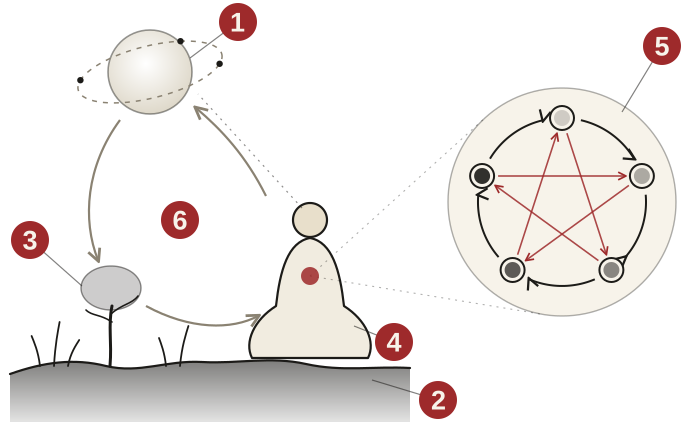
The three powers and the five thieves, as the Yinfu jing describes them. A schematic drawing.
- Heaven and its course, which the sage observes and holds to
- Earth
- The ten thousand things
- The person: heaven’s nature in a human being, the heart-mind as its pivot
- The heart enlarged: the five thieves, read as the five phases, generating one another round the ring (ink) and restraining one another across it (cinnabar)
- The three thieves: heaven and earth, the ten thousand things and people, each drawing on the other; in due measure, the three powers are at peace
4. Timing and the hidden pivot
Classical text
故曰:食其時,百骸理;動其機,萬化安。人知其神之神,不知不神之所以神也。日月有數,大小有定,聖功生焉,神明出焉。其盜機也,天下莫能見,莫能知。君子得之固躬,小人得之輕命。
English reading
So it is said: eat at the right time, and all the bones of the body are in order; move at the pivot, and all transformation is at peace. People know the spirit that looks spirit-like, not the plain from which spirit comes. Sun and moon keep their measure, the great and the small their fixed degree; from this the sage’s work arises and spirit-like clarity comes forth. No one in the world can see or know the pivot of this exchange. The noble person who grasps it strengthens their own life; the petty person who grasps it treats life lightly.
Here the text turns practical, and its advice is easy to miss for being so ordinary. Health and order come from timing in ordinary things, meals and movement, not from marvels. Do not look further afield: the real wonder is the regularity of sun and moon. Mark the last line too: it is a caution that runs through the whole text: the same understanding can steady a life or be used carelessly, and what decides is the person who holds it.
To try: on a clear night, look at the moon for a few minutes and compare its place with the night before.
5. The senses, and the pivot in the eye
Classical text
瞽者善聽,聾者善視。絕利一源,用師十倍;三反晝夜,用師萬倍。心生於物,死於物,機在目。
English reading
The blind hear well; the deaf see well. Close off gain at one source, and one’s forces are ten times as effective; turn back three times, day and night, and they are ten thousand times as effective. The heart-mind is born from things and dies by things; the pivot is in the eye.
Begin with the simple point: when one channel closes, another sharpens. From there the readings divide. Strategists read the lines about forces literally, as the use of troops. Inner cultivators read “closing off gain at one source” as stopping the senses from leaking attention outward, and “turning back three times” as turning that attention round to look within, again and again. Note the “again and again”: the turning is repeated, not done once. “The pivot is in the eye” names where your mind is caught: by what it looks at. It is the same insight as the turning inward of Inner Observation.
To try: sit quietly for a few minutes, eyes softly lowered, and notice how often your attention drifts back out to what you see.
6. Heaven is impartial
Classical text
天之無恩而大恩生。迅雷烈風,莫不蠢然。至樂性餘,至靜性廉。天之至私,用之至公。禽之制在氣。生者死之根,死者生之根。恩生於害,害生於恩。愚人以天地文理聖,我以時物文理哲。人以愚虞聖,我以不愚虞聖;人以奇期聖,我以不奇期聖。故曰:沉水入火,自取滅亡。
English reading
Heaven shows no favour, and from this the greatest favour is born. Under sudden thunder and fierce wind, every creature stirs. With the greatest joy, one’s nature has abundance; with the greatest stillness, it is pure and spare. Heaven is most private, yet in its use it is most public. Mastery of birds lies in qi. Life is the root of death; death is the root of life. Favour is born of harm; harm is born of favour. Fools take the patterns of heaven and earth for wisdom; I take the patterns of time and things for wisdom. Others judge the sage through their own folly; I do not. Others expect the sage to be strange and marvellous; I do not. So it is said: those who sink into water or walk into fire bring their own ruin.
If heaven’s lack of favour sounds cold, read it beside chapter 5 of the Tao Te Ching, where heaven and earth are “not humane”. It is not cruelty: nature does not play favourites, and that impartiality is what lets everything live. The spring thunder that wakes every creature is the season the calendar calls Awakening of Insects. The pairs of life and death, favour and harm, are the same turning of opposites as yin and yang. The closing lines are a quiet portrait of the sage: not a wonder-worker, but someone who reads time and things well and does not walk into the river. The lines from “Others judge the sage” to the end of this section appear only in the longer version.
To reflect on: think of one harm that later turned out to be a favour, and one favour that carried a cost.
7. Stillness, yin and yang, and the Changes
Classical text
自然之道靜,故天地萬物生。天地之道浸,故陰陽勝。陰陽相推,而變化順矣。是故聖人知自然之道不可違,因而制之。至靜之道,律曆所不能契。爰有奇器,是生萬象,八卦甲子,神機鬼藏。陰陽相勝之術,昭昭乎進乎象矣。
English reading
The way of what is so of itself is still, and so heaven, earth and the ten thousand things are born. The way of heaven and earth is gradual, and so yin and yang overcome each other in turn. Yin and yang push each other, and change follows its course. So the sage knows that the way of what is so of itself cannot be opposed, and works with it to give it measure. The way of utmost stillness cannot be matched by pitch-pipes or calendars. Then there is a wondrous instrument that gives rise to the myriad images: the eight trigrams and the sixty-day cycle, a spirit-like pivot hidden like the unseen. The art of yin and yang overcoming each other shines out plainly and is shown in the images.
This closing passage is found only in the longer version. It ties the text to the Book of Changes: the “wondrous instrument” is the system of trigrams and the sixty-day cycle of stems and branches, through which the hidden alternation of yin and yang can be read. Notice how it closes the circle: it ends where the first section began, with stillness as the source of all movement.
To try: now read section 1 again, and see what has changed.
Reading it today
The Yinfu jing is terse, and its images are sharp on purpose, so do not hurry it. Read slowly, and you will find three ideas that travel well.
- Timing is most of wisdom. Eat at the right time, act at the pivot: the text cares less about force than about the moment.
- Attention is the gate. “The pivot is in the eye.” What you look at shapes your mind, and closing one channel sharpens the others.
- Nature is impartial. Everything draws on everything else; your task is due measure, not a world without exchange.
A caution: the text has been read as a manual of power as well as of cultivation, and its own last word on that is the warning in section 4: the same understanding can steady a life or squander it. Which one it does depends on you.
Further in the library
- The Classical Library: the complete texts collected on this site.
- The Qingjing jing: the other short classic often read alongside it.
- The Tao Te Ching: the book behind both.
- The five phases: the cycle the five thieves are usually read as.