The Huangting jing (黄庭经), the Scripture of the Yellow Court, is a meditation poem in lines of seven characters that maps the human body as a landscape of palaces, gates and resident spirits. For more than fifteen centuries Taoists have recited it, visualised it and copied it out. It stands at a turning point in Taoist practice, between the early art of holding the gods of the body in the mind and the later inner alchemy that works with essence, breath and spirit.
Start with the name, because it already teaches. “Yellow” is the colour of earth and of the centre; a “court” is an open courtyard, a space left empty in the middle of a house. So the Yellow Court is the empty centre of the person. You will find that commentators place it differently, in the head, at the spleen in the middle of the body, or below the navel, and some speak of three yellow courts, one in each of these regions. The text itself is less interested in fixing a point than in teaching you to dwell at the centre; a beginner who hunts for the exact spot can miss that.
It comes down to us in two main versions. The Outer Scripture (Huangting waijing jing, 黄庭外景经) is the older and shorter, in about a hundred lines, usually divided into three parts. The Inner Scripture (Huangting neijing jing, 黄庭内景经), in thirty-six sections, belongs to the Shangqing revelations of the fourth century and is associated with Lady Wei Huacun (魏华存, 252–334), the school’s first transmitter; it expands the outer text and names the spirits it only hints at. A small number of scholars argue that the order was the reverse, but most read the Outer Scripture as the earlier, and this page follows them.
The Outer Scripture is also famous as calligraphy. A copy in small regular script, dated 356, is attributed to Wang Xizhi (王羲之), and the poet Li Bai tells how Wang wrote out the Yellow Court for a Taoist priest in exchange for his white geese. Note that the earlier Book of Jin tells the same story with a different book, the Tao Te Ching (Dao De Jing). Either way, the text was prized as much for its calligraphy as for its teaching.
Below are five foundational passages, one from the Outer Scripture and four from the Inner, each in Chinese with a plain English reading and a short note. Read the Chinese first, then the reading, then the note. The figure after the first passage shows where the main places of the inner landscape lie.
1. The Outer Scripture opens: a map of the body
Classical text
上有黃庭下關元,後有幽闕前命門。呼吸廬間入丹田,玉池清水灌靈根。審能修之可長存。
English reading
Above is the Yellow Court, below is the Pass of the Origin; behind are the Dark Gates, in front the Gate of Life. Breathe through the hut and enter the Cinnabar Field; let the clear water of the Jade Pond water the numinous root. Whoever can truly cultivate this may long endure.
This is the first map of the inner landscape, and nearly every word in it has been read in more than one way, so take it slowly. The Pass of the Origin (guanyuan, 关元) lies below the navel; the Dark Gates (youque) are usually read as the kidneys. Here is where beginners often slip: the “Gate of Life” in front is here often read as the navel, not the point between the kidneys that later texts call mingmen, so do not carry the later meaning back into this line. The “hut” is glossed as the nose. Notice, too, the variants: the copy attributed to Wang Xizhi has the Dark Gates in front and the Gate of Life behind, and one edition breathes “outside” the hut rather than through it. They show how early the text was already being studied and argued over. Keep the last line, “water the numinous root”, in mind: it refers to the practice described in section 4.
To try: read the four directions slowly and notice where your attention goes with each.
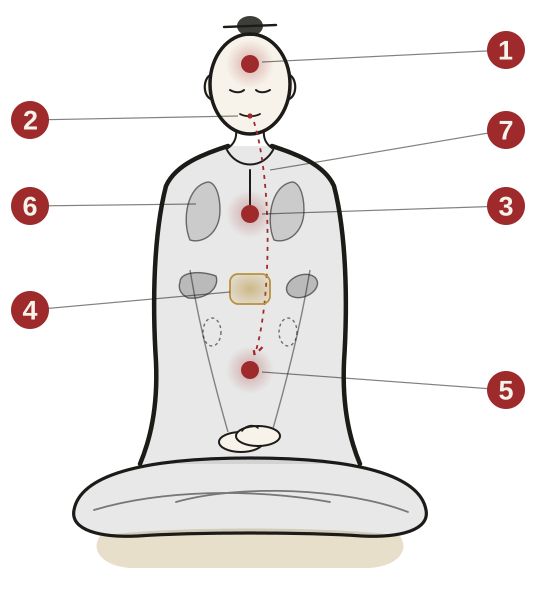
The inner landscape of the Huangting jing. A schematic drawing; commentators place several of these differently.
- The Niwan (泥丸), the upper Cinnabar Field in the head
- The Jade Pond: the mouth
- The Crimson Palace (jianggong 绛宫): the heart, the middle Cinnabar Field
- The Yellow Court: the empty centre, read in the head, at the spleen or below the navel; drawn here at the centre
- The lower Cinnabar Field, near the Pass of the Origin (关元) below the navel
- The five viscera, each with its spirit: lungs, heart (3), liver, spleen and kidneys (dotted, at the back)
- The water of the Jade Pond, swallowed down to “water the numinous root”
2. The Inner Scripture’s preface: seven-character verses
Classical text
上清紫霞虛皇前,太上大道玉晨君,閑居蕊珠作七言,散化五形變萬神,是為黃庭作內篇。
English reading
Before the Sovereign of Emptiness in the purple mists of Highest Clarity, the Lord of the Jade Dawn of the Great Way, dwelling at leisure in the Pistil Pearl palace, composed verses of seven characters. They disperse and transform the five forms and change the myriad spirits: this is the inner book of the Yellow Court.
Notice first where the Inner Scripture places its own origin: in heaven. Highest Clarity (Shangqing) is the heaven that gave the school its name, and the Lord of the Jade Dawn is one of its high deities; the text presents itself as a revelation, not a human composition. It also tells you its form: verses of seven characters, made to be chanted. The lines that follow promise that reciting it ten thousand times lifts the reciter to the heavens and dispels illness. Read such lines for what they are, the claims of a liturgical text about itself. What they show the historian is how central recitation was to its use.
To try: read the English reading aloud once, evenly, and notice how it differs from reading in silence.
3. Above and below, left and right
Classical text
上有魂靈下關元,左為少陽右太陰,後有密戶前生門,出日入月呼吸存。
English reading
Above are the spirits of the hun soul, below is the Pass of the Origin; on the left is the lesser yang, on the right the great yin; behind is the hidden door, in front the gate of birth. Going out with the sun and coming in with the moon, keep the breath present.
Set this beside the Outer Scripture’s opening and you will see what it is doing: rewriting that map, with the same frame of above and below, behind and in front, and a new axis of left and right. Why is yang on the left? In Shangqing visualisation the left eye is the sun and the right eye the moon, so yang stands on the left and yin on the right. “Going out with the sun and coming in with the moon” then joins breathing to that pairing: the practitioner breathes in time with the lights of heaven, held inside the body. Compare the calm, inward attention taught in inner observation.
To try: for a few minutes, simply notice your breath going out and coming in, without changing it.
4. The Jade Pond: the mouth and its water
Classical text
口為玉池太和宮,漱咽靈液災不干,體生光華氣香蘭,卻滅百邪玉煉顏。
English reading
The mouth is the Jade Pond, palace of great harmony. Rinse and swallow the numinous liquid, and calamity will not intrude. The body gives off light and the breath is fragrant as orchids; a hundred ills are driven off, and the face is refined like jade.
The “numinous liquid” is saliva, and this is a practice still taught in qigong today. As the tradition describes it, the tongue rests on the palate, the mouth fills, and the saliva is rinsed and swallowed slowly, often in three parts, with the attention following it down to the lower field. Connect this with section 1: in the Outer Scripture this is the “clear water of the Jade Pond” that waters the root. A common mistake is to read the light, fragrance and youthful face literally. They are the text’s poetic picture of a body in good order, not a medical promise; what the tradition values here is the image of quiet, unhurried swallowing as a way of settling the mind.
To reflect on: notice how the passage moves from a small act in the mouth to the whole body.
5. The spirits of the five viscera
Classical text
心神丹元字守靈,肺神皓華字虛成,肝神龍煙字含明,翳鬱導煙主濁清,腎神玄冥字育嬰,脾神常在字魂停,膽神龍曜字威明。六腑五臟神體精,皆在心內運天經,晝夜存之自長生。
English reading
The spirit of the heart is Cinnabar Origin, styled Guardian of the Numinous. The spirit of the lungs is Luminous Splendour, styled Empty Completion. The spirit of the liver is Dragon Mist, styled Holding Brightness; shading and gathering, it guides the vapours and rules the clear and the turbid. The spirit of the kidneys is Dark Obscurity, styled Nourisher of Infants. The spirit of the spleen is Ever-Present, styled Stilling the Soul. The spirit of the gall bladder is Dragon Radiance, styled Majestic Brightness. The spirits of the six receptacles and the five viscera are the essence of the body; all are within the heart, turning with the course of heaven. Hold them in mind day and night, and you will live long of yourself.
Here the Inner Scripture gives each organ a resident spirit with a name and a style-name, as a person has. Understand the purpose before the method: the aim is that the body’s gods stay at home and the body stays whole. The practice is cunsi (存思), “holding in thought”: the practitioner visualises each spirit in its palace, in its colours and robes. The organs follow the five phases. Now look for the key line, “all are within the heart”: the heart-mind is the hall where all the others gather. It is easy to get lost in the list of names and miss it. Later inner alchemy kept this map but read the spirits as essence, breath and spirit rather than as gods; the Tang commentator Liangqiuzi already leans that way.
To reflect on: read “all are within the heart” slowly, and ask what it might mean for one centre to hold all the rest.
Reading it today
Remember first what kind of text the Huangting jing is: a religious text, written to be chanted and visualised inside a tradition with teachers. Read as history and as a meditation map, it offers you three things.
- The body as a place to dwell. It treats the body not as a machine but as a landscape that your attention can inhabit, room by room.
- The centre. The Yellow Court is an empty middle; the practice is to rest there rather than to chase what passes through.
- Small, steady practices. Calm breathing and slow swallowing are its simplest exercises, and they are still part of qigong.
One caution. Its promises of long life and healing belong to the tradition and to its time; they are not medical advice. Visualisation practices of this kind are best learned with an experienced teacher.
Further in the library
- The Classical Library: the complete texts collected on this site.
- The Qingjing jing: a short classic of clarity and stillness, recited daily.
- The Shangqing school: the tradition that revealed the Inner Scripture.
- Taoist meditation: the practices this map belongs to, from inner observation to the small heavenly circuit.