The Wuzhen pian (悟真篇), “Awakening to Reality”, is the founding classic of Taoist inner alchemy (neidan, 内丹), and it rewards a slow reading. Start with the man who wrote it. Zhang Boduan (张伯端, traditionally 987–1082), styled Ziyang (紫阳), was a scholar-official from Tiantai. In his preface, dated 1075, he says that after years of fruitless searching he met a realised teacher in Chengdu in 1069, who gave him the oral instructions on the “golden elixir”. In the Southern Song, the inner-alchemy tradition later called the Southern Lineage (Nanzong, 南宗) took him as its first patriarch.
Before you read a single poem, look at how the book is built, because it is built on numbers. Zhang wrote sixteen regulated poems of eight lines, for the “two eights” of the alchemical balance; sixty-four quatrains, one for each hexagram of the Book of Changes; one poem in five-character lines, for the Great One; and twelve lyrics to the tune “West River Moon”, for the months of the year. Later editions add songs on the nature of mind.
Next, the language. It comes from the furnace. Lead and mercury, dragon and tiger, the trigrams Kan ☵ and Li ☲, the crucible and the furnace, the timing of the fire: these were the terms of laboratory alchemy, the search for an elixir made from metals and minerals. Zhang turns all of them inward. In his poems they name the transformation of essence, breath and spirit (jing, qi and shen) in the practitioner, and he says plainly that herbs, metals, and even breathing exercises and visualisation are not the elixir. The commonest mistake a new reader makes is to take these words literally. The code is deliberate: the poems point, and the key was expected to come from a teacher.
The preface also places the work across the Three Teachings. Laozi and the Buddha, Zhang writes, both opened a gate to the study of nature and life: Taoism through refining and nourishing life, Buddhism through emptiness and stillness, and he draws on Confucian texts as well. That balance of the two, later summed up as “cultivating nature and life together” (性命双修), is the Southern Lineage’s mark; you will meet it again in the fourth poem.
This page gives you four poems, each in Chinese with a plain English reading and a note. Look at the Chinese first, even if you cannot read it, then the reading, then the note. Remember that this is symbolic literary language, not chemistry and not a do-it-yourself manual. The figure after the third poem shows the exchange it describes.
1. Why seek the Way: the first regulated poem
Classical text
不求大道出迷塗,縱負賢才豈丈夫。百歲光陰石火爍,一生身世水泡浮。只貪利祿求榮顯,不顧形容暗悴枯。試問堆金等山嶽,無常買得不來無。
English reading
If you do not seek the great Way and leave the paths of confusion, then for all your talent and worth, how are you a person of stature? A hundred years of light and shade flash like a spark from flint; a whole life floats like a bubble on water. You chase salary and rank and seek renown, and never notice your face quietly withering. Ask yourself: with gold piled as high as mountains, can you buy off impermanence when it comes?
Notice where the book begins: not with alchemy but with death. Everything technical that follows rests on this first motive. The images of the spark from flint and the bubble on water are shared with Buddhist writing, and the argument is simple: a career is no answer to the shortness of life. Zhang was an official himself, so you can read the poem as advice to his own class. To reflect on: read the last line slowly, and ask what you treat as if it could buy time.
2. The crucible and the ingredients: the first quatrain
Classical text
先把乾坤為鼎器,次將烏兔藥來烹。既驅二物歸黃道,爭得金丹不解生。
English reading
First take Qian and Kun as the crucible and the furnace; then take the crow and the hare as the ingredients to cook. Once the two are driven onto the Yellow Path, how could the golden elixir fail to form?
Here you meet the code for the first time, so take it one word at a time. Qian and Kun, heaven and earth, are the vessel: many commentators read them as the body itself, head and belly. The crow lives in the sun and the hare in the moon in Chinese myth, so they stand for yang and yin, the sun-trigram Li and the moon-trigram Kan. The Yellow Path is the sun’s road through the sky, read here as the centre where the two meet. “Golden” means incorruptible. Beginners often read the poem as a recipe; it describes a process in the person. To try: open the eight trigrams and look at Qian, Kun, Kan and Li side by side.
3. Taking from Kan to fill Li
Classical text
取將坎位中心實,點化離宮腹內陰。從此變成乾健體,潛藏飛躍總由心。
English reading
Take the solid centre from the place of Kan, and with it transform the yin within the palace of Li. From then on it becomes the strong body of Qian; hidden or leaping, all depends on the mind.
This quatrain is the heart of the method, later summed up as “taking from Kan to fill Li” (抽坎填离), so go slowly and look at the lines first. Kan ☵, water, has a solid yang line hidden between two broken ones; Li ☲, fire, has a broken yin line between two solid ones. Now the meaning. In inner alchemy Li is the heart and mind, bright outside but restless within, its yin centre called “true mercury”; Kan is the kidneys and essence, dark outside but holding a spark of yang, “true lead”. Notice the reversal: the bright trigram is the one with the restless centre. When the yang line returns to Li’s centre, Li becomes Qian ☰, pure yang, the state before birth that the practice seeks to restore. “Hidden or leaping” recalls the dragon of the first hexagram, Qian, hidden in the deep and leaping over it. To try: draw Kan and Li on paper, swap their middle lines, and compare what you get with the figure below.
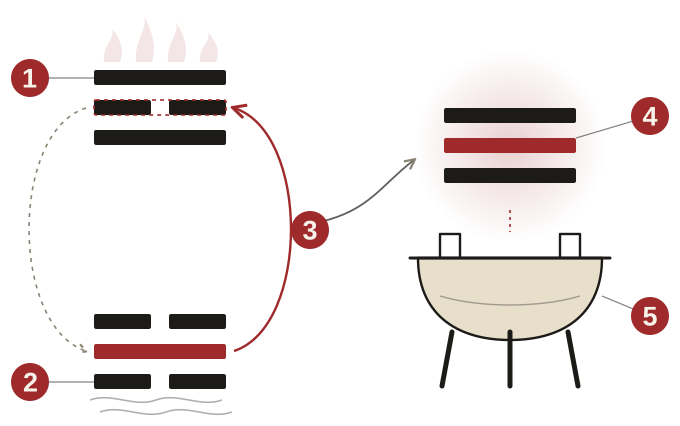
Taking from Kan to fill Li, as the third poem describes it. A schematic drawing of symbolic language.
- Li ☲, fire: the heart and mind, with a yin line at its centre (“true mercury”)
- Kan ☵, water: the kidneys and essence, with a yang line at its centre (“true lead”)
- The exchange: Kan’s solid line rises to fill Li’s centre (cinnabar), while the broken line returns below (grey)
- Qian ☰, pure yang: the state before birth, restored
- The crucible (ding): the body as the vessel of the work
4. Empty the mind, fill the belly
Classical text
虛心實腹義俱深,只為虛心要識心。不若煉鉛先實腹,且教守取滿堂金。
English reading
Empty the mind and fill the belly: both meanings run deep. Emptying the mind is for knowing the mind. Better, though, to refine the lead and first fill the belly, and so keep guard over a hall full of gold.
Zhang is quoting the Tao Te Ching (Dao De Jing), chapter 3, where the sage “empties their minds and fills their bellies”. Watch how he reads the line: as two halves of practice. Emptying the mind is insight into one’s nature, close to Chan, and filling the belly is the cultivation of life, the refining of “lead”. Then notice the order, because it is the point: here he puts the belly first. That order, life before nature, became characteristic of the Southern Lineage, where the Quanzhen masters of the north began with nature. The “hall full of gold” echoes Tao Te Ching chapter 9, where such a hall cannot be kept; Zhang’s gold is the kind that can. To reflect on: read the two chapters beside this poem and ask what kind of wealth could be kept.
Reading it today
The Wuzhen pian is poetry written in a code, and it was meant to be read with a teacher. If you read it as literature and history, it still teaches you three things.
- Turn the work inward. The furnace, the metals and the fire all became images of attention, breath and vitality. The elixir is a change in the person, so look for it there, not in a substance.
- Balance nature and life. Insight alone, or bodily practice alone, is half the work; the book insists on both. Notice which half you tend to favour.
- Begin from what matters. The first poem’s question, what a life is for, comes before any method.
One caution matters more than anything else here. The book’s terms are symbols, not chemistry. Never take metals or minerals as an “elixir”: the poisonings of outer alchemy, emperors among the victims, are part of why the tradition turned inward. If you want to practise inner alchemy, it is best learned from an experienced teacher.
Further in the library
- The Classical Library: the complete texts collected on this site.
- The Qingjing jing: the short classic of clarity and stillness, recited daily.
- The eight trigrams: Qian, Kun, Kan and Li, the symbols the poems turn on.
- The Quanzhen order: the northern inner-alchemy tradition, which began with nature where the south began with life.