How to Read Bronze at Wudang: Casting, Gilding and Imperial Networks
如何读懂武当铜建筑:铸造、鎏金与帝国网络
Bronze at Wudang can look permanent, even seamless. Look closely, however, and a different story appears: cast parts fitted together, timber forms translated into metal, gilded surfaces weathered and renewed, and inscriptions that connect a mountain sanctuary to workshops, donors and transport routes far beyond Hubei.
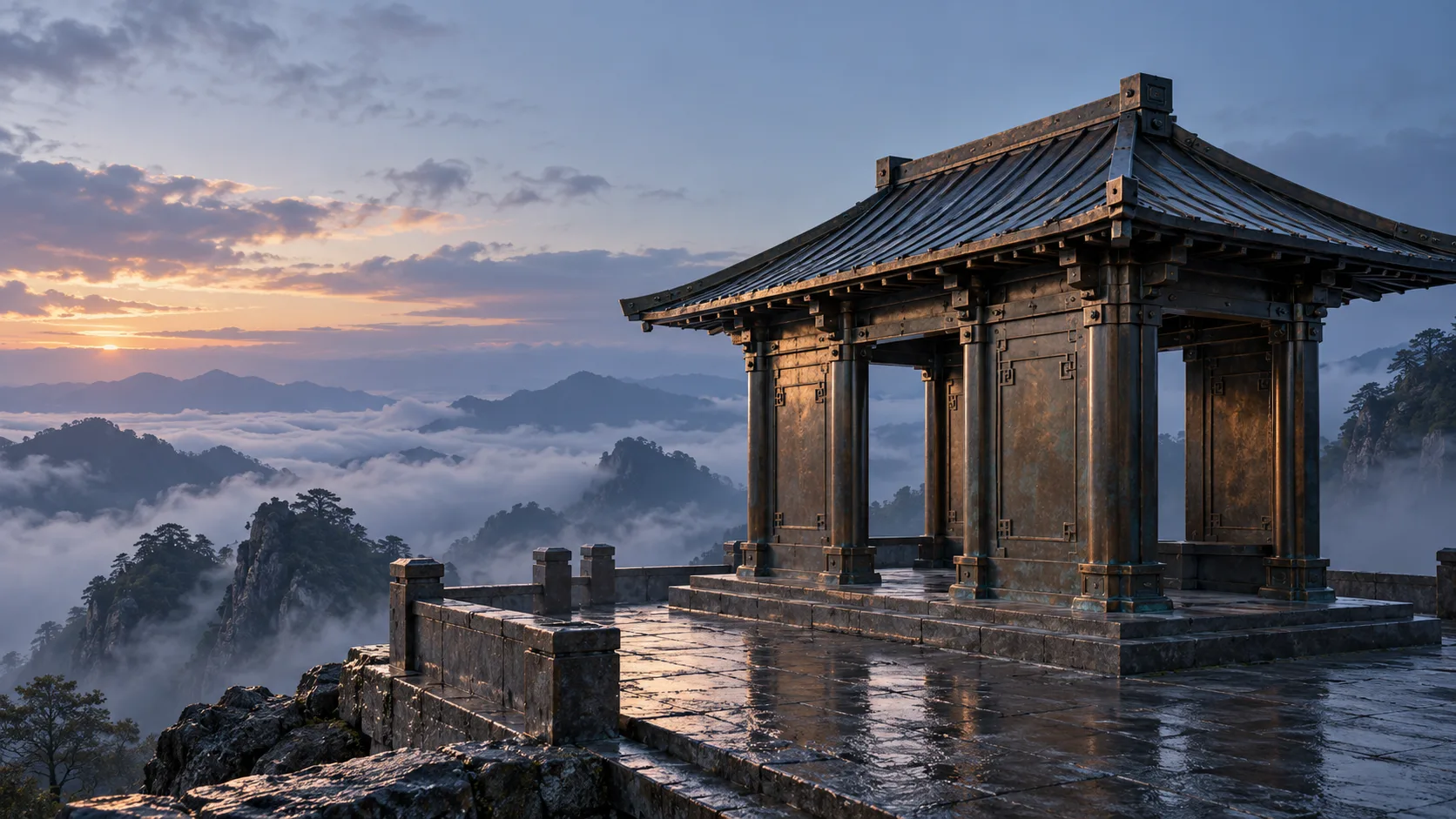
The first discipline is to identify the object. Two summit buildings are easily confused in retellings: the Ancient Bronze Shrine, cast in 1307, and the larger Golden Hall commissioned under the Ming Yongle emperor and completed in 1416. They stand near one another, but they belong to different moments and should not be treated as a single monument.
Begin by naming what you see
Ancient Bronze Shrine: a Yuan-period survivor
ICOMOS records the small shrine on Lotus Flower Peak as made in 1307, with its metalwork cast at Wuchang. This makes it an exceptional early surviving bronze building, not a preliminary phase of the later Golden Hall. Its scale, location and date deserve to be read on their own terms.
Golden Hall: a Ming imperial project
The Golden Hall crowns the summit complex described in our guide to Wudang’s summit. The 1994 ICOMOS evaluation describes a bronze structure that imitates timber construction, with columns and a double-eaved roof. Architectural historian Zhang Jianwei characterizes its copper-alloy components as separately cast, assembled and gilded. “Golden” therefore describes the luminous gilded surface and ritual status; it does not mean a building made from solid gold.
Architecture, image and furnishing are different layers
A metal hall may contain metal statues, railings, lamps or ritual vessels, but these do not automatically share one date, workshop or donor. Start by separating the building frame and enclosure from the sacred images and later furnishings. Our overview of Wudang layout and architecture helps place each layer within the wider summit ensemble.
Read a building made from cast parts
Think in components, not one giant pour
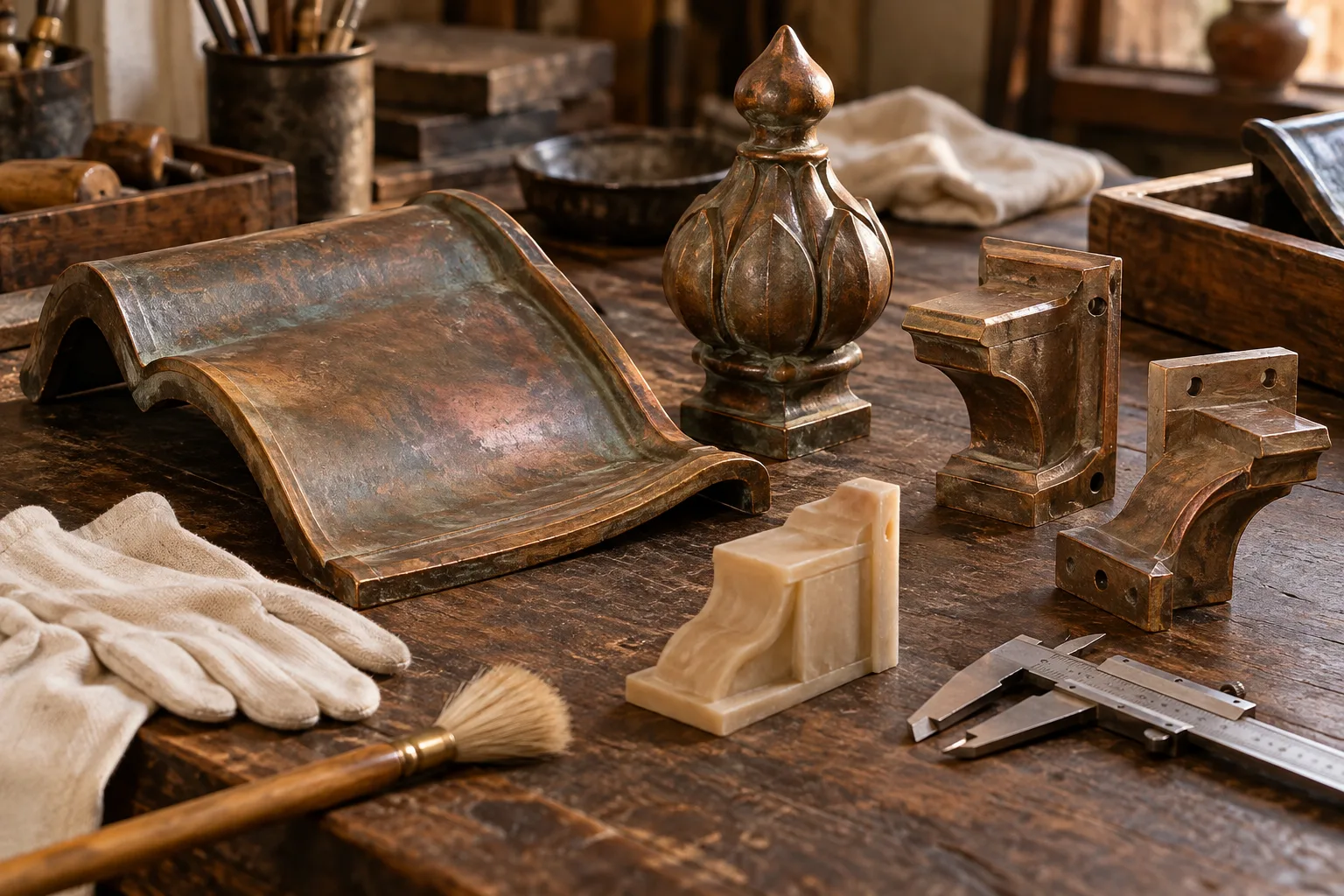
The Golden Hall was not cast as one hollow object. Columns, panels, roof members and ornaments were made as separate components and joined into an architectural whole. Seams, fastenings and repeated modules are therefore evidence of its making, not defects that spoil an illusion of seamlessness.
Timber grammar translated into metal
Metal reproduces the visual grammar of a Chinese timber hall: upright columns, bays, bracket-like transitions and a tiled roof profile. Yet bronze does not behave like wood. Reading the translation means asking which forms imitate carpentry, which joints answer the demands of casting and assembly, and where metal permitted a different solution. Compare this with the companion guide to reading dougong at Wudang.
Assembly reveals an imperial transport network
According to the ICOMOS evaluation, the Golden Hall’s components were prefabricated in Beijing, carried along the Grand Canal to Nanjing, then moved by the Yangtze and Han rivers before assembly at Wudang. The building is therefore both a summit shrine and the end point of a logistical chain joining court workshops, waterways, overland labour and mountain construction.
Read surface, inscription and change
Gilding is a surface, not the whole material
A gilded copper-alloy building presents several material histories at once: the cast body, the gold-bearing surface, accumulated patina and later care. Brightness alone cannot date a component. A luminous area may have been protected or maintained; a darker one may reflect exposure, handling, corrosion products or past treatment. Observe variation without turning colour into a simple clock.
Inscriptions can map people and materials
Names, dates and donor records can connect an object to networks that visual style alone cannot reveal. Sun Jianling’s study of the Golden Hall’s links with Yunnan argues that many bronze railings were donated by people from Yunnan and that at least some copper used for the main hall came from there. This is a scholarly reconstruction from inscriptions and historical evidence—not a licence to assign every component a single origin.
Conservation becomes part of the evidence
Metal architecture still depends on joints, foundations and exposure conditions. The 1994 evaluation documented lightning danger and cracking in the rock foundation around the Golden Hall. Such records belong to the monument’s conservation history; they should not be converted into claims about present conditions without current inspection. Repair can protect significance while also changing the surface a visitor sees.
A six-step practice for visitors
Move from identity to evidence
Name the building. Distinguish the 1307 Ancient Bronze Shrine from the 1416 Golden Hall before interpreting details.
Separate the layers. Tell the architectural shell from statues, railings and movable furnishings.
Find the modules. Look for repeated columns, panels, roof pieces, joints and seams that reveal assembly.
Compare form and material. Ask how a timber architectural form has been translated into cast metal.
Read surfaces cautiously. Distinguish gilding, exposed alloy, patina and possible later treatment without dating by colour alone.
Check the record. Use inscriptions, documented repairs and reliable research to test what visual evidence suggests.
Look without touching
At the summit, vary your viewing distance: read the building silhouette first, then repeated components and surface changes. Do not touch metalwork, trace inscriptions with a finger or cross barriers for a closer photograph. Continue with our guide to reading Wudang roofs to compare how the same architectural profile works in timber, tile and metal.
Sources and limits. This guide distinguishes documented dates from interpretation and avoids assigning an origin or age by appearance alone. The generated photographs are conceptual and do not depict a real Wudang object, workshop or conservation intervention.
Further reading: ICOMOS, 1994 evaluation of the Wudang nomination; Peking University repository, Zhang Jianwei on the Golden Hall; Sun Jianling, “Wudang Mountain’s Golden Hall and Yunnan”; UNESCO, Ancient Building Complex in the Wudang Mountains.