How to Read Painted Timber at Wudang: Colour, Craft and Renewal
如何读懂武当建筑彩画:色彩、工艺与更新
Colour at Wudang is not applied to a building after the architecture is finished. On columns, beams, bracket sets and ceiling panels, painted work helps viewers distinguish parts of the timber frame, directs the eye through a hall and records successive campaigns of care. The result is both visual design and material evidence.
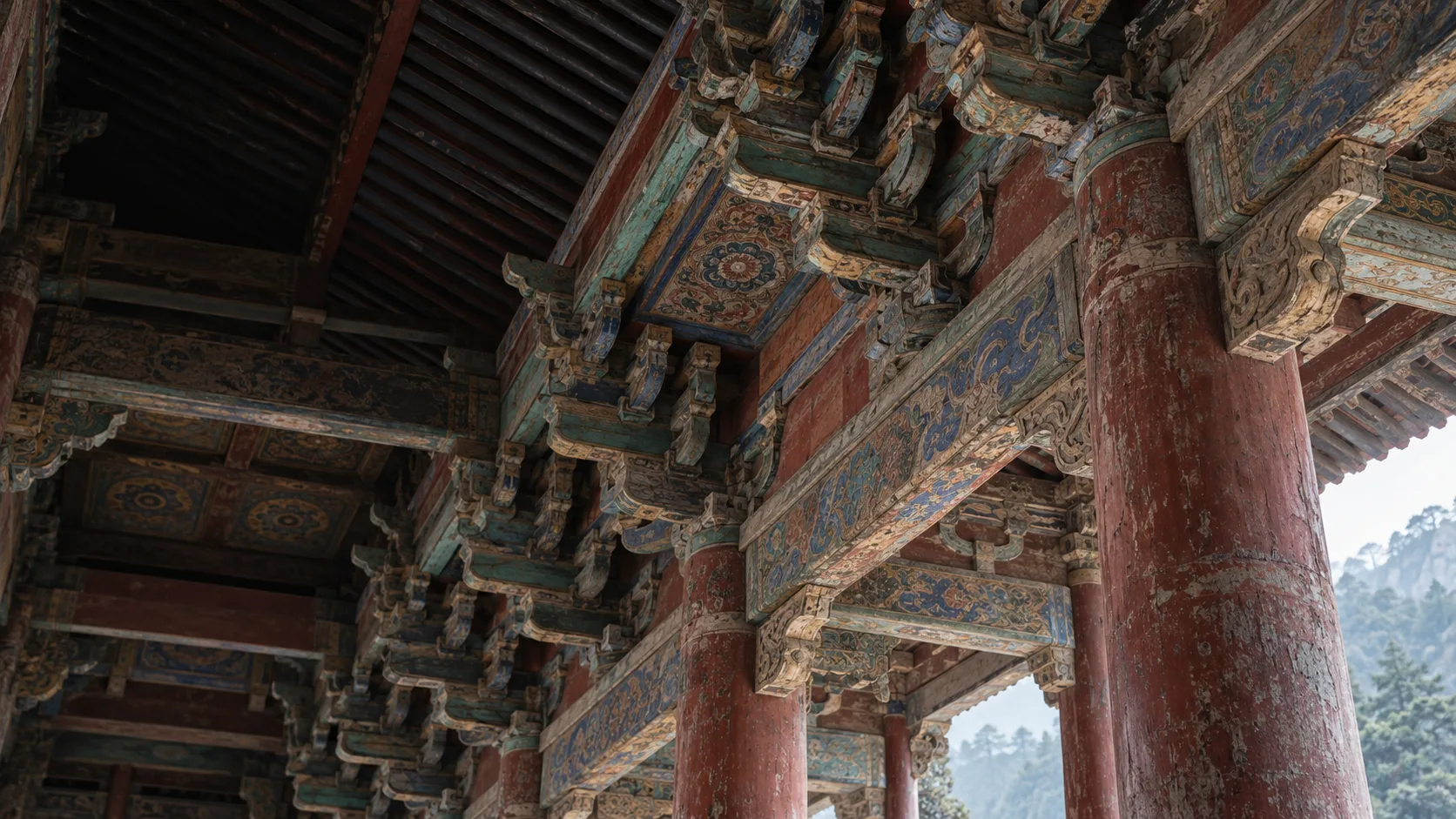
That evidence must be read cautiously. Paint fades, ground layers detach, smoke and dust darken surfaces, and repairs introduce new timber and new finishes. A bright pattern may be recent; a dull one is not automatically ancient. The most useful question is not “Is this original?” but “What does this surface reveal about where it sits, how it was made and how the building has been maintained?”
First locate the painted work
Painted timber is not the same as a wall painting
Architectural polychromy is colour and pattern applied to building components. At Wudang, it may cover beams, purlins, bracket sets, rafters, ceilings, doors or columns. A wall painting, sculpture or inscribed tablet has a different support and often a different conservation problem. Separate these categories before interpreting technique or date.
Read colour with the timber frame
Painted bands often make joints, bays and layers of support easier to see. Follow a column upward to the brackets, then across a beam and into the ceiling. Our overview of Wudang layout and architecture explains how these parts carry loads; colour adds a second, visual order to the same frame.
Begin with location, not a colour name
Record whether a surface is indoors, beneath deep eaves or exposed to wind-driven rain. Note its height, orientation and distance from incense, doors and leaking roof joints. The guide to reading Wudang roofs helps connect deterioration below with the water-shedding system above.
Read pattern, rank and workmanship together
Colour organizes a viewer’s attention
Strong contrasts can clarify major beams and bracket sets from a distance, while finer borders reward close viewing. In an important hall, density, scale and placement may contribute to a sense of rank. Yet colour alone is not a fixed code: significance depends on the component, building, period and repair history.
Motifs are historical evidence
Repeated scrolls, floral forms, geometric borders and auspicious imagery can connect a surface to broader court, religious and workshop traditions. Comparisons are most reliable when researchers use securely dated buildings or objects. Palace Museum scholarship, for example, compares early-Ming painted work at Wudang with other dated material rather than treating “Ming style” as one timeless formula.
Look for the hand behind repetition
Even regulated designs were executed by craftspeople. Spacing, turning points, brush edges, joins between colours and adjustments around irregular timber may reveal setting-out and sequence. Do not mistake small variation for carelessness: it may show how a repeated scheme was fitted to a real structure.
Distinguish age, weathering and renewal
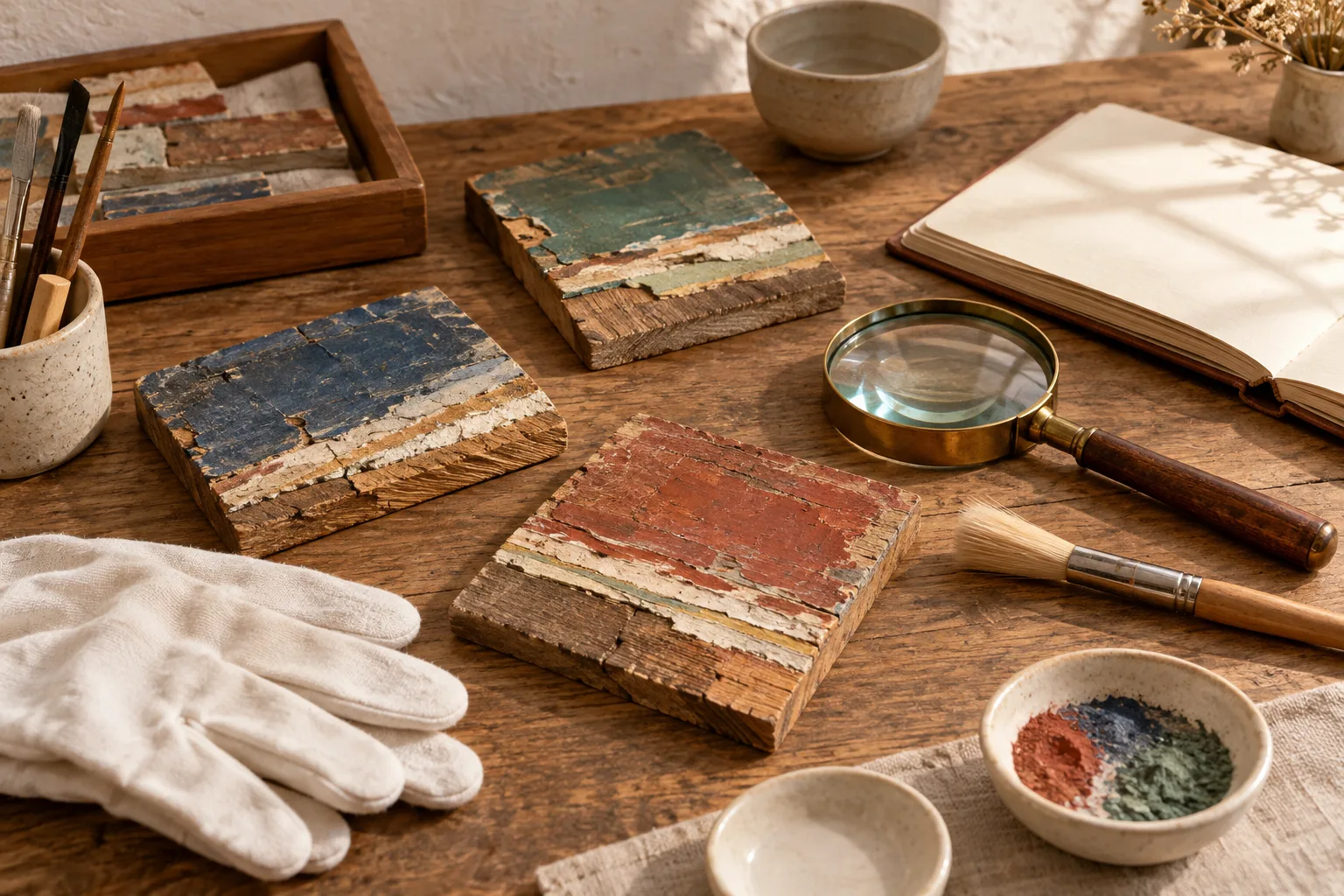
A painted surface is layered
Visible colour may sit over a preparation system that evens the wood and receives paint or an oil finish. Later work can cover, imitate or partly expose earlier campaigns. Edges, losses and protected recesses may show several layers, but visitors should never scrape or touch them. Specialists document and sample only where a conservation plan permits.
Survey and testing turn clues into evidence
In 2023, reporting on work by the China Academy of Cultural Heritage at Wudang described mapping deterioration and taking samples from painted layers and pigments for laboratory study. The aim was to compare materials and techniques before proposing treatment. That sequence—survey, analysis, diagnosis, then intervention—is more reliable than choosing a fresh-looking colour by eye.
Renewal is part of the record
Maintenance may replace decayed timber and provide the new piece with preparation and finishing. The 2025 repair notice for Zixiao Palace explicitly included ground preparation and oil finishing for replacement timber. Such work can keep a building usable while changing what visitors see. Read it beside our guide to what survives and what was rebuilt.
A six-step practice for visitors
Move from context to close evidence
Name the component. Decide whether you are looking at a column, beam, bracket set, ceiling, door, wall painting or sculpture.
Map exposure. Compare sheltered recesses with edges facing light, moisture, smoke or contact.
Read the composition. Trace large colour fields, borders and motifs before isolating one pigment.
Look for transitions. Notice losses, overpainting, replacement wood, sharper lines and changes in surface sheen without assigning dates too quickly.
Compare several bays. Repetition and variation reveal more than one photogenic detail.
Check the record. Use dated photographs, inscriptions, repair reports and technical studies to test what the surface seems to show.
Try the method at Zixiao Palace
At Zixiao Palace, begin beneath shelter and identify the timber component before judging its colour. Compare protected and exposed areas, then relate visible repairs to the building’s documented maintenance. Respect barriers and active work zones: conservation evidence is easily damaged, and a careful reading never requires touching the surface.
Sources and limits. This article uses the Chinese Museums Association’s explanation of architectural polychromy, Palace Museum research on early-Ming painted work, reporting on China Academy of Cultural Heritage investigations at Wudang, the Wudang Taoist Association’s 2025 repair notice and UNESCO’s conservation framework. Colours and motifs vary by date, place, building and intervention. The generated images are interpretive and do not document a real Wudang interior or conservation project.
Further reading: Chinese Museums Association, lecture on Chinese architectural polychromy; Palace Museum, periodization of surviving Ming official polychromy; Hubei Daily, conservation investigation at Wudang; Wudang Taoist Association, Zixiao Palace repair notice; UNESCO, Ancient Building Complex in the Wudang Mountains.