How to Read Stonework at Wudang: Platforms, Steps and Weathering
怎样读懂武当山石作:台基、阶道与风化痕迹
Stone is easy to treat as the quiet background of a Wudang temple: something underfoot, below the painted timber and beside the bronze. Look more closely and it becomes an archive of decisions. A platform negotiates slope and rank; a stair controls approach; a joint records assembly; a worn edge records movement; a drain shows how builders expected water to leave.
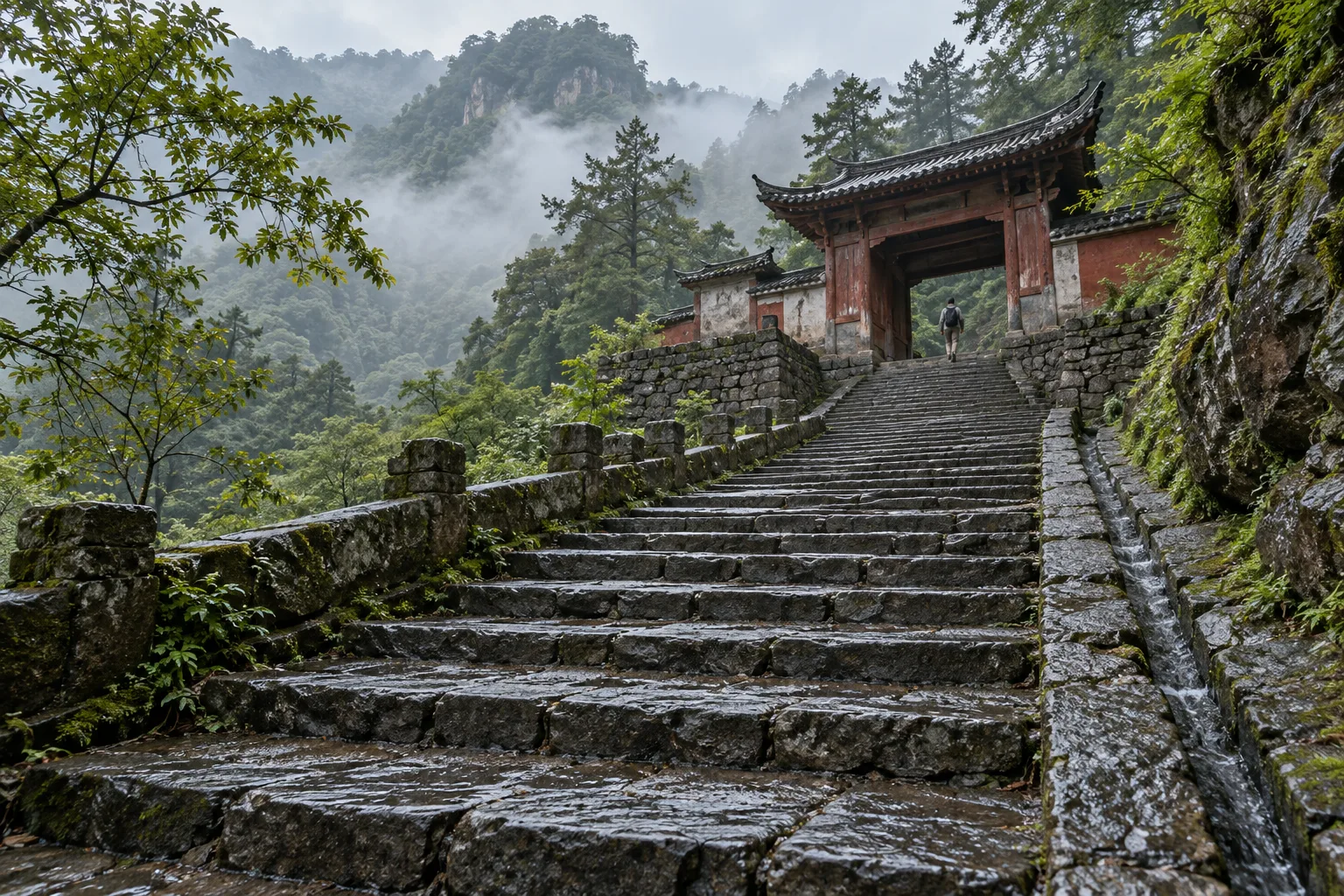
This guide complements Wudang.Org’s overview of Wudang Mountain temple layout and architecture. It offers a method for looking, not a catalogue of every site. A feature’s date, stone type, repair history or symbolic meaning should not be assigned from appearance alone.
First ask what the stone is doing
Platforms turn steep ground into usable architecture
At Wudang, architecture occupies peaks, terraces, valleys and cliff edges. Stone bases, retaining work and prepared terraces can make level ground where little exists naturally. Read them together with the site rather than as isolated decoration: note the direction of the slope, the height gained, and the transition from path to threshold. The related guide to building on difficult ground explains the wider topographic problem.
A platform also changes how a hall is encountered. It may lift timber away from damp ground, create a formal foreground, or concentrate access at a stair. Height is meaningful, but it is not a simple rank chart. The function of the building, later alteration, local terrain and what survives must all be considered before interpreting status.
Steps organize movement as well as ascent
Count flights, landings and changes of direction before looking for symbolism. A long central stair creates a different pace from short offset flights; broad treads invite gathering, while narrow mountain steps limit flow. Unequal risers can reflect difficult ground, wear, settlement or repair. They are observations, not automatic proof of age.
Compare the stair with doors, gates and axes. Does it lead directly to the central bay, pause at a landing, or approach from the side? The answer connects stonework to the imperial route and overall plan without assuming that every visitor historically followed the same path now used by tourists.
Edges, thresholds and rails separate zones
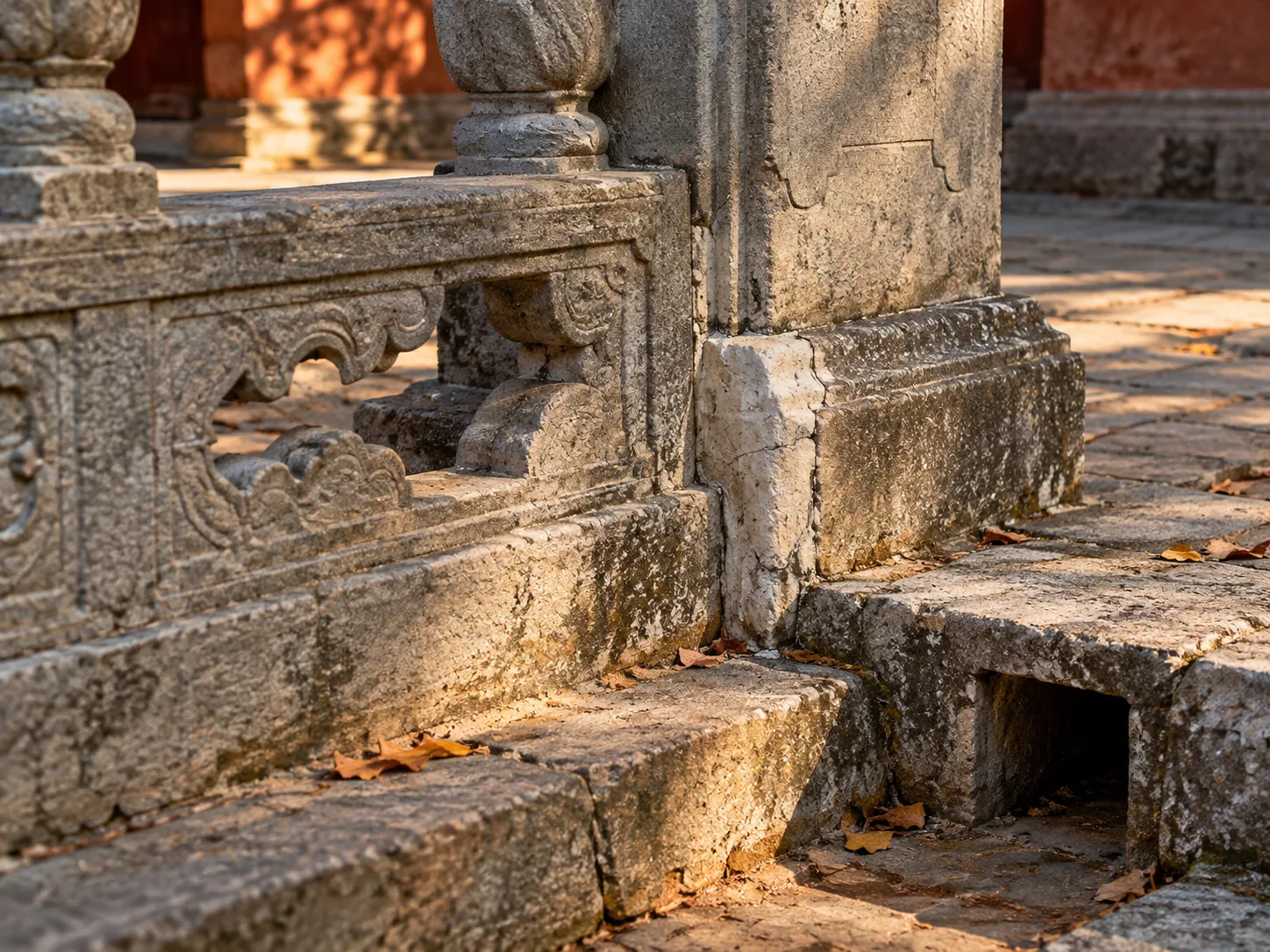
A curb can keep runoff away from a wall; a threshold can protect an opening and mark passage; a balustrade can prevent a fall while giving a terrace a formal edge. One component may perform several jobs. Begin with position and wear before assigning ceremonial meaning.
At entrances, look at the meeting between stone and timber. Post bases, sockets and thresholds help explain how the frame was supported and how people crossed it. Then compare the frames, doors and windows above. The point is to reconstruct relationships, not to detach an attractive carving from the building that gives it work.
Read making and assembly before style
Tool marks are evidence, but rarely a date by themselves
Raking light may reveal parallel dressing lines, small point marks, drilled holes or a smoother finishing pass. These traces can show the sequence by which a face was shaped and which areas were meant to be seen. They do not, by themselves, identify a named craftsperson or a precise dynasty; tools, repair practices and surface reworking persist across time.
Distinguish deliberate finishing from later abrasion. A regular pattern that continues beneath a protected edge differs from random rounding on a tread. When a surface carries text, consult the separate guide to stone inscriptions and steles; carving technique cannot replace transcription, provenance and historical documentation.
Joints reveal how pieces were fitted
Follow seams around corners. Large blocks may overlap, butt together, key into adjacent pieces or sit on a separate base. A tight joint can indicate careful fitting, while a wide joint may result from movement, loss or later filling. Colour alone cannot tell whether a pale line is original bedding, a modern repair mortar or a mineral deposit.
Look for changes in grain, texture and edge treatment across the seam. Those contrasts can identify separate pieces and sequences of replacement. The same relational method helps when reading dougong and timber joinery, even though wood and stone respond differently to load and weather.
Carving belongs to structure, viewing distance and use
A relief on a low rail is seen obliquely and at close range; a gateway component is read from farther away; a base moulding catches light near the ground. Scale, depth and repetition often follow those viewing conditions. Identify the component first, then describe motif and workmanship. Avoid naming animals, clouds or sacred emblems when erosion leaves the form uncertain.
The UNESCO World Heritage description identifies both stone-walled and stone-built elements within the complex, including the Forbidden City enclosure and the Zhishi-Xuanyue Gateway, while emphasizing the ensemble’s Yuan, Ming and Qing history. That breadth is a warning against treating “Wudang stonework” as one material, workshop or moment. See the UNESCO property record for the site-level synthesis.
Water, use and repair write different histories
Trace water as a route, not as a stain
After rain, follow the sequence from roof edge to paving, channel, outlet and downslope ground. Darkening at a joint may reflect brief wetting; green growth may indicate a persistently damp margin; pale crusts may have several causes. A photograph records appearance, not diagnosis. The companion article on rainwater, courtyards and mountain drainage places individual drains within the whole water system.
Peer-reviewed research on Wudang stone components has investigated mineral composition, microstructure and physical properties to explain surface flaking. That work shows why confident diagnosis requires material analysis, not a visual guess. See Wang, Chen and Wang’s 2023 study of surface flaking and a 2024 experimental study of green schist. Their laboratory methods should not be mistaken for visitor treatments.
Wear patterns record repeated contact, not a single story
Rounded nosings, polished centres and shallow depressions can indicate repeated passage, but movement is rarely uniform. Water, grit, cleaning, footwear, settlement and replacement can all change a tread. Compare several steps and the sheltered edges of each one before deciding that a pattern is caused by feet.
Visitor behaviour matters because cultural relics remain vulnerable. The 2017 local preservation regulations reproduced in China’s World Heritage reporting require measures against stone weathering and permit guardrails around important components. Visitors should observe without touching, rubbing, tracing, chalking or taking impressions; the practical Wudang temple etiquette guide explains the broader conduct expected at working religious sites.
Repairs are part of the object’s documented life
A replacement block, mortar patch, metal restraint or reset edge may be visually obvious—or deliberately compatible. Do not call every difference “fake.” First record where it occurs, how it meets older fabric and whether official interpretation identifies the intervention. The page on what survives and what was rebuilt explains why authenticity at Wudang is evaluated through evidence, not a simple untouched-versus-new divide.
The Principles for the Conservation of Heritage Sites in China frame intervention around significance, documentation and preservation of historic fabric. UNESCO’s property statement likewise says maintenance should respect original layout, specification, style and material. These principles make a repaired joint worth reading carefully rather than hiding it beneath a romantic idea of timeless ruins.
Use a repeatable six-step field method
Move from whole setting to one component
A disciplined sequence prevents a striking detail from swallowing its context. Work from terrain and building to component, surface and comparison:
- Locate it. Record slope, orientation, building, level and route.
- Name its job. Ask whether it supports, retains, drains, protects, guides or marks passage.
- Map its parts. Trace blocks, joints, edges, sockets, rails, paving and outlets.
- Describe the surface. Separate tool marks, wear, deposits, biological growth, fractures and loss.
- Compare. Check sheltered edges, neighbouring components and repeated examples before explaining a pattern.
- Verify. Use site interpretation, conservation records and material analysis before assigning date, stone, repair or meaning.
Photograph relationships without manufacturing evidence
Take an overall view, a mid-range view and a detail from a safe public position. Include a known scale only when permitted; do not place coins, rulers or hands on protected fabric. Record light and weather because both alter colour and legibility. A single dramatic close-up is weaker evidence than a small sequence that shows location and relationship.
Do not wet stone to increase contrast, clean away growth, make rubbings or enter closed areas. The World Heritage Committee’s 2025 decision on Wudang stresses continuing conservation, visitor control and impact assessment; it can be read in Decision 47 COM 7B.64. Good looking is compatible with restraint.
End with levels of confidence
Separate what you can see from what you infer. “Three fitted blocks form the terrace edge” is an observation. “The centre is smoother than the margins” is a comparison. “Repeated foot traffic contributed to the difference” is a hypothesis. “This block dates to the Yongle reign” requires documentary, archaeological or scientific support.
This layered language keeps uncertainty useful. Stonework can connect mountain terrain, imperial building, craft, ritual approach and contemporary conservation without forcing every groove into a symbol. Continue by comparing the material logic of painted timber, roofs and bronze: each preserves a different kind of evidence.