What Is Original at Wudang Mountain—and What Was Rebuilt
武当山哪些是原物,哪些经过修复或复建
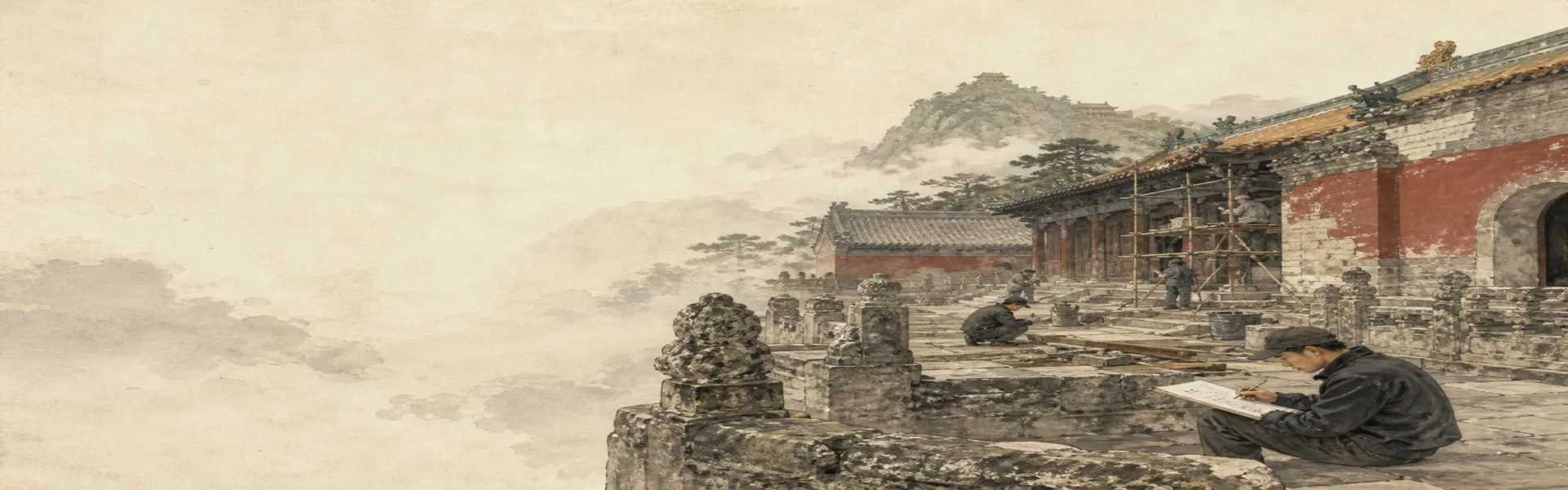
Visitors who have read about a fifteenth-century imperial building programme sometimes arrive expecting a fifteenth-century site, and are disconcerted to find bright paint, new statues and fresh stone. This page sets out honestly what is old, what is not, what happened in between, and why extensive rebuilding is the normal condition of Chinese religious architecture rather than a scandal.
The categories
It helps to sort what you see into five groups, because lumping them together produces either false disappointment or false credulity.
First, genuinely early fabric of the highest importance: the gilded bronze hall on the summit, cast and assembled in the early fifteenth century; the stone hall on the southern cliff, earlier still and of the Yuan period; and the earlier Yuan bronze hall now standing below the summit. These are exceptional survivals by any international standard.
Second, authentic Ming timber, repaired over the centuries in the normal way: above all the principal hall of the great mid-mountain palace, one of the more significant surviving Ming halls in China. Timber buildings of this age always contain replaced members; that does not make them modern.
Third, extensive historic masonry: terraces, platforms, balustrades, column bases, paving, drainage, retaining walls, stairways, gateways, the summit enclosure wall, and the inscribed steles with their stone animal bases. This is quantitatively the largest category of original fabric on the mountain and the least noticed.
Fourth, buildings of mixed and later date: halls rebuilt under the Qing or in the twentieth and twenty-first centuries, often on original platforms and to traditional form, with modern paintwork, tiling, joinery and fittings.
Fifth, outright modern reconstruction and new work: replacement statues, reconstructed halls where the original was destroyed, rebuilt gateways, and the railings, paving, lighting, signage and safety works that a visited site requires.
What destroyed things
The losses were not random, and naming the causes explains the pattern of what survives.
Fire is first and by a wide margin. Timber buildings containing lamps and burning incense, on a mountain where water is hard to bring to a fire and access is slow, burn. The mountain lost halls to fire in every period of its history, including a great complex at the foot in the eighteenth century and the principal hall of the cliff complex in the 1920s, and a further significant loss at the foot as recently as 2003. Where the builders anticipated this, using stone and bronze, the buildings are still standing.
Second, the withdrawal of funding. The Qing court's religious patronage went substantially elsewhere, and a building stock designed for imperial maintenance cannot be kept up on local devotion alone. Most decay on this mountain is not dramatic; it is deferred maintenance accumulating over generations.
Third, war and disorder, particularly at the end of the Yuan and during the Republican period, when buildings were damaged, requisitioned and occupied.
Fourth, water: flooding on the low ground near the river, and the constant attrition of rain and damp on timber everywhere else.
Fifth, the mid-twentieth century, which removed the monastic economy through land reform and then, during the Cultural Revolution period, destroyed images, scriptures, ritual implements and archives, dispersed the clergy and put buildings to secular use.
The distinction that matters most
If you take one idea from this page, take this: immovable heritage survived far better than movable heritage.
The buildings, platforms, walls and steles are substantially present. What was inside them very largely is not. Statues were destroyed and have been replaced. Scriptures, ritual manuals, altar furnishings, paintings, hanging scroll sets, musical instruments and administrative archives were lost in quantity. So was something harder to categorise: the human transmission of liturgical knowledge, interrupted for a generation, which cannot be reconstructed from a photograph the way a roof can.
This is why a Wudang hall can be architecturally authentic and, in terms of its contents, almost entirely new. It is also why the surviving inscriptions and steles matter so much. Stone outlasted both the halls and their contents, so the documentary record of this mountain is in better condition than the mountain.
What the record lets us check
It is fair to ask how anyone knows which parts are which, and the answer is better documented here than at most Chinese sites.
There is a substantial Ming gazetteer of the mountain compiled in the 1430s by an official appointed to it, which lists buildings, their ranks, their staff and their endowments, so we know a great deal about what existed shortly after the great programme. There are inscriptions on stone throughout the site, standing where they were erected, recording construction, repairs, donors and dates. Later gazetteers, repair records and Qing pilgrimage accounts continue the sequence. For the modern period there are archaeological reports, measured surveys, and the documentation generated for heritage listing and monitoring.
Dendrochronology, materials analysis and structural survey can date timbers and mortars directly, and where such work has been published it settles questions that visual inspection cannot. Where none of that exists, judgements rest on style, technique and comparison, which are useful but weaker. This page reflects those differing levels of confidence, which is why some statements here are firm and others are hedged.
How restoration is judged
Modern conservation practice at a World Heritage site works to principles that are worth knowing, because they explain what you see.
Interventions should be documented and justified. Original fabric should be retained wherever possible rather than replaced. New work should generally be distinguishable from old on close inspection, so that a visitor or a later researcher can tell evidence from interpretation. Reconstruction of what has been entirely lost is treated with caution, and where it is done it should be acknowledged as reconstruction. Reversibility is preferred.
These principles frequently conflict with other legitimate demands: religious use wants functioning halls and worshipped images, tourism wants access and buildings that look complete, and a community living on a site wants somewhere habitable. Every scaffolded hall, closed door, new-cut stone and freshly painted beam is a decision made among those pressures. There is no neutral answer, and the honest position is to notice the decisions rather than to assume either authenticity or fakery.
How to tell on site
You can assess most of this yourself with a few habits.
Judge by material first. Bronze and dressed stone are likely to be old. Weathered timber with visible, worn joinery may well be old. Uniform machine-cut stone with regular tooling striations, bright even paint, crisp sharp carving and glossy new tile are almost certainly recent.
Look for horizontal lines where old work meets new, especially on walls rebuilt above original bases; the change in colour, weathering and mortar is usually plain. Look at statues sceptically, since most are modern. Look at column bases rather than columns, because bases survive when timber does not. Read inscriptions and dates where they exist, and note that a stele recording an eighteenth-century repair is itself evidence that the building needed one. And treat signage as helpful but not final; it is generally honest about reconstruction, but it is written for a general audience.
A reasonable attitude
Two views are worth holding at once, rather than choosing between them.
The documentary view says that a rebuilt hall is a new building resembling an old one, and that authenticity resides in surviving physical fabric. That view underlies modern conservation and is a real intellectual achievement, and it is why you can trust the distinction between old and new stone at a properly managed site.
The traditional Chinese view says that a hall rebuilt on its original platform, to its original form, continuing its original use, is the same hall — that identity resides in place, function and form rather than in specific timbers. This is not an excuse for carelessness; it is a coherent position, and it is the view under which this mountain was maintained for most of its existence. On that account the repeated rebuilding is not a series of losses but evidence of continuous care.
The useful attitude for a visitor is to know which of the five categories you are standing in front of, and to let the genuine survivals impress you more because you know how rare they are. Disappointment at reconstruction usually comes from expecting a European ruin. Wudang is not a ruin; it is a place that has been continuously repaired, and its history of repair is part of what it is.
Sources and limits. Attributions of date and authenticity follow the mountain's gazetteers, published architectural and conservation studies, and inscriptions on site; they vary building by building, are sometimes disputed, and are revised as investigation continues. The account of twentieth-century losses is deliberately plain but summary, and detailed local documentation of that period is uneven. Conservation policy, current works and the condition of individual buildings change continually, and nothing here describes present-day access.
Key points
Sort what you see into five categories: exceptional early survivals, authentic Ming timber, historic masonry, later rebuilding, and modern reconstruction.
The outstanding survivals are the summit bronze hall, the Yuan stone hall on the cliff, the earlier Yuan bronze hall, and the great Ming timber hall mid-mountain.
Historic masonry is quantitatively the largest category of original fabric and the least noticed.
Fire was by far the greatest destroyer, followed by the loss of imperial funding, war, water and the mid-twentieth century.
Immovable heritage survived far better than movable: buildings largely remain, contents and liturgical transmission largely do not.
Modern practice documents interventions and keeps new work distinguishable, which conflicts with religious use and tourism.
Judge age by material, look for the line where old meets new, be sceptical of statues, and read column bases rather than columns.
Hold both views: the documentary one that locates authenticity in fabric, and the traditional one that locates it in place, form and continuing use.