Chinese Calligraphy Paper: Xuan, Sizing and the Life of a Sheet
中国书画纸:宣纸、施胶与纸张的一生
Paper is not a neutral background in Chinese calligraphy. Fibre, sheet formation, thickness, surface finishing and sizing all affect how quickly water and ink enter the sheet, how far a wash spreads and how a brush edge appears. Once written or painted, the sheet may also be trimmed, backed, joined and mounted, so the paper seen in a museum is both a working surface and part of a constructed object.
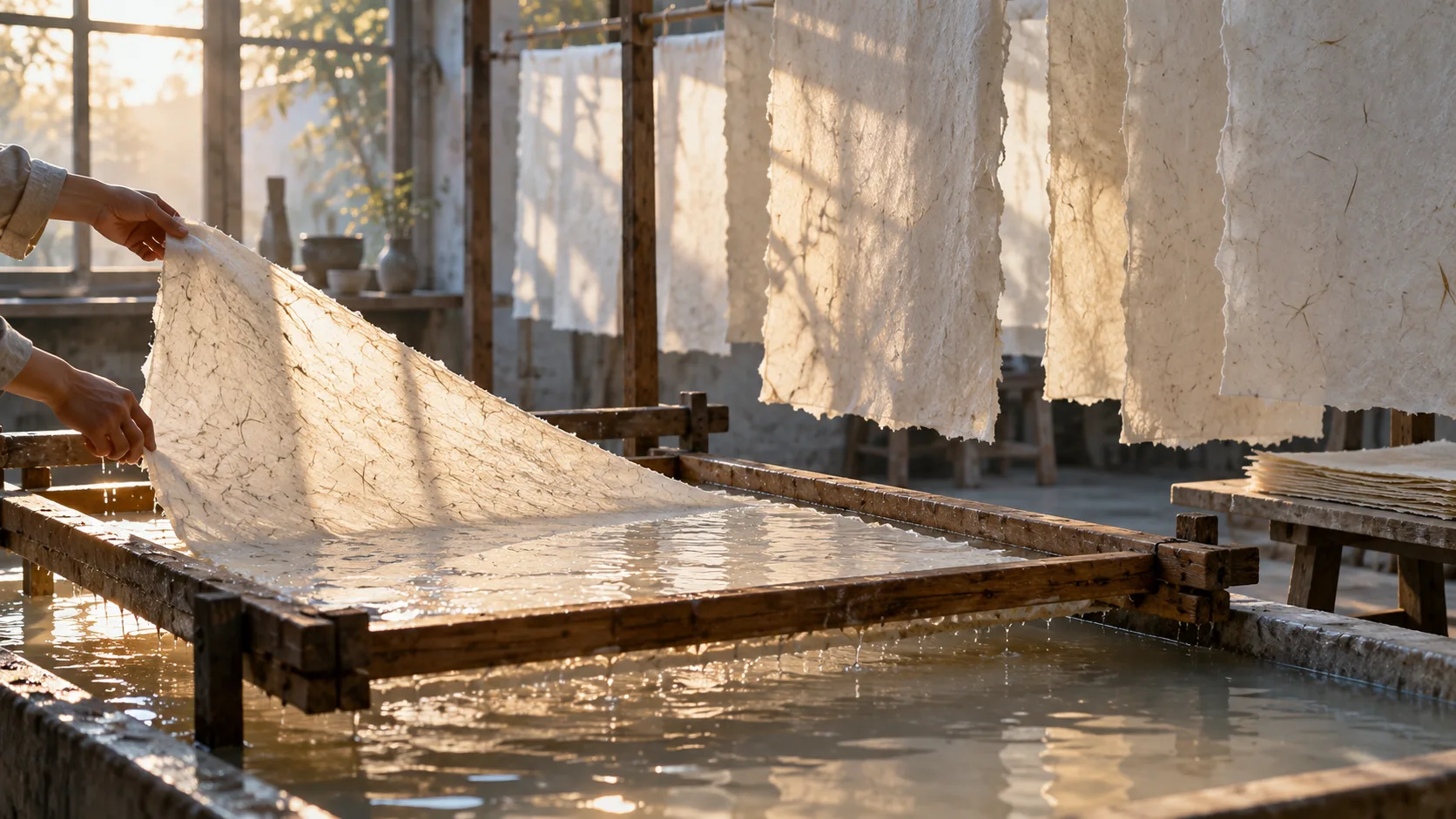
This guide extends the practical introduction to paper in the Four Treasures of the Study. It does not offer a visual shortcut for identifying old papers. Instead, it shows how to read a catalogue term, compare modern practice sheets and follow a support through making, use and mounting. For the wider relationship among brush, ink, paper and stone, begin with Chinese Calligraphy.
Xuan is a place-linked craft, not a synonym for paper
One celebrated tradition belongs to Jing County
UNESCO inscribed the traditional handicrafts of making Xuan paper in 2009. Its account locates the craft in Jing County, Anhui, and describes a long sequence using the bark of blue sandalwood (Pteroceltis tatarinowii) and rice straw. Steeping, washing, fermenting, bleaching, pulping, sheet formation, drying and cutting are among more than one hundred steps, and the complete process can extend beyond two years. These details describe a named regional tradition; they should not be applied to every pale sheet sold for calligraphy.
Chinese papers use many fibres and treatments
A conservation study from Hong Kong’s Leisure and Cultural Services Department compares papers made from hemp, mulberry, paper mulberry, rattan, bamboo, straw and mixed fibres. Its analysis of contemporary Chinese papers found that sheets with similar colour and texture could differ in fibre composition, fillers, sizing and ageing response. “Rice paper” is therefore an unreliable technical label: a seller’s name, a museum’s material field and a scientific fibre analysis answer different questions. Record the exact wording and avoid turning appearance into composition.
Historical names need object-specific evidence
Famous names may refer to places, workshops, grades or later emulations rather than one timeless recipe. In a 1063 letter, calligrapher Cai Xiang asks for Chengxintang paper of a particular width, thickness and firmness. The National Palace Museum’s catalogue record for the letter identifies the support simply as paper and explains the prestige attached to the name. The document is evidence for connoisseurship and procurement in the Northern Song; it is not a recipe or proof that a modern sheet bearing that name is identical.
Sizing changes the working surface
Unsized and sized are broad working categories
In studio language, shengxuan usually denotes an absorbent, unsized or lightly treated sheet, while shuxuan denotes paper whose sizing reduces absorption. Half-sized papers sit between them. The Hong Kong study notes that Xuan papers may be supplied fully sized, half sized or unsized, and laboratory examination found both surface and internal sizing agents in different samples. These are useful starting terms, not guarantees of identical behaviour across brands, batches, ages or storage histories.
Absorption is an interaction, not a ranking
On a more absorbent sheet, water can travel through the fibre network before the brush leaves the surface, producing soft edges, blooms and tonal transitions. A more strongly sized sheet can hold a crisper boundary and allow slower layering. Neither response is inherently superior. Ink concentration, water load, brush pressure, speed, room humidity and the sheet itself act together. The ground ink introduced in Chinese inksticks and the working surface described in Chinese inkstones complete the same material system.
Test a labelled sample before a finished work
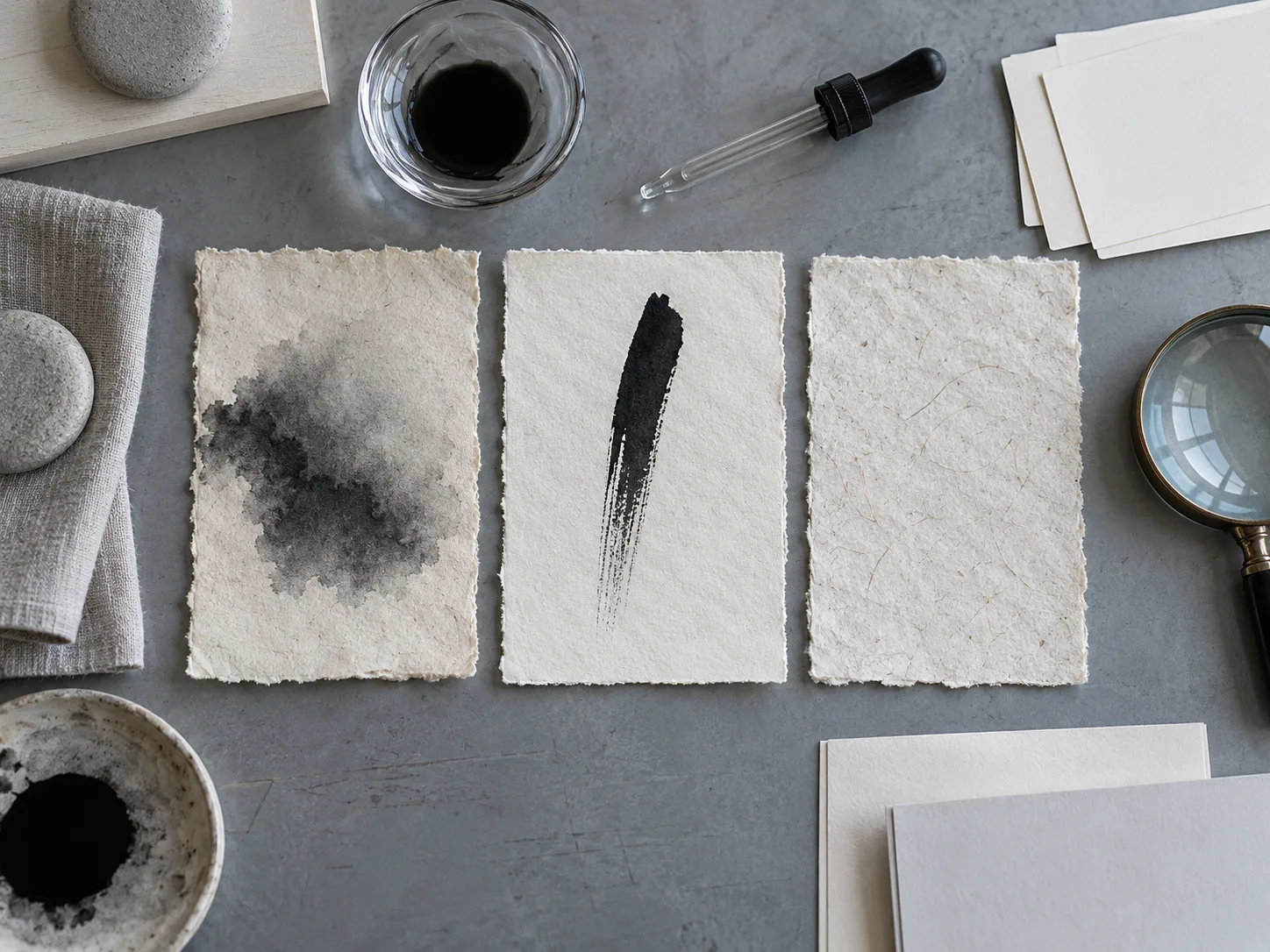
For modern practice paper, write the product name, seller, date and any fibre or sizing information on a separate sleeve. Cut small samples only from paper you own. With the same brush and ink, place one dry line, one water-rich line and one small wash on each sample; observe edge spread, show-through, drying and the feel of the brush without declaring a universal winner. Do not perform this test on historical, borrowed or collection material. For how pressure and movement shape a line, continue with brush technique and the living line.
A sheet can become a mounted object
The visible paper may be only one layer
A calligraphy sheet can be joined to borders, linings, backing papers, rods or album leaves. These additions create the format through which the work is handled and viewed, and they may come from more than one period. The image-bearing sheet, the mount and later repairs should therefore be described separately. A guide to reading a Chinese hanging scroll follows those relationships across the complete object.
Mounting history changes physical behaviour
The British Museum’s account of treating a Ming painting describes temporary facing and layers of Xuan paper used by professional conservators during remounting. A Library of Congress case study of an 1842 Chinese scroll map shows the other side of that history: strong linings and adhesive had made a thin paper support rigid over time. These are conservation records, not home instructions. They demonstrate why a mount’s materials and date belong to the work’s biography.
Contemporary artists can reorganise the sheet
Xuan paper is not confined to copying old formats. The Metropolitan Museum’s record for Wu Jian’an’s 2016 500 Brushstrokes #10 identifies ink, paper cut and collage on Xuan paper. The work uses cut and layered paper as structure as well as support. A museum catalogue may therefore record paper, ink, cutting, collage and conservation technique together; “work on paper” should not erase the way the sheet was transformed.
Use a six-pass museum method
Begin with the record, not the colour
Note the institution, accession number, title, date wording, dimensions, support term, media, format, inscriptions, seals, provenance, conservation history and access date. Preserve distinctions such as “paper,” “Xuan paper,” “bamboo paper,” “album leaf” and “hanging scroll.” A cream colour, visible fibre or deckled edge does not by itself establish fibre, origin, age or quality.
Move through six questions
- Identity: What exact material and format terms does the catalogue use, and which remain uncertain?
- Making: What fibres, water, pulping, sheet formation, drying or finishing are documented for this paper?
- Surface: Is sizing, coating, burnishing, colour, ruling or another treatment recorded?
- Marks: How do ink, colour, pressure, cutting, seals, inscriptions and wear interact with the sheet?
- Mount: Which borders, joins, linings, backing papers or repairs belong to later stages?
- History: Which makers, users, owners, transfers and conservation events are supported by evidence?
Practise on known sheets; protect historic ones
Use labelled contemporary samples to learn how a surface responds, and store unused sheets flat, clean, dry and protected from strong light according to the supplier’s guidance. Never wash, humidify, flatten, peel, resize or remount an old work yourself: water and pressure can move ink, disturb seals, alter fibres and erase evidence from earlier mounting. Seek a qualified paper conservator for collection objects. To compare another process in which paper receives and preserves an image, read Chinese ink rubbings.