How to Read a Chinese Handscroll: Sequence, Colophons and Seals
怎样观看中国手卷:展开顺序、题跋与印章
A Chinese handscroll is not simply a long painting reduced to one panoramic image. It is an object encountered in sequence: a viewer opens a manageable section, follows the image, rolls the viewed portion, and continues. The format makes time, touch, pace and memory part of looking.
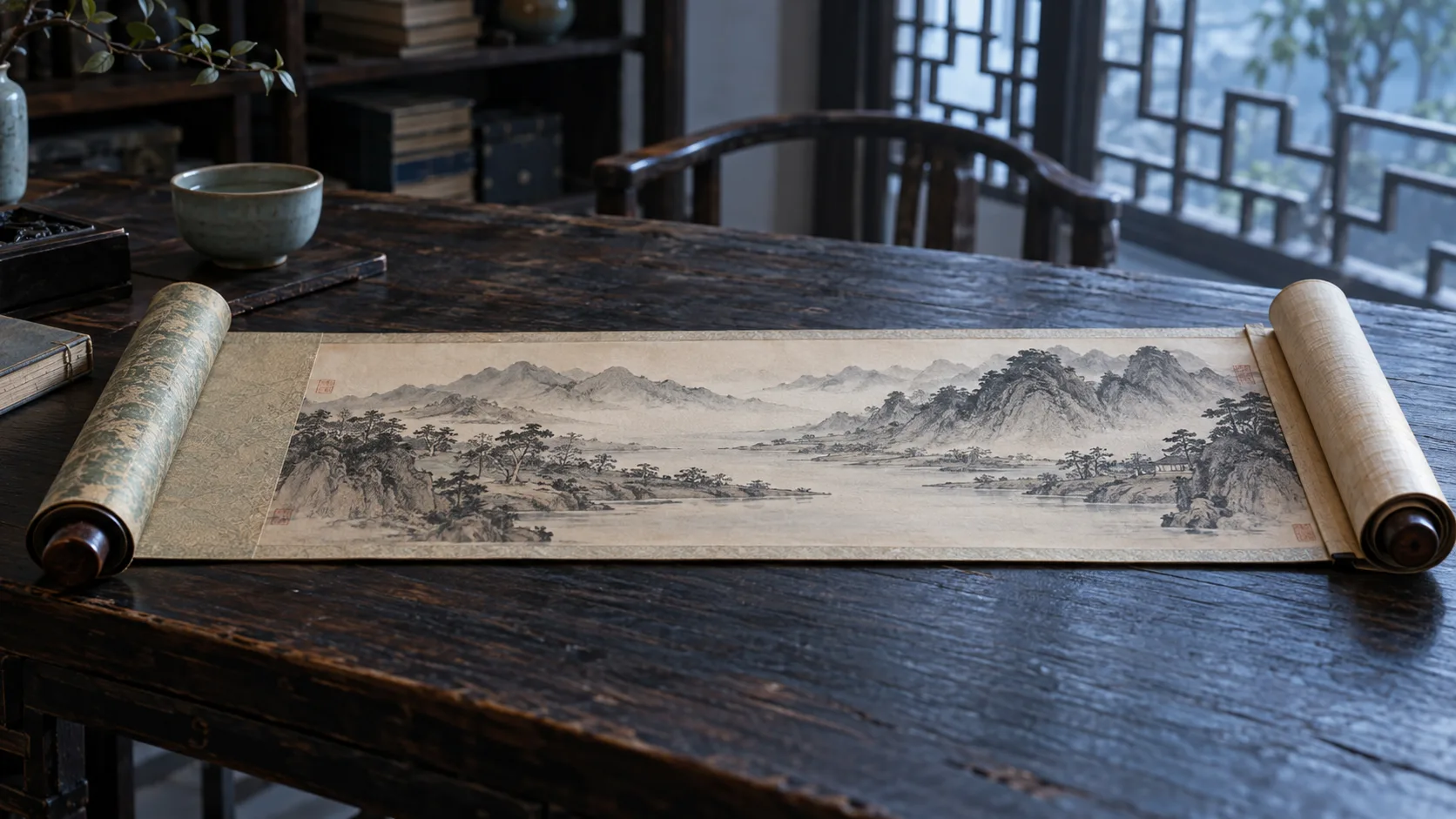
This guide explains how to distinguish the painted core from its mounting, inscriptions, colophons and seals. It also shows why those later additions can record an object’s social life without automatically proving an attribution or date. For broader foundations, begin with Chinese Painting: Materials, Formats and Ways of Looking.
A picture experienced in time
Handscroll, hanging scroll and album are different experiences
A hanging scroll is displayed vertically and can organize a single field of vision. An album offers separate leaves. A handscroll is horizontal, normally stored rolled and viewed on a table. Its length may hold a journey, a sequence of episodes, calligraphy or a sustained change of landscape. Format is therefore part of meaning, not a neutral frame. The Metropolitan Museum of Art’s introduction to Chinese handscrolls emphasizes this intermittent, intimate mode of viewing.
Open from the right and advance section by section
In the conventional Chinese handscroll, the viewing path proceeds from right to left. Only a shoulder-width section is exposed at one time; the right side is rolled as the left side opens. This prevents the whole work from becoming a static panorama. The Smithsonian’s handscroll teaching guide maps this order and names the principal parts of the mounted object.
Notice pauses, thresholds and changing distance
Blank paper or silk may act as mist, water, sky, interval or silence. A bridge, doorway, turn in a river or shift in scale may mark a transition between episodes. Do not rush to identify every motif. First notice what enters the visible section, what disappears, and how the imagined viewpoint moves. The site’s guide to reading shanshui painting develops this spatial vocabulary.
Read the object in layers
The mounting is part of the present object
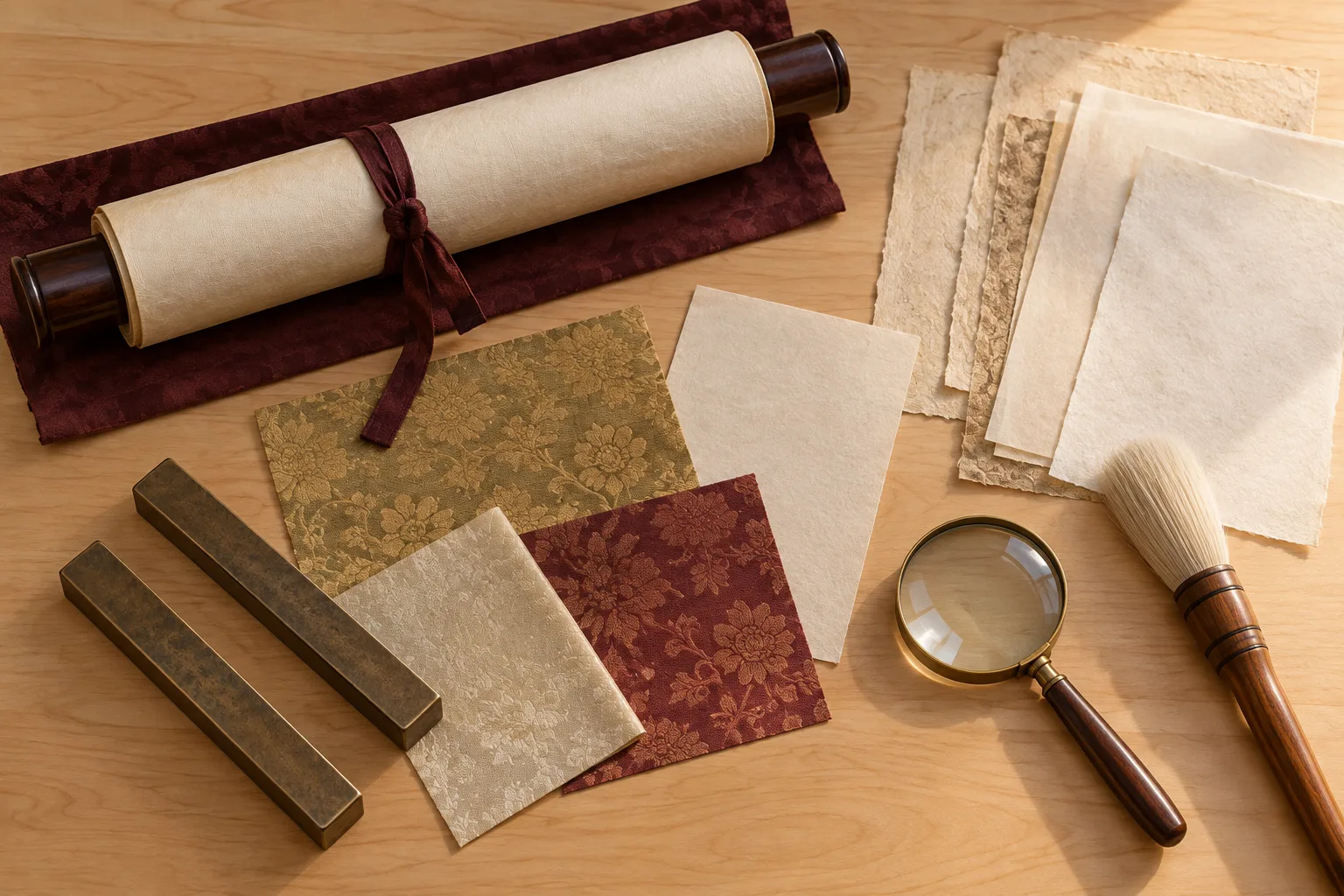
Silk borders, backing papers, cords, roller ends, a title slip and a frontispiece protect and organize the work. They are not necessarily contemporary with the painting. A scroll may have been repaired or remounted several times, so differences in cloth, paper, joins and dimensions may belong to its later care rather than its original design.
Separate the painted core from artist inscriptions
Begin with the image or calligraphic core. Then locate signatures, dates, dedications and seals associated with the maker—if present. Their absence does not by itself make a work anonymous, and their presence does not settle authorship. Brushwork, materials, documented provenance and comparison with reliable works must be considered together. See Ink and Brush in Chinese Painting for a closer look at marks and materials.
Colophons and collector seals extend the story
Later owners, viewers and scholars could add written responses, authentication opinions or poems to the mounting, followed by personal seals. The result may preserve encounters across centuries. The Met’s study of a fourteenth-century landscape and its colophons also demonstrates the necessary caution: some texts may have been attached later or written for another painting.
Use seals and inscriptions as evidence, not decoration
What later marks can document
When a seal or colophon is securely identified, it may help trace ownership, circulation, viewing networks or the history of an attribution. Position matters: a seal across a join, on the painted core or on a later mounting does not carry the same evidential weight. Museum records often distinguish the artist’s seals from collectors’ and imperial seals.
What they cannot prove alone
A famous collector’s seal does not prove that every older attribution is correct. Seals can be copied, repeated, transferred or misread; colophons may express admiration, memory or opinion rather than firsthand knowledge. Treat each mark as a claim to investigate. The Met’s object-based painting guide shows how inscriptions can add precise context while still requiring comparison with the object itself.
A handscroll can be a composite history
Painted sections, title panels and colophons may have different dates and may have been reordered or remounted. The British Museum notes that the Admonitions Scroll was separated and mounted onto panels in the early twentieth century for conservation and display. That history changes how the object is encountered today; it should not be hidden behind a single artist-and-date label.
A practical six-step viewing method
Before viewing, read the museum record
Record the title, attributed maker, date range, medium, dimensions and mounting format. Note whether the catalogue separates the painted core from inscriptions and colophons. If the page offers a high-resolution viewer, learn its direction and section divisions before zooming into details.
Move through six questions
- Format: Is it a true handscroll, a later panel mounting, an album fragment or a digital reconstruction?
- Sequence: What appears in the first visible section, and how do paths, water, figures or blank space guide the eye leftward?
- Transitions: Where does scale, viewpoint, season, architecture or narrative rhythm change?
- Layers: Which parts are image, maker’s inscription, later colophon, seal, border, backing or repair?
- Evidence: Which names and dates are established by museum research, and which remain traditional attributions or later opinions?
- Afterlife: How have ownership, remounting, conservation and digital display changed what can now be seen?
Use digital surrogates; protect fragile originals
High-resolution digital scrolls are excellent for repeated comparison because they allow the whole sequence and minute details to be revisited without stressing the object. Do not practise on an old or valuable scroll. The Smithsonian’s safe-handling resources show why trained procedures matter. For a next reading path, compare museum records through Chinese Painting Masters: A Guided Path and bring the same layered method to inscriptions in Chinese Calligraphy.