How to Read a Chinese Hanging Scroll: Vertical Space, Mounting and Display
如何阅读中国立轴:纵向空间、装裱与陈设
A Chinese hanging scroll is both an image and a flexible object made to be suspended, rolled and stored. Its vertical field can meet the eye nearly at once, yet the gaze may still move through height, depth, blank space, brushwork, inscriptions and mounting in many directions. It should not be read as a handscroll turned upright.
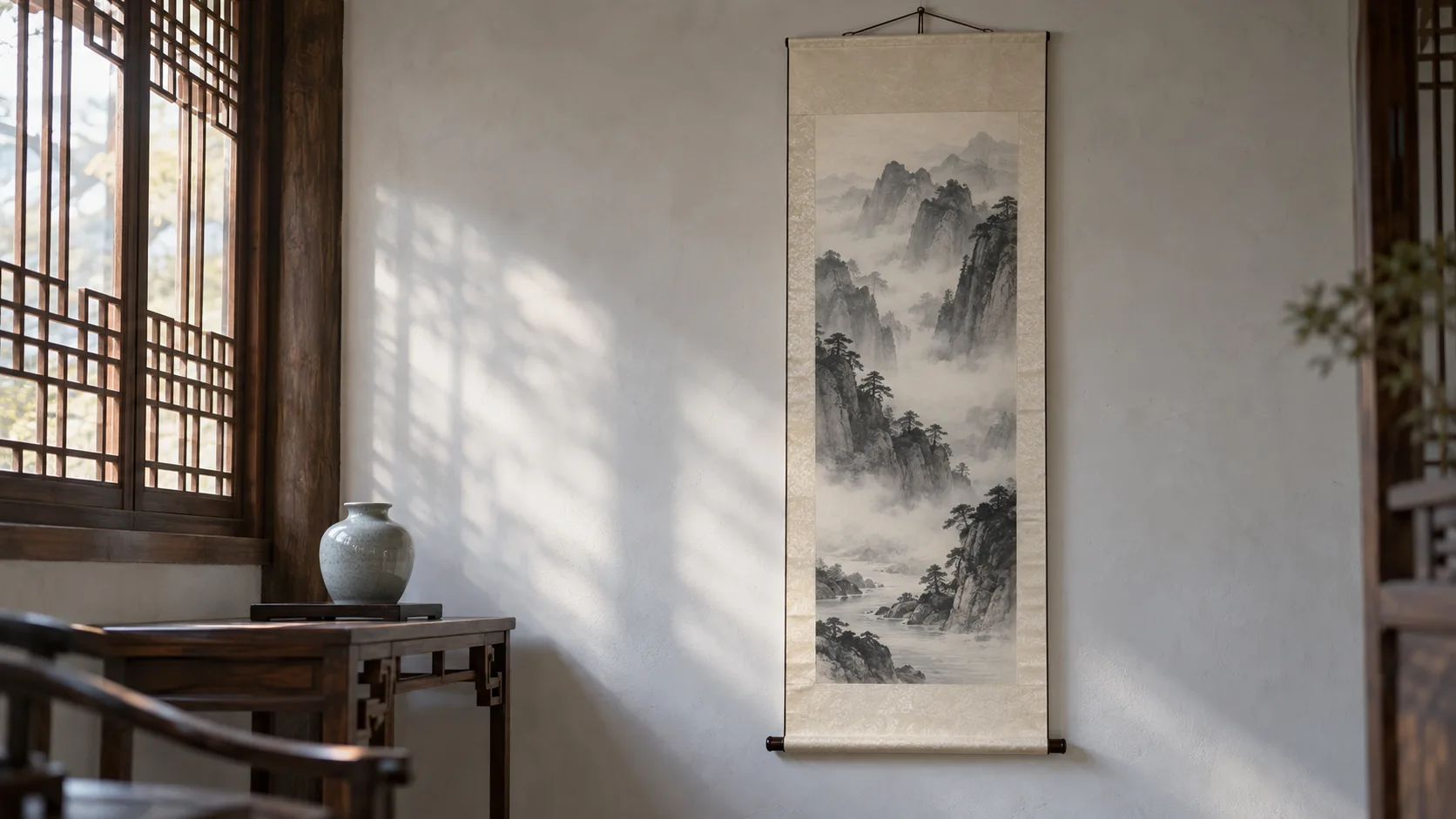
This guide offers an object-led way to look. It separates what belongs to the painted or calligraphic work from the support that now presents it, and it treats later mounting, conservation and display as part of the object’s history. For the wider context, begin with Chinese Painting: Materials, Formats and Ways of Looking.
Recognize the format before reading the image
A vertical field, not a fixed viewing route
The Metropolitan Museum of Art’s overview of East Asian painting formats defines the hanging scroll as a format for vertical compositions. Unlike a handscroll opened section by section, it is suspended for viewing. This does not impose one compulsory top-to-bottom path: a dominant peak, face, inscription, colour or void may attract attention first, and the eye can return across the field.
The mounting makes suspension and rolling possible
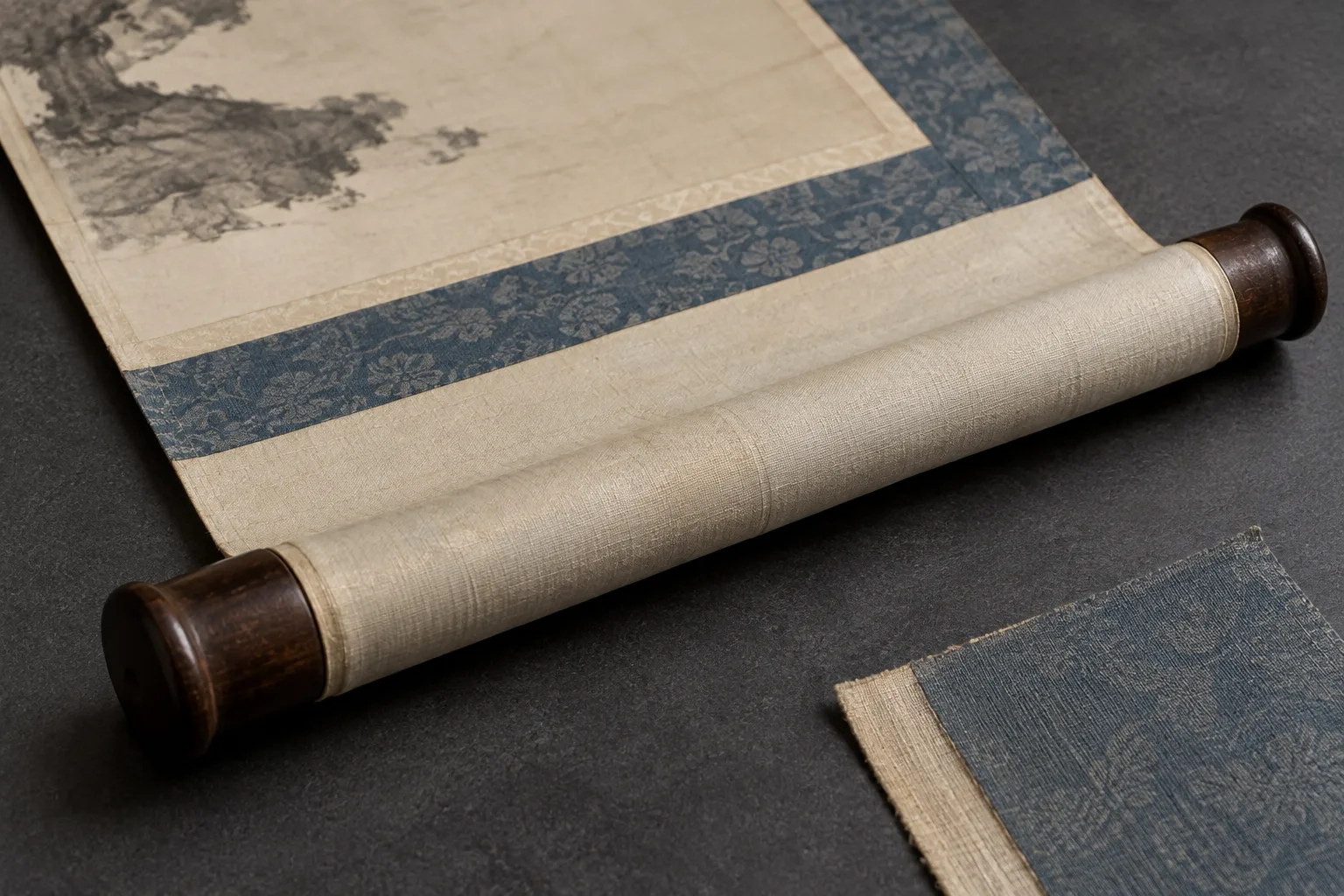
The image is normally backed and surrounded by mounting materials. Decorative silk borders frame it; a wooden rod at the bottom adds weight and serves as the core for rolling; a narrow strip and cord at the top provide suspension. Names and arrangements vary with place, period and mounting tradition, so identify only parts that the object record or close observation supports. The handscroll guide shows how a related mounting answers a different kind of viewing.
Display was often temporary
Portable East Asian paintings were not necessarily intended to remain on a wall indefinitely. The Met notes that they were shown for occasions and then stored. Its care and handling manual explains that rolling, light, humidity and repeated handling can affect both painting and mounting. A scroll’s ability to disappear into storage is therefore part of the format, not an inconvenience to modern display.
Read the vertical composition
Begin with the whole silhouette
Stand back, or reduce the digital image, until the entire scroll is visible. Record the proportions of the image and the overall mounting. Notice the largest dark mass, the widest area of open paper or silk, and the relation between the upper and lower zones. This first pass prevents a compelling detail from becoming the whole composition.
Trace anchors, intervals and changing scale
Move through the image without assuming that height equals chronological sequence. In Xie Shichen’s Spring Morning in the Mountains, the Met identifies the central monolith as a vertical anchor while clouds obscure lower portions of the peaks. The eye can connect small scholars, trees, torrent, mist and mountain through changing scale. The site’s guide to shanshui develops these spatial questions without turning every landscape into one formula.
Let blank space do several kinds of work
Unpainted or lightly worked areas may separate forms, open atmosphere, suggest water or cloud, hold an inscription, or expose the support itself. Describe where the space lies before assigning it a universal symbolic meaning. An apparent void can be compositional, material and atmospheric at the same time.
Separate the work from its changing object history
Image dimensions and overall dimensions tell different stories
Museum records may give measurements for the image, the full mounting and the roller knobs. The Met’s record for Shi Lu’s Mountain Rain is Coming, for example, distinguishes all three. Record those differences: a tall present object includes more than the painted field, and a later mount should not be silently dated to the moment of painting.
Inscriptions and seals are evidence, not automatic proof
A poem, signature, dedication or seal may help identify a maker, recipient, owner or viewing history, but famous names and marks can be copied, misread or added later. First locate each element—within the image, across a join or on the mounting—then consult the catalogue’s attribution and provenance. Compare the visible marks through Ink and Brush in Chinese Painting rather than treating a seal as a shortcut to authenticity.
Remounting can change how separate works meet
The Smithsonian records two album leaves by Bada Shanren now mounted together as a hanging scroll. Their present vertical relationship is real, but it is not the same as turning leaves in an album. Other Smithsonian records describe Chinese paintings as a hanging scroll mounted on a panel. Current format, earlier format and original image should therefore be recorded separately. Compare the different rhythm of a bound sequence in the painting-album guide.
Use a six-pass viewing method
Read the record before making a claim
Note the title, attributed maker, date or range, medium, image dimensions, overall dimensions and current format. Preserve qualifiers such as “attributed to,” “formerly attributed to,” “mounted on panel” or “album leaves mounted as a hanging scroll.” They describe the evidence and the object’s history.
Move through six questions
- Format: Is the object a hanging scroll, a painting mounted on panel, a remounted fragment or a digital reconstruction?
- Whole: What are the proportions, dominant masses and largest intervals when the full scroll is seen?
- Path: Which forms, changes of scale, edges and empty passages redirect the eye?
- Layers: Which parts are image, inscription, seal, border, backing, roller, cord, repair or later mount?
- Evidence: Which names, dates and provenances are established, and which remain traditional or revised attributions?
- Afterlife: How have remounting, storage, conservation, photography and exhibition changed the present encounter?
Use museum surrogates and leave handling to trained staff
High-resolution images and catalogues allow repeated comparison without exposing a fragile object. The Smithsonian’s safe-handling resources are made for professional awareness; they are not permission to practise on an old scroll. Do not hang, unroll, flatten, repair or clean a valuable work without a qualified conservator. The safest next step is comparative looking, not physical intervention.