Painting and Taoist Cultivation: Images, Ideas and Practice
绘画与道家修养:图像、观念与实践
Painting is often called a Taoist practice, but the phrase can hide several different relationships. A temple mural, a landscape discussed with Daoist vocabulary and a modern session of attentive brushwork do not have the same purpose or evidence.
This guide keeps those layers distinct, then shows where they can meet. The aim is neither to claim every Chinese painting for Taoism nor to deny the genuine place of Daoist religion and thought in Chinese visual culture.
1. Three connections, not one formula
The first connection is religious: images were commissioned for Daoist temples, rituals and communities. The second is interpretive: writers used terms also found in Daoist texts when discussing nature, transformation, spirit and unforced action.
The third is practical and personal. A painter may use preparation, repetition and close attention as cultivation. That can be a meaningful approach, but it does not turn the exercise into an ancient universal ritual or prove a spiritual result.
2. Painting made for Daoist settings
Daoist visual culture includes murals, hanging scrolls, portraits of sacred figures, diagrams and prints. These works served worship, ritual, teaching, commemoration and the ordering of sacred space; they were not simply private landscapes painted for self-expression.
Yongle Palace in Shanxi preserves an important Yuan-period mural programme. Its scale and coordinated imagery remind us that much religious art depended on patrons, artisans, workshop planning and shared conventions rather than a lone inspired painter.
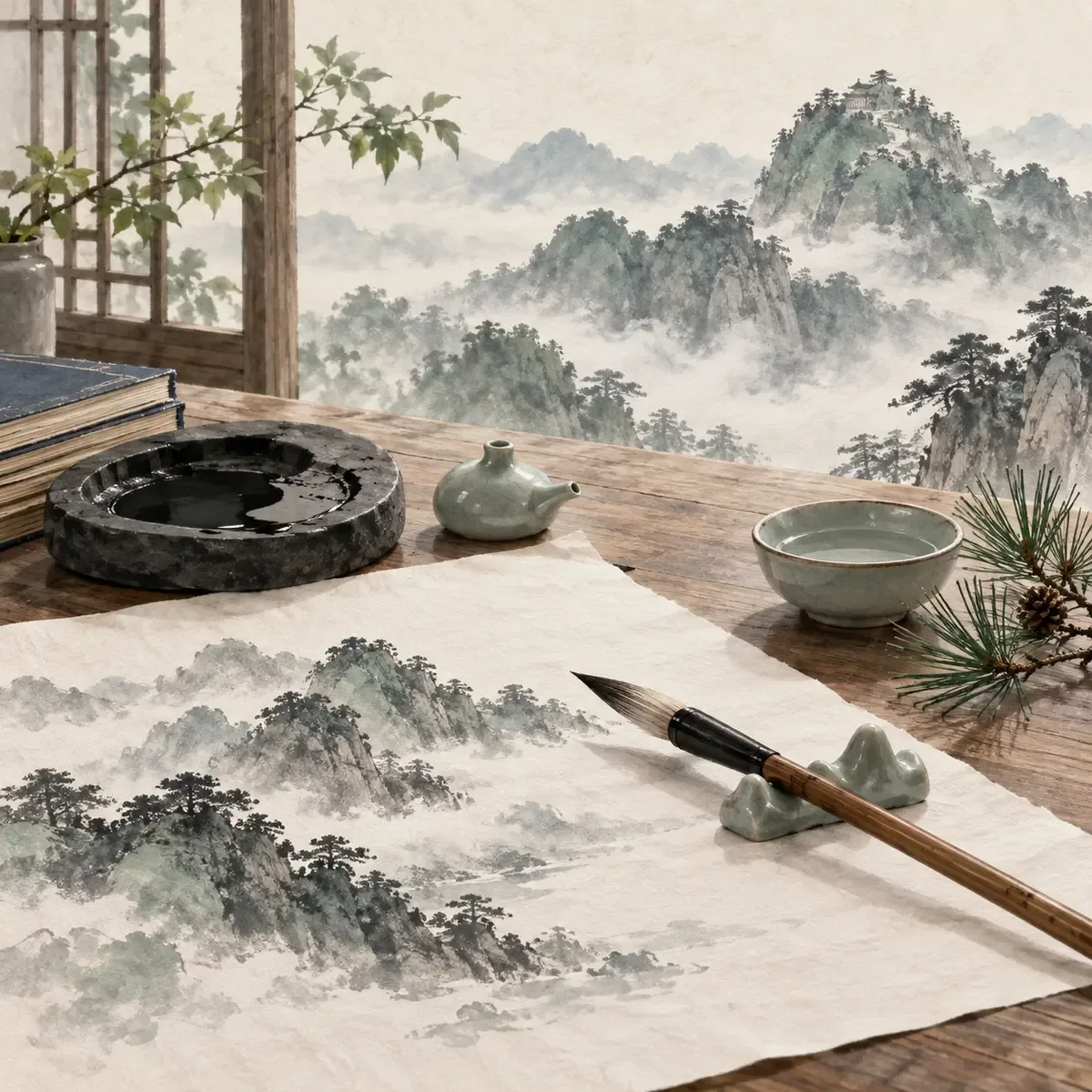
An editorial still life suggesting the material setting of reflective brush practice. AI-generated for Wudang.Org.
3. Zhenwu imagery and Wudang
At Wudang, the most important religious image is Zhenwu, also called the Perfected Warrior. Depending on period and setting, he may be shown with a sword, loose hair and bare feet, and with the tortoise-and-snake emblem associated with the north.
These features help identify an image, but iconography is not a mechanical code. Material, date, temple setting, inscription and ritual use still matter. Wudang’s surviving buildings and artworks also belong to a long history of imperial patronage, rebuilding and local religious life.
4. Daoist words in a wider critical language
Painting theory often values qualities translated as natural, self-so, vital, spirited or free from forced display. Such language can resonate with the Laozi and Zhuangzi, especially when a writer praises responsiveness over rigid control.
Yet Chinese art writing developed through overlapping court, scholarly, Buddhist, Confucian and Daoist settings. A familiar term may change meaning between texts and periods. It is safer to trace the wording and context than to label an entire style “Taoist.”
5. What the Zhuangzi painter story can—and cannot—do
One Zhuangzi story tells of painters summoned by a ruler. While others wait formally, one returns to his room, loosens his clothing and sits at ease; the ruler recognizes him as the true painter. Later readers connected the scene with freedom from self-conscious display.
The anecdote is a prompt for interpretation, not a biography of an artist or a licence for bad conduct. It asks what kind of readiness permits action without performance. It does not say that skill, responsibility or respect for other people no longer matter.
6. Unforced work still has a method
Chinese critics sometimes used yi, often translated as untrammelled or逸, for work that exceeded familiar standards. Its position and meaning varied across writers; it was never a single timeless rule placing roughness above accomplished technique.
Apparently effortless brushwork usually rests on material knowledge and repetition. Copying a model, testing ink and practising a stroke can support freedom rather than oppose it. Naturalness is better treated as a quality that may emerge from practice, not a style to imitate on command.
7. What brush practice can train
Working with brush, ink and absorbent paper makes timing and hesitation visible. The painter must notice moisture, pressure, direction, spacing and the relation between one mark and the whole sheet. These are observable demands of the medium.
Repeated practice may develop attention, patience and tolerance for imperfect results. Whether a painter understands that work as Daoist cultivation depends on intention, teaching and context; the material alone does not make the claim for them.
8. A responsible modern approach
Begin by naming what you are doing: studying brush control, copying a historical model, making an artwork or using painting as quiet reflection. Do not present a short exercise as lineage training, therapy or a guaranteed way to regulate qi.
Use materials within your ability and budget. Bottled ink is acceptable; grinding an inkstick is an optional preparation, not a test of authenticity. Credit the works you study, distinguish a copy from an original composition and follow a teacher’s safety guidance for unfamiliar pigments or tools.
9. A ten-minute brush exercise
Choose one simple form from direct observation or a clearly identified study model. Spend a minute looking before painting. Test wet and dry marks on scrap paper, then make five deliberate strokes while noticing where the brush accelerates, catches or runs out of moisture.
Pause without correcting the sheet. Compare intention with result, choose one variable to change and try again. The exercise is not a test of calmness or talent; its value lies in making attention, decision and consequence easier to see.
10. Read the object before the philosophy
When viewing a painting, first identify its format, material, date, attribution and original setting. Then observe composition and brushwork. Only after that should you test a Daoist reading against inscriptions, subject, documented use and the language of its period.
For chronology and institutions, continue to Origins and History of Chinese Painting. For materials, use Ink and Brush in Chinese Painting; for the wider subject map, return to Chinese Painting, and compare philosophical terms in Dao.