Chinese Fan Painting: Shape, Brushwork and the Art of the Small Format
中国扇面书画:形制、笔墨与方寸之美
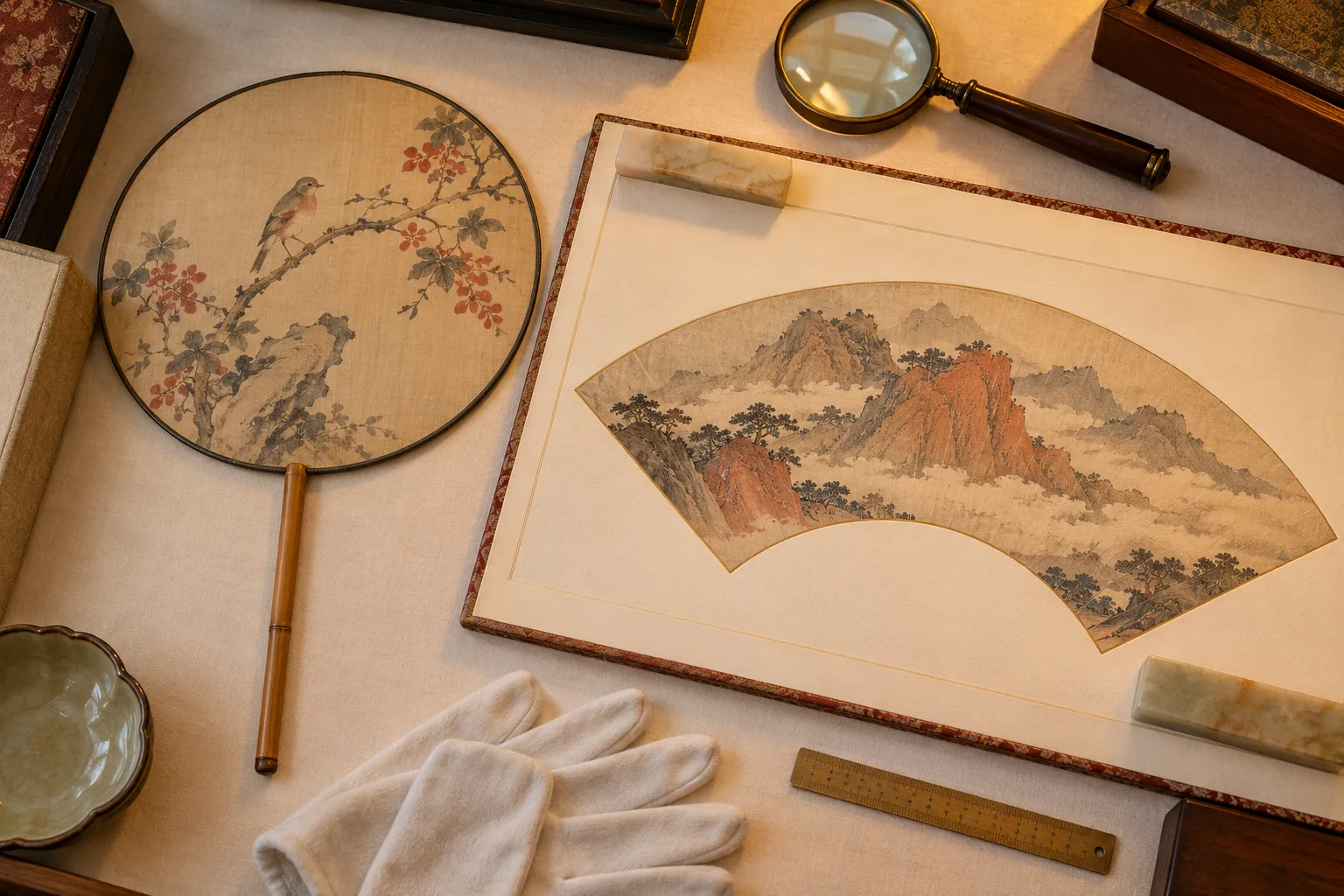
A Chinese painted fan can be several things at once: an object that moved air, a support for brushwork, a portable social gift, and—after its working life—a detached leaf mounted for study. Reading it well begins by asking what survives now. A complete fan, a fan-shaped painting and an album leaf cut from a fan are related, but they are not interchangeable.

The format sits where Chinese painting meets Chinese calligraphy. Its small scale rewards economy, while its curve, folds and ribs make every placement consequential. The shape is not a decorative border added after the image; it is part of the image’s grammar.
Begin with the object
Complete fan, detached leaf or fan-shaped work?
First identify the current physical state. A complete fan retains its handle or folding ribs and can still be opened. A detached leaf has been removed from that structure. A fan-shaped work may have been designed for mounting from the start. Museum records often describe folding-fan paintings as “mounted as an album leaf,” a phrase that preserves both the original function and the later format.
Round and folding formats
Traditional round or oval silk fans present a continuous field held in a fixed frame. Folding fans normally use paper or silk over radiating ribs, so their surface expands and contracts. The Metropolitan Museum of Art’s guide to East Asian painting formats notes that folding paper fans were probably introduced to China from Japan or Korea in the Ming period. That history should not be simplified into a neat replacement of one type by another: round and folding fans continued as different objects with different uses.
Material directs the brush
Silk, plain paper, gold-flecked paper and prepared decorative paper take ink and colour differently. Rib lines can resist or redirect the brush; a fold can break a wash; sizing changes absorption. These effects belong beside the vocabulary of ink and brush, because the support actively shapes what the brush can do.
Let the shape guide the eye
The arc compresses distance
A folding fan is narrow near the pivot and broad along its outer edge. Long horizontal lines cannot simply cross it as they would a rectangular sheet. Painters may bend a shoreline with the arc, stagger mountain peaks, or concentrate detail where the surface opens. In a round fan, by contrast, forms can circulate around a centre or press against the enclosing rim.
Empty space carries weight
Small formats magnify the value of an unpainted interval. A bird can face into a broad reserve; a branch can enter from the edge and leave most of the field open; mist can separate two compressed landforms. These are not gaps awaiting decoration. They establish breath, direction and scale, much as the site’s guide to birds, flowers and the Four Gentlemen explains how a few strokes can imply season and character.
Painting and writing negotiate space
An inscription may answer the painted subject, record a date or recipient, quote a poem, or simply balance the composition. It may be by the painter or by another hand. Zhu Yunming’s calligraphy on a gold-paper folding fan shows how a writer adjusted the lengths and spacing of lines to an expanding arc. Do not treat the words as a caption squeezed into leftover space: their scale, rhythm and position are visual decisions.
Read the social and historical layers
A portable work could mark a relationship
Some fans preserve a named encounter. Wen Zhengming’s View of Lake Tai, dated 1543, was made for a friend after a spring boat journey. The record connects landscape, poem, season and recipient without proving that every painted fan was a gift. Specific inscriptions matter more than a general story about “fan culture.”
Front, reverse and multiple hands
A complete folding fan has two sides, and its painting, calligraphy, signature, collector’s seals and later labels may belong to different moments. A leaf remounted flat can hide the reverse or separate originally paired sides. Read each component before assigning one author to the whole object. The site’s introduction to Chinese seals is useful here, but a seal is evidence to assess—not automatic proof.
Famous names require testing
Attribution can change. The Met catalogues Bamboo in a Spring Thunderstorm as a seventeenth-century copy after Tang Yin and explains that its inscribed 1522 date is spurious. Brushwork, calligraphy, paper, mounting, inscriptions and provenance must be considered together. An admired signature may tell us about reception and collecting even when it does not identify the maker.
Read the present object responsibly
Mounting is part of the history
Fans were often removed from their frames and preserved as album leaves. This can protect fragile painting and make viewing easier, but it changes handling, scale and sequence. The Met’s Winter Journey in the North is catalogued as calligraphy on a folding fan mounted as an album leaf. A good description records both states rather than presenting the flat leaf as timeless.
Catalogues make comparison possible
Dimensions, material, inscriptions, seals, mounting and provenance allow comparisons across collections. The Shanghai Museum’s exhibition The Perfection of Fan Painting and Calligraphy brought together examples from Northern Song round fans to modern folding fans, across landscape, bird-and-flower, figure painting and calligraphy. Such range warns against using one famous style as the definition of the entire format.
A six-pass reading method
- Name. Distinguish complete fan, detached leaf, fan-shaped painting and later album mounting.
- Map. Trace the rim, pivot, ribs or circular boundary before following the painted subject.
- Material. Identify paper or silk, surface preparation, folds, losses and repairs.
- Separate. Read painting, poem, signature, seals, reverse and labels as potentially different layers.
- Date. Separate the claimed date from the object’s assessed date and the date of its mounting.
- Compare. Use catalogued works and provenance, and retain uncertainty where evidence remains incomplete.
Fan painting compresses a large question into a small field: how does an image respond to an object’s shape, movement and social life? Looking slowly reveals that the answer lies not only in subject matter, but also in the curve of a line, the pause of an empty space, the interruption of a fold and the history of the object now before us.
Research note: This guide draws on the Metropolitan Museum of Art’s overview of East Asian painting formats and object records for works by Zhu Yunming and Wen Zhengming and a later copy after Tang Yin, together with the Shanghai Museum’s survey exhibition of fan painting and calligraphy. It uses specific catalogued objects as examples rather than treating them as universal rules.