Birds, Flowers and the Four Gentlemen in Chinese Painting
中国画中的花鸟与四君子
Flower-and-bird painting, huaniao hua, reaches well beyond the two subjects named in English. It can include insects, fish, animals, fruit and vegetables, presented as close studies, seasonal scenes, auspicious gifts or experiments in brush and ink.
This guide treats symbolism as one layer of evidence rather than a codebook. For the wider historical setting, read Origins and History of Chinese Painting; for materials and mark-making, see Ink and Brush in Chinese Painting.
1. A broad category of living subjects
Chinese catalogues and histories often distinguish figure, landscape and flower-and-bird painting, but the boundaries are practical rather than universal. A bird on a branch, a carp beneath lotus, insects among grasses or a study of vegetables may all enter the flower-and-bird category.
Scale and purpose vary just as widely. An intimate album leaf invites close viewing; a hanging scroll addresses a room; a handscroll unfolds in time; a decorated object may adapt related motifs for another material and audience.
2. Begin with object evidence
Before decoding a peony or crane, note the format, material, date range and attribution. Paintings on silk, paper and fans age differently, and familiar compositions may survive through later copies or works once attributed to a famous master.
Seals, inscriptions, mounting and provenance can reveal makers, recipients and collectors, but they may be later additions. A museum label that says “attributed to,” “formerly attributed to” or “after” is part of the work’s history, not a minor qualification.
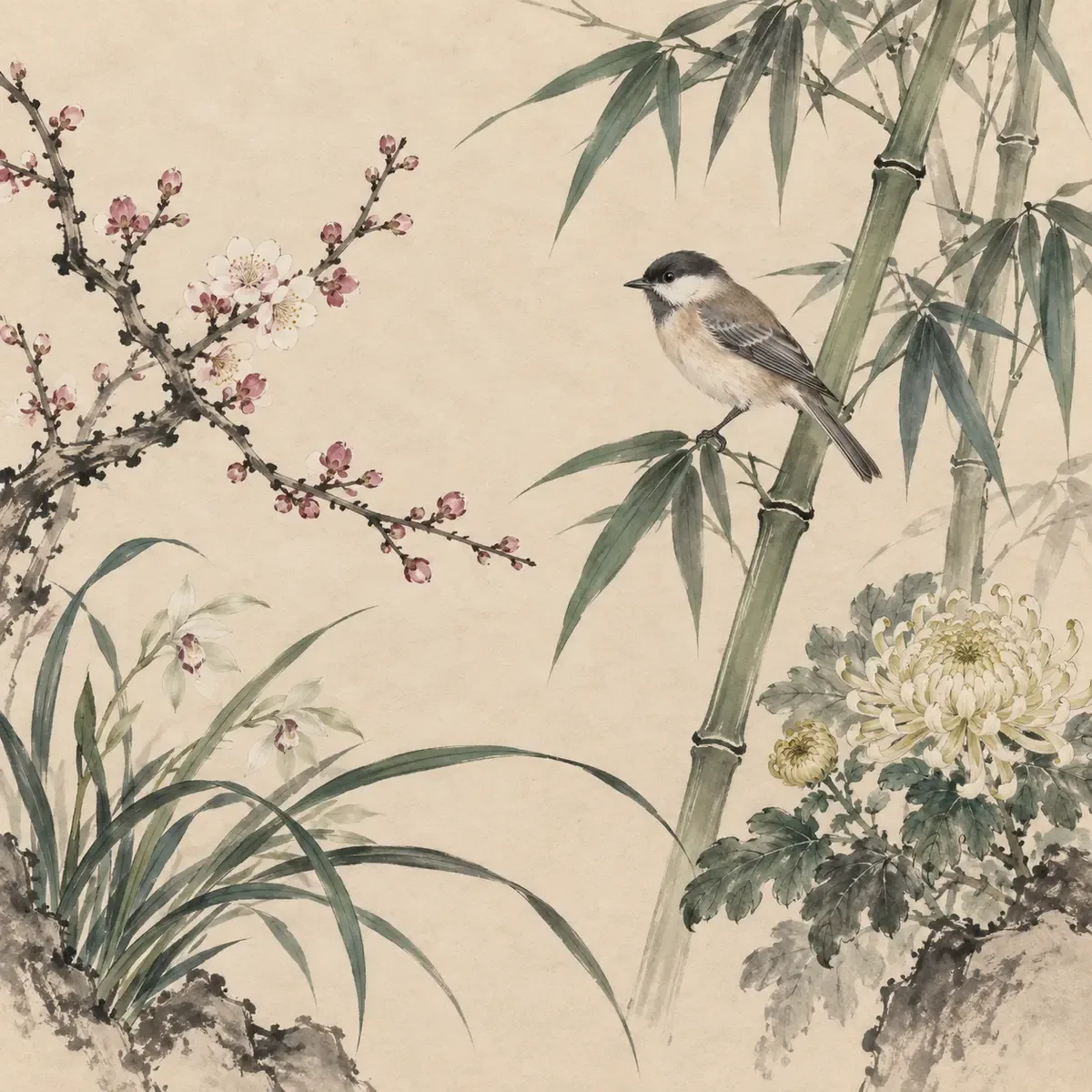
Editorial illustration bringing together a bird and the Four Gentlemen—plum, orchid, bamboo and chrysanthemum. AI-generated for Wudang.Org.
3. Huang Quan and Xu Xi as a historical framework
Later histories contrasted two tenth-century approaches: the detailed, richly coloured manner associated with Huang Quan and the freer ink-and-wash manner associated with Xu Xi. The phrase “Huang family wealth and honour, Xu Xi’s wild ease” made the contrast memorable.
It is useful as a map of later discussion, not as proof that every flower-and-bird painting belongs to one of two pure camps. Secure surviving works by the two masters are scarce, and later painters mixed outline, wash, colour, observation and inherited convention in many ways.
4. Song court painting and attentive observation
Song court workshops produced remarkably focused images of birds, blossoms, fruit and insects. Small album leaves can make a turning leaf, a bird’s weight or a damaged edge feel like the centre of an entire world.
Precision did not make these works neutral scientific records. Selection, cropping, season, poetic title and court setting shaped meaning. Close observation and cultural association can operate together in the same image.
5. Detailed and freely written manners
Terms such as gongbi, careful brushwork, and xieyi, writing the idea, describe useful tendencies. Fine outlines and layered colour may build feathers or petals; abbreviated ink marks may suggest a stem, leaf or creature with a few movements.
They are not a simple contest between rigid craft and authentic freedom, nor do they always identify the painter’s social status. A single artist can work in more than one manner, and apparently spontaneous strokes may rest on years of disciplined practice.
6. The Four Gentlemen as subjects and a set
Plum, orchid, bamboo and chrysanthemum became known together as the Four Gentlemen. Each plant had a longer individual history before the set became widespread, and the grouping has served poetry, painting, moral analogy and teaching.
Common associations connect plum with flowering through cold, orchid with subtle fragrance, bamboo with resilient growth and chrysanthemum with the autumn and Tao Yuanming. These are traditions of reading, not fixed meanings carried identically by every image.
7. Why bamboo meets calligraphy
Ink bamboo makes the movement of the brush especially visible. Stems, nodes, branches and leaves demand changes of pressure, speed, angle and moisture, so painters and viewers often compare the practice with calligraphy.
Accounts of Wen Tong and Su Shi helped establish bamboo as a model of conception joined to execution; the phrase “complete bamboo in the breast” later became an idiom for having a plan in mind. Historical association does not mean that bamboo requires no specialist training: economical marks make control, rhythm and error easier to see.
8. Reading symbols without forcing a code
Plants and animals can carry literary, seasonal, religious and social associations. Some combinations make wishes through wordplay, while others recall poems, exemplary people or occasions such as birthdays, examinations and weddings.
Interpretation is strongest when title, inscription, recipient, date or an established combination supports it. A lotus can invite a reading of purity, but it may also record summer growth or solve a compositional problem. Begin with what is visible, then test a symbolic reading against the object’s evidence.
9. Birds and creatures are more than emblems
A painted creature has posture, weight, direction and attention. Ask where the bird looks, how its feet meet the branch, whether insects form a food chain, and how leaves or water establish habitat and season.
Such questions respect the painter’s observation without pretending the image is a biological field report. They also keep animals from becoming mere labels for human virtues. For the larger family of formats and themes, return to the Chinese Painting guide.
10. A five-minute close-looking method
First identify the object and trace the main movement of the composition. Compare the most detailed passage with the loosest one, find repeated strokes, and notice how colour, ink density and empty space distribute attention.
Then list possible associations, read the inscription and label, and mark which ideas have evidence. Finish by asking what remains unexplained. Good looking does not eliminate symbolism; it keeps symbol, technique, natural observation and social occasion in conversation.