The Three Distances in Chinese Landscape Painting: High, Deep and Level Space
中国山水画的“三远”:高远、深远与平远
Chinese landscape paintings often make room for more than one kind of distance. A path may climb toward a summit, a ravine may slip behind overlapping ridges, and a river may carry the eye across low banks toward a remote horizon. The Northern Song painter Guo Xi gave these movements memorable names: high distance, deep distance and level distance.
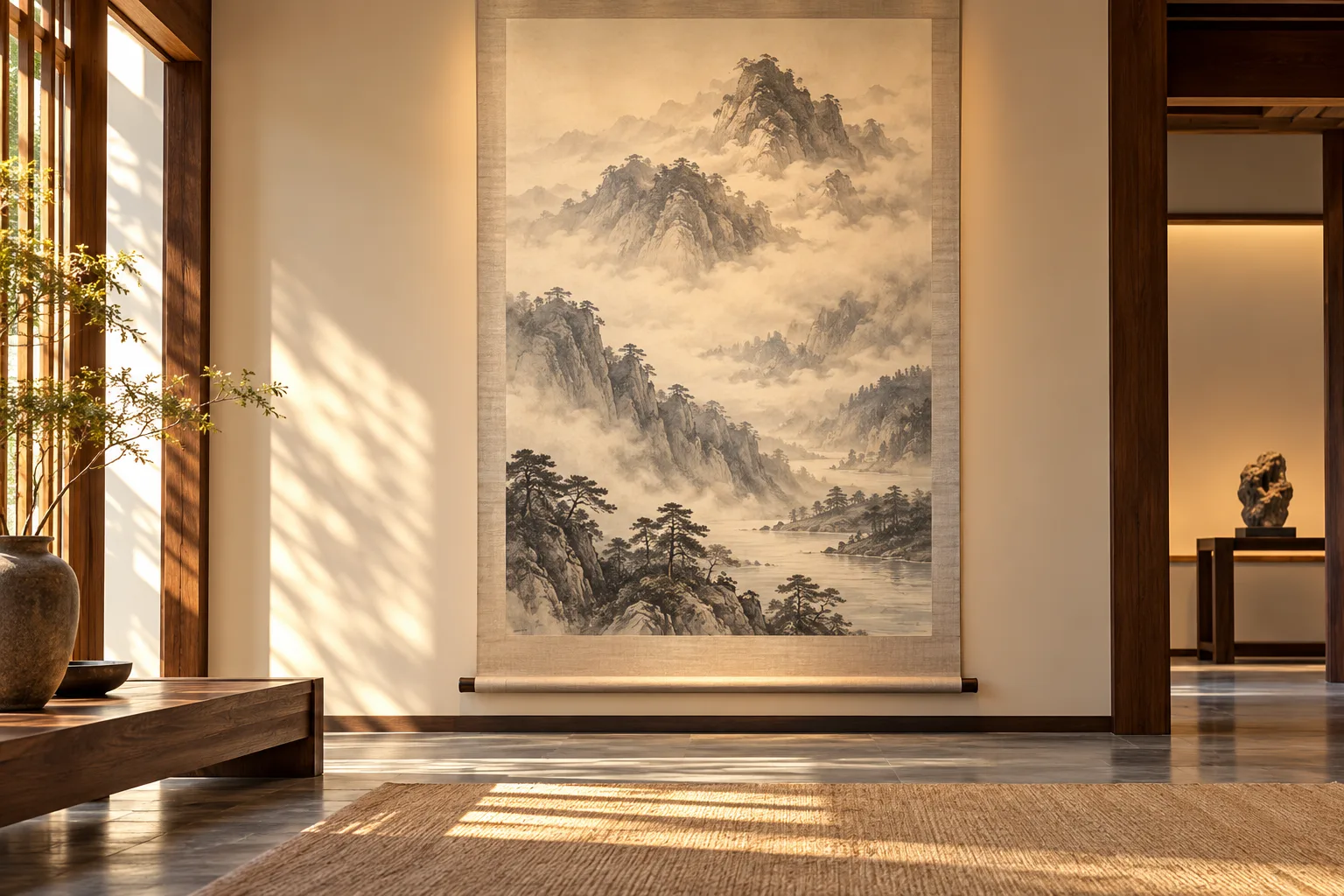
The “three distances” are most useful as questions to test against an object—not as a master key for every Chinese landscape, and not as a substitute for the work’s date, format, attribution or material history. Begin with the wider guide to shanshui, then use this vocabulary to describe how a particular image asks the eye to travel.
A vocabulary for moving through a landscape
Guo Xi and Lofty Message of Forests and Streams
Guo Xi was a major Northern Song court painter active in the eleventh century. Teachings associated with him were recorded and organized by his son Guo Si in the text now known as Linquan gaozhi, often translated as Lofty Message of Forests and Streams. The Palace Museum’s record for Guo Xi’s Old Trees, Level Distance connects the three terms to that text and identifies the signed and dated painting as a work of 1078.
Three movements, not three boxes
In the text’s compact formulation, looking up from the foot of a mountain toward its summit is high distance; looking from the mountain front toward what lies behind is deep distance; and looking from a near mountain toward a far one is level distance. These are relational movements between positions. A painting need not choose only one, and the terms do not automatically describe every passage within it.
Why this is not single-point perspective
The three distances do not prescribe one fixed viewer, vanishing point or mathematically uniform recession. They name ways of organizing and experiencing pictorial space. Changing scale, overlapping forms, water, mist, blank paper and shifts in brush density may all help the eye move. Comparing them with another perspective system can be illuminating, but declaring one a deficient version of the other obscures what each painting actually does.
How the three distances work
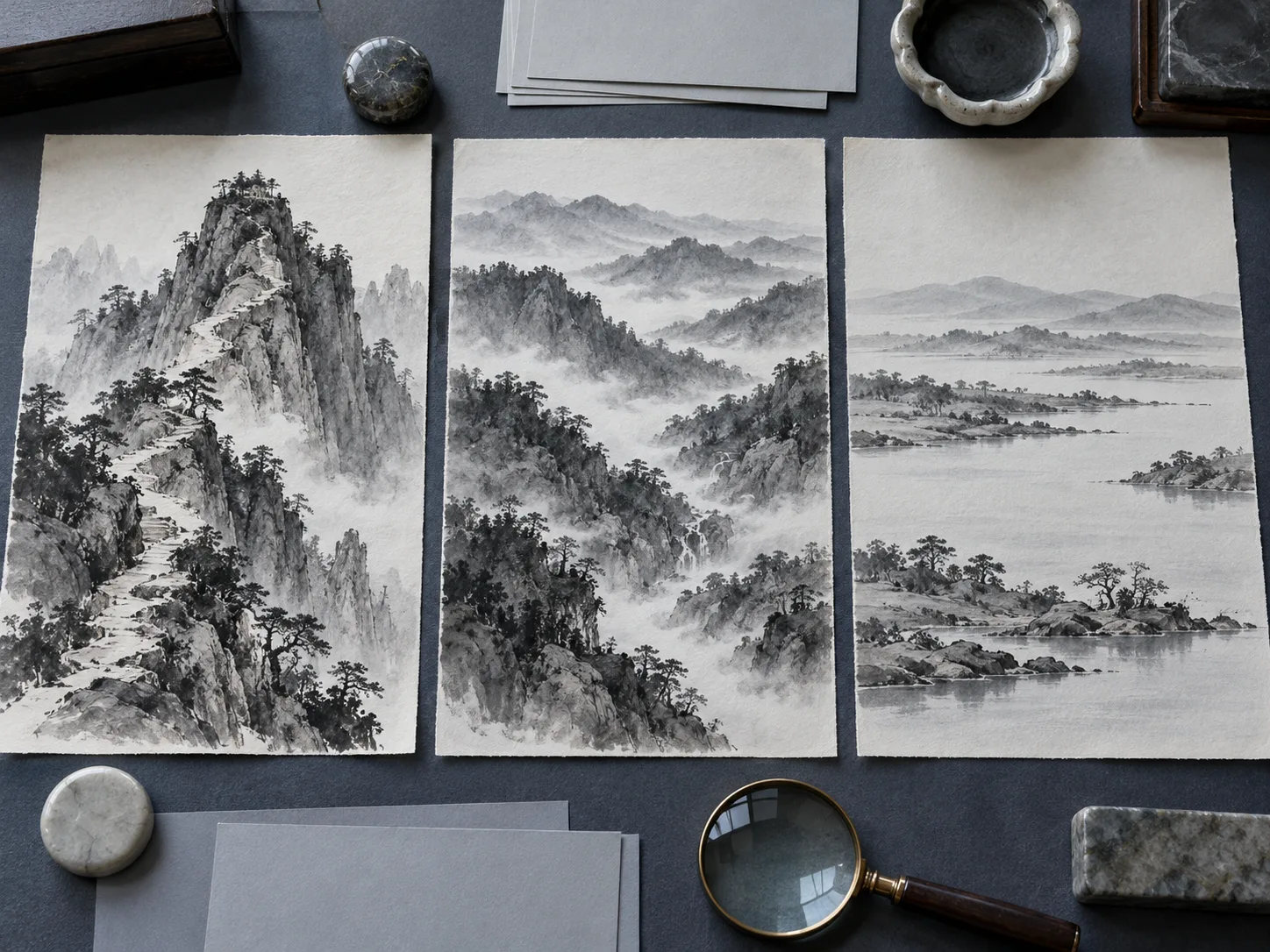
High distance: from below toward a summit
High distance makes ascent legible. Look for a low entry point, steep diagonals, stacked cliffs, climbing trees or paths, and a summit that seems to rise above the foreground. In a hanging scroll, vertical format can intensify this movement, but height alone is not proof: trace the actual connections between lower and upper forms. The hanging-scroll guide helps separate pictorial ascent from the object’s overall vertical mounting.
Deep distance: from the front toward what is behind
Deep distance sends the eye around and between forms. A foreground ridge may block part of a valley; a stream may reappear beyond rocks; mist may separate one plane from the next. Occlusion matters because what is hidden encourages an imagined continuation. Ask which edges overlap, where a route disappears, and how tonal or brushwork changes distinguish front, middle and rear.
Level distance: from near ground toward a far horizon
Level distance often expands laterally across water, plains, low ridges or successive shorelines. The Palace Museum describes Guo Xi’s Old Trees, Level Distance as moving from foreground rocks through a middle zone to distant mountains, with a relatively low horizon opening a broad realm. The term does not mean “flat” or “without depth”; its recession is generated through intervals, bands and near-to-far relations rather than a dominant upward climb.
Objects combine, compress and revise the vocabulary
Start with format and catalogue evidence
Before naming a distance, record whether you are looking at a hanging scroll, handscroll, album leaf, fan, screen, fragment or digital crop. A handscroll reveals space over time; a hanging scroll presents a larger field at once. Consult the object record for title, artist, date, medium, dimensions and attribution. The handscroll guide shows why unfolding sequence must not be silently treated like a wall image.
One painting may activate several distances
The three terms can overlap. A tall composition may rise toward peaks, open passages behind nearer ridges and offer horizontal release across water. The point is not to count one example of each, but to explain how their movements interact. Follow the route: where does the eye begin, what blocks it, where does it turn, and what provides release?
Later artists could transform the inherited scheme
At the Metropolitan Museum of Art, Fa Ruozhen’s 1684 Cloudy Mountains is described through foreground, middle ridge and distant peaks, with streams and mist maintaining separation. Yet the museum also stresses that Fa flattened forms and compressed distances to heighten vertical energy. An inherited spatial vocabulary therefore remained available for deliberate alteration, not just faithful repetition. Works “after Guo Xi” likewise require attention to date and artist: the Met’s Landscape after Guo Xi by C. C. Wang is dated 1937, centuries after Guo Xi.
A six-step museum method
Read the record, then restore the whole
Use a complete object view when possible. A detail may make a ravine look like the whole composition, while a cropped reproduction can remove the distant bank that establishes level recession. Distinguish the painted field from later mounting through the guide to Chinese painting mounts, and keep catalogue qualifiers such as “attributed to,” “after” or “formerly attributed to.”
Trace six questions in order
- Witness: What object, format, collection record and image version are you actually using?
- Entry: Which foreground form, path, figure, tree or bank first admits the eye?
- Rise: Which connections lead from low ground toward a summit or upper zone?
- Depth: Which overlaps, passes, ravines, streams or mists lead behind nearer forms?
- Level: Which banks, waters or low ridges carry the gaze from near to far?
- Combination: Where do these movements reinforce, interrupt or compress one another?
Write observations before interpretations
First record visible relationships: “the path vanishes behind the ridge,” or “three pale water bands separate darker shores.” Then identify the distance term that best fits, and only afterward consider broader meaning. Brushwork can complicate the space, so compare the site’s guide to ink and brush. Avoid turning all mountains, emptiness or multiple viewpoints into automatic evidence of Daoist belief. The safest conclusion is specific: this work, in this format and state, directs the eye in these demonstrable ways.