Chinese Scholars’ Rocks: Stone, Display and Imagined Landscapes
中国文人赏石:石质、陈设与想象山水
A Chinese scholar’s rock is not simply an unusual stone and not a miniature mountain with one fixed meaning. It is a natural body brought into a human setting, oriented for viewing, sometimes given a fitted stand, name, inscription or recorded ownership, and made available to imagination. The object begins with geology, but its cultural life is built through selection, placement and repeated looking.
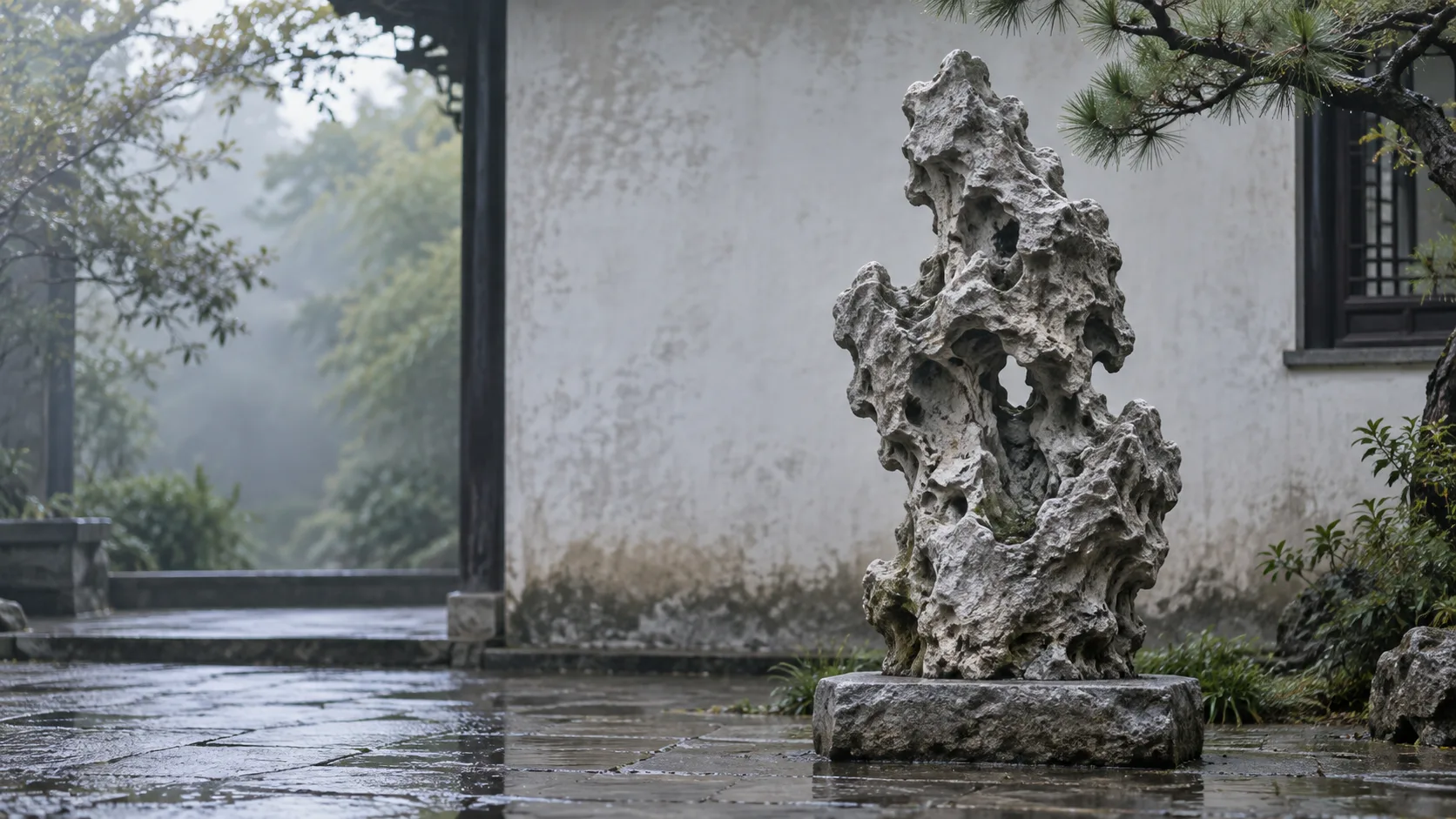
This guide offers a method for reading one stone without pretending that shape alone proves origin, date or spiritual meaning. It connects the object to shanshui painting while keeping material evidence separate from association.
From terrain to collected object
Garden stone and studio stone
Rocks have long organised space in Chinese gardens, where a large stone may act like a peak, screen, threshold or partner to water and planting. The Metropolitan Museum’s garden history notes that by the early Song dynasty smaller ornamental rocks were also collected for the scholar’s study. Scale changes the encounter: a garden rock is approached bodily, while a desk or floor stone can be turned, compared and contemplated at close range.
Material and place names
Catalogue words such as Taihu or Lingbi can point to geological material, source region and collecting tradition, but they are not interchangeable style labels. A Met Taihu limestone example and a black Lingbi limestone example differ in colour, density, surface and silhouette. Record what a reliable catalogue actually says before assigning a famous name from appearance alone.
A history made through collections
The Met’s World of Scholars’ Rocks exhibition joined physical stones with paintings in which rocks shape gardens and landscapes. That pairing shows why collecting history matters: a stone may be valued as natural form, studio companion, image source, antiquarian object or all of these at different times. “Scholar’s rock” names a cultural mode of attention, not a geological species.
Read stone, stand and orientation together
Silhouette and voids
Begin with the outer contour, then look through rather than only at the stone. Openings may connect, close or change shape as you move. Peaks may appear to lean, balance or divide. The National Museum of Asian Art’s Lingbi limestone rock explains how irregular form can prompt associations with clouds, caverns and miniature mountains. Such associations are invitations, not identifications hidden inside the stone.
Surface, weight and scale
A photograph can exaggerate monumentality because it withholds scale, weight and the relation between front and back. Record dimensions, material and whether the surface is granular, grooved, weathered, cut, polished or coated. Do not infer sound, density or quarry from an image. Even when a tradition praises texture or resonance, a museum label or scientific examination is stronger evidence than a poetic category applied at a distance.
The stand is not neutral
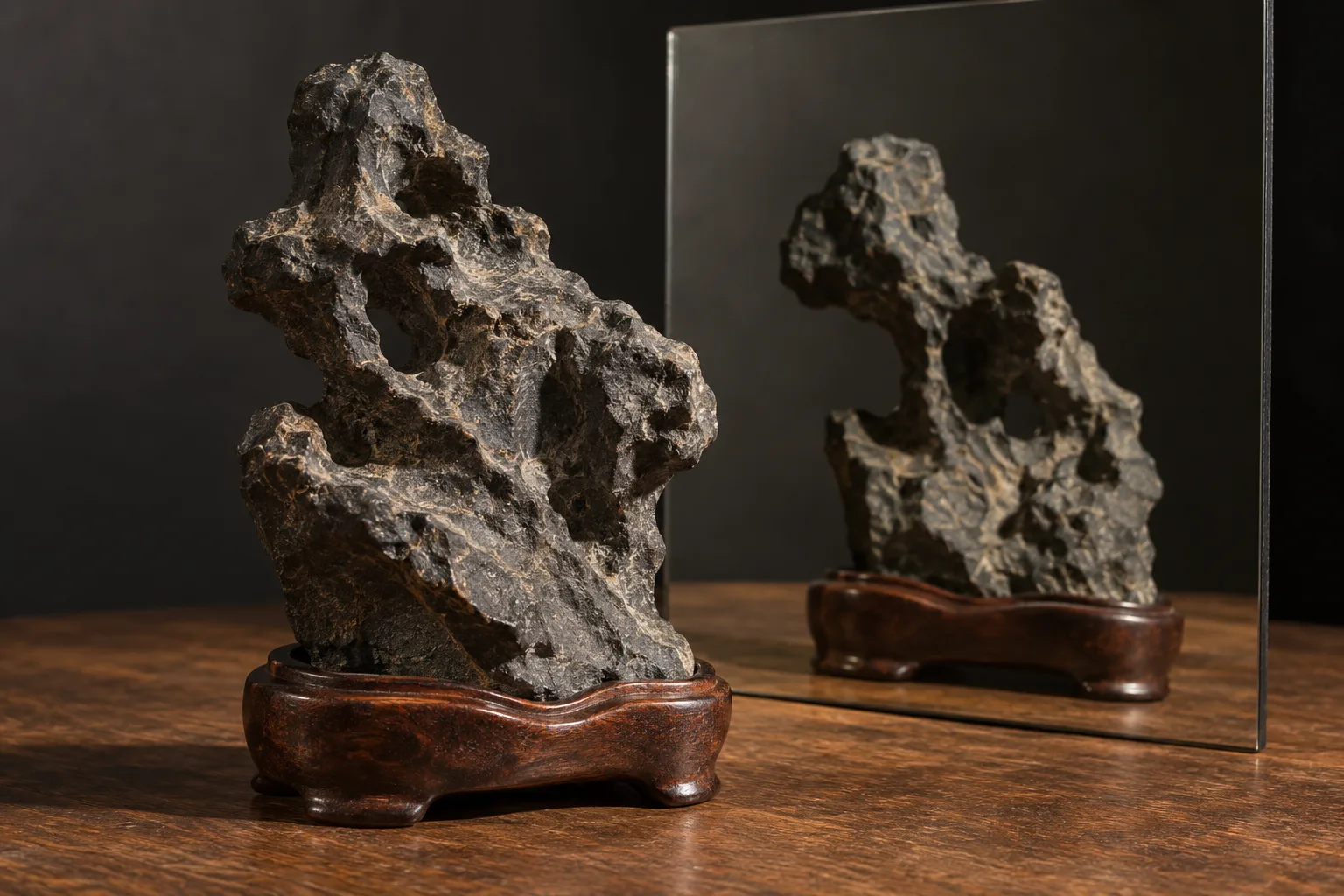
A fitted wooden base stabilises the stone, establishes an upright direction and frames where natural material meets craft. The Met’s Lingbi rock with an elaborate wooden stand catalogues stone and base together while describing their different qualities. Ask whether the stand is contemporary with the stone’s collection, a later replacement or undated; never let a convincing fit silently become proof of age.
Keep imagination and evidence separate
Mountain likeness is an invitation
A stone can suggest a ridge, grotto, animal or moving cloud without being carved to represent one. First describe contour and voids in plain terms; only then record associations. This two-column habit prevents imagination from masquerading as physical description and lets another viewer disagree productively.
Paintings create comparisons
Rocks in painting need not be portraits of owned stones, yet comparison can reveal shared habits of looking: swelling mass, broken contour, dry texture, layered wash and the rhythm between solid and empty. Continue with ink and brush for how marks build surface, or use the handscroll guide to follow how a painted rock participates in a longer sequence.
Names, inscriptions and provenance
A name, carved line, label, stand or collector’s note belongs to the object’s history, but each layer needs its own date and source. The National Museum of Asian Art’s Longmen river stone is especially useful because the museum distinguishes a geological souvenir mounted by Charles Lang Freer from stones selected within established Chinese connoisseurial practice. Context can change the category without changing the rock.
A six-pass looking method
Work around the object
When access permits, look without touching and move yourself rather than the object. For a digital record, rotate the museum viewer or compare several photographs. Use six passes:
- Name. Copy the catalogue title, material, dimensions, stated date and accession number.
- Outline. Trace the silhouette mentally from more than one side without naming an imagined subject.
- Openings. Follow which voids pass through, overlap or disappear as the angle changes.
- Surface. Separate observable texture from guesses about weathering, tools, polish or age.
- Support. Record the stand or plinth, fit, orientation and any visible later additions.
- History. Distinguish quarry or find-place, collection history, inscription, attribution and your own response.
Compare with records
Use object records to test, not decorate, your first impression. Compare two documented stones of different material and scale, and note which qualities survive photography. The Met’s nineteenth-century limestone stone with wood stand provides dimensions and component information that a cropped image cannot. If an online seller supplies only a poetic name, treat geological origin, age and authorship as unverified.
Continue across the literati arts
Return to the Chinese painting guide to relate stone, landscape and studio practice, or study Chinese seals before interpreting marks and ownership claims. The aim is not to solve a stone like a coded symbol. It is to hold material fact, crafted display, documented history and imaginative response together without confusing one for another.