Chinese Screens: Space, Painting and the Art of the Fold
中国屏风:空间、图像与开合之艺
A Chinese screen is easy to mistake for a picture with legs. Look longer and it becomes something more active: furniture that edits a room, an image that changes as a viewer moves, and a crafted object whose front, reverse, frame and hinges all carry evidence. The broad term pingfeng (屏风) covers objects at very different scales, from multi-panel floor screens to framed insert screens and small screens made for a desk.
This guide asks four practical questions. What kind of screen is it? How does it stand or fold? How is its surface made? And what did its placement allow people to see—or keep from seeing? These questions connect the screen to the Wudang site’s wider route through Chinese painting, material culture and ways of looking, without claiming that every screen belonged to a temple, a scholar or one unchanging tradition.
A movable boundary, not a fixed wall
One name, several forms
A freestanding screen can be a single framed panel on feet. A folding screen joins several tall leaves so that the angles between them provide stability. An insert screen sets a panel into a separate stand, while a table or desk screen brings the same idea to a smaller scale. The Palace Museum’s hardwood insert screen with inlaid decoration identifies the insert screen as a type of seated screen and describes such objects in Qing palace interiors. Its small brush screen combines display, a screen and a brush holder, showing that “screen” is a functional family rather than one standard silhouette.
Scale changes the job. A tall screen can interrupt a direct view, mark a place of honour, make a temporary enclosure or serve as a pictorial focus. A table screen does not divide a room in the same way; it frames attention at close range. Before interpreting imagery, therefore, notice height, base, hinges and the direction in which an object was meant to face.
Space changes as the viewer moves
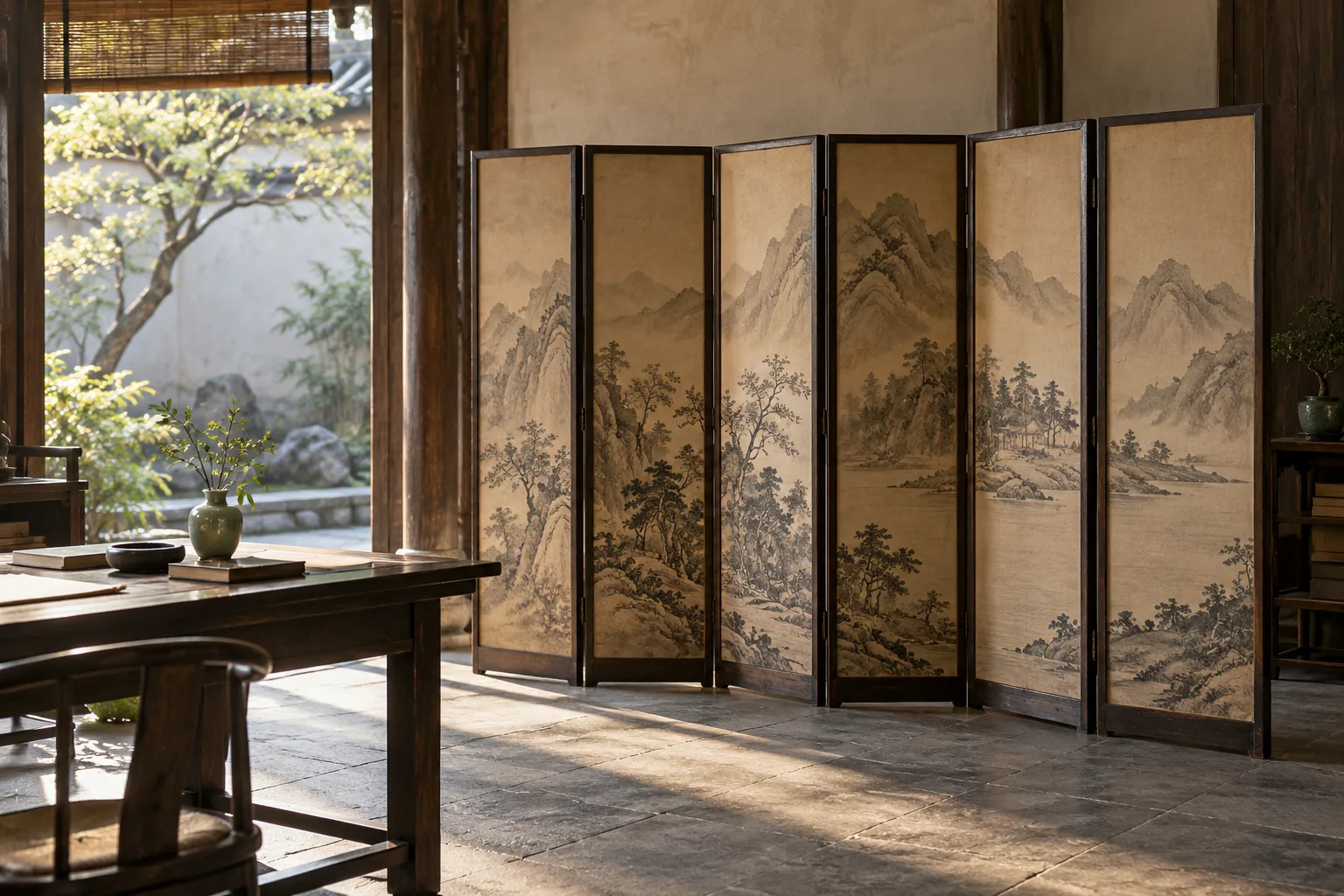
A wall stays put. A screen can be opened, angled, turned and stored. Its zigzag footprint makes a folding screen stand, but also creates a sequence of surfaces rather than one flat plane. From the centre, an image may read continuously; from the side, joints interrupt it and one panel hides another. The object choreographs both movement and looking.
This is why a screen belongs beside, but is not identical to, a hanging scroll. Both can present a vertical image in an interior. The scroll is normally suspended flat and rolled for storage; the screen depends on a frame or stand and occupies the floor or furniture. Its thickness, reverse and angle are part of the experience.
A meeting place for materials and skills
Painting is only one possible surface
Paper and silk can carry ink and colour, but screens also use carved or inlaid wood, lacquer, textiles, stone, jade, metal and enamel. A fifteenth-century Ming table screen at The Metropolitan Museum of Art renders a blue-and-green landscape in cloisonné enamel on copper alloy. Its copper wires perform a task analogous to drawn contours, yet the surface was made through metalwork and enamelling rather than brush and ink alone.
The comparison matters because subject and medium should not be collapsed. A landscape does not automatically make an object a “painting” in the same technical sense as an ink work on paper. Start with the museum record: identify support, surface, frame and stand separately. Then ask how those materials alter line, colour, reflection, weight and durability.
The image must negotiate edges
On a multi-panel screen, the artist or workshop has to decide whether one scene crosses the joins or whether each leaf behaves more independently. Continuous mountains, water or trees can bind several panels into one field; repeated plants, birds, inscriptions or decorative units can emphasize rhythm instead. Hinges and borders never disappear completely. They divide the image while allowing the object to move.
This produces a different kind of sequence from a handscroll, which is encountered gradually from one end, or an album, which presents separate leaves. A screen may offer many segments at once, but their visibility changes with the fold and viewpoint. Format is not packaging added after the picture; it helps make the picture intelligible.
How to read a screen as an object
Begin with structure, front and reverse
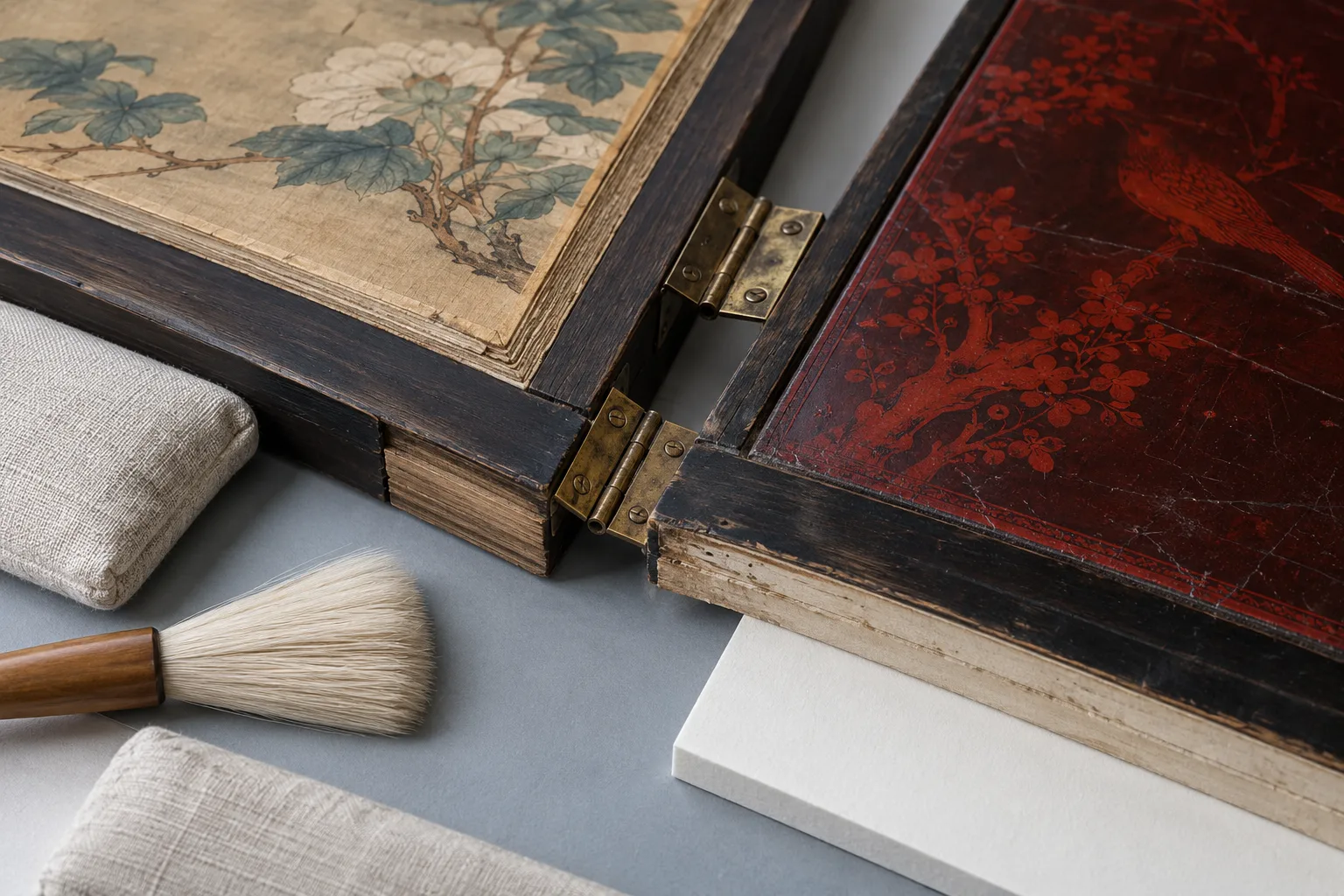
First count panels and look for feet, a stand or hinge traces. Check whether the screen is self-supporting, inserted into a base or designed for a table. Next distinguish front from reverse. The two sides may use different materials and levels of finish, or both may be intended for viewing. On a folding screen, alternate hinge directions are what allow the leaves to close; replacement hardware, worn edges and repaired frames may reveal a long history of handling.
Do not treat every crack, faded area or uneven join as an original artistic effect. Large lacquer screens are layered structures, and changes in wood, ground, lacquer and inlay can interact over time. The Smithsonian’s exhibition Palace Life Unfolds centres on the research and conservation of a Chinese lacquer screen, making the object’s construction and later care part of its history rather than invisible backstage work.
Then connect image, object and setting
Read motifs only after identifying what is actually present. A mountain scene may invite the eye into imagined distance; birds and flowers may organize the panels by season or rhythm; figures, architecture or precious materials may point to a more specific courtly, domestic or export context. Meanings depend on date, workshop, patronage and documented use. Avoid turning every pine, cloud or red lacquer surface into a fixed code.
Placement also matters. A screen behind a seat, beside a bed, across a doorway or on a writing table performs a different social and visual task. Yet a museum display may not preserve that original arrangement. Use installation evidence when it exists, and say “possibly,” “likely” or “unknown” when it does not. The screen can shape a room without proving who occupied it.
A six-step looking method
Observe before naming
- Measure the encounter. Is the object floor-sized, table-sized or desk-sized?
- Find the support. Look for feet, a separate stand, slots, hinges or a frame.
- Read the fold. Notice how panel angles reveal, compress or interrupt the image.
- Separate materials. Identify image surface, core, border, frame, fittings and base.
- Compare both sides. Ask which faces were meant to be seen and what later repairs disclose.
- Return to context. Check the museum record before assigning date, function or symbolism.
This method slows down the leap from decoration to meaning. It also gives useful comparisons across the site: the changing viewpoint of a screen, the close looking invited by fan painting, and the way a scholar’s rock turns physical material into an imagined landscape.
Display without pretending to reconstruct the past
For a modern display, stability and care come before atmosphere. A folding screen should not be forced flat merely to make its image easier to photograph, and delicate painted, textile or lacquer surfaces need professional advice about support, light and climate. A contemporary room can demonstrate how a screen redirects a view, but it should not be labelled as an exact Ming or Qing interior unless evidence supports that claim.
The most rewarding question is therefore not “What does a Chinese screen symbolize?” but “What does this screen do?” It stands, folds, frames, shelters, displays and guides attention. Reading those actions alongside material and imagery turns an attractive backdrop into a complex cultural object.