Mounting Chinese Painting: Silk Borders, Backing Papers and the Life of a Scroll
中国画装裱:绫边、托纸与卷轴的生命
A Chinese painting may look like a single sheet, yet the object in front of us is often a carefully built structure. Thin painted paper or silk is joined to supporting papers, borders, covers, rods and sometimes a box. Together these layers make a handscroll possible to unroll, a hanging scroll possible to suspend, an album possible to turn and a screen possible to stand.
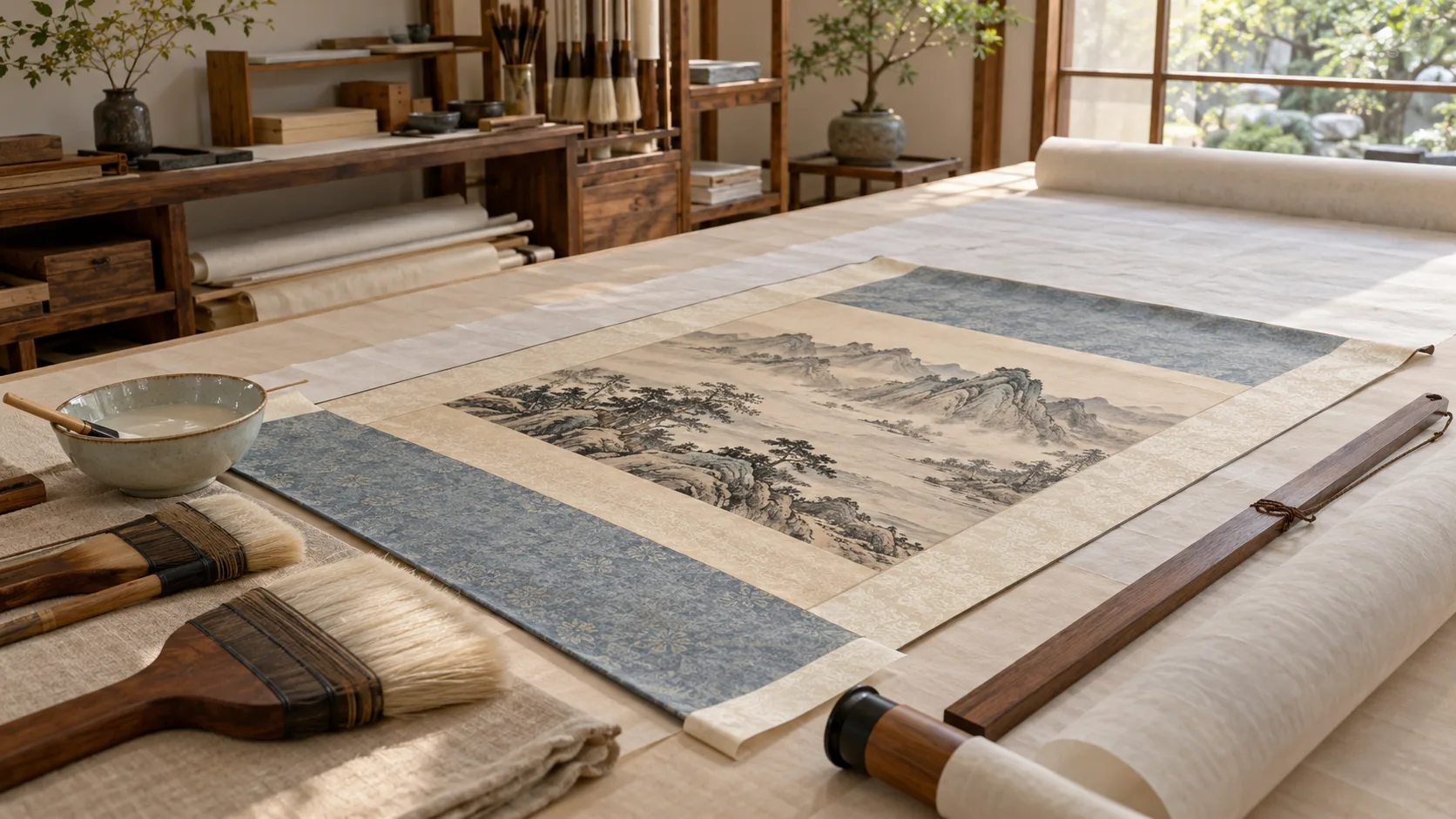
This guide treats mounting as part of the painting’s material history, not as an invisible frame. It explains what can be observed without dismantling an object, why old mounts deserve evidence-based decisions, and why washing, relining or remounting belongs to trained conservators rather than home repair.
A mount turns an image into a working object
Thin paper and silk need a support system
Chinese paintings are frequently made on fine paper or silk. These supports can carry subtle ink and colour, but they are vulnerable to tears, creases, distortion and repeated handling. The Cleveland Museum of Art’s conservation laboratory therefore describes the surrounding mount as part of the object’s care, not a disposable accessory.
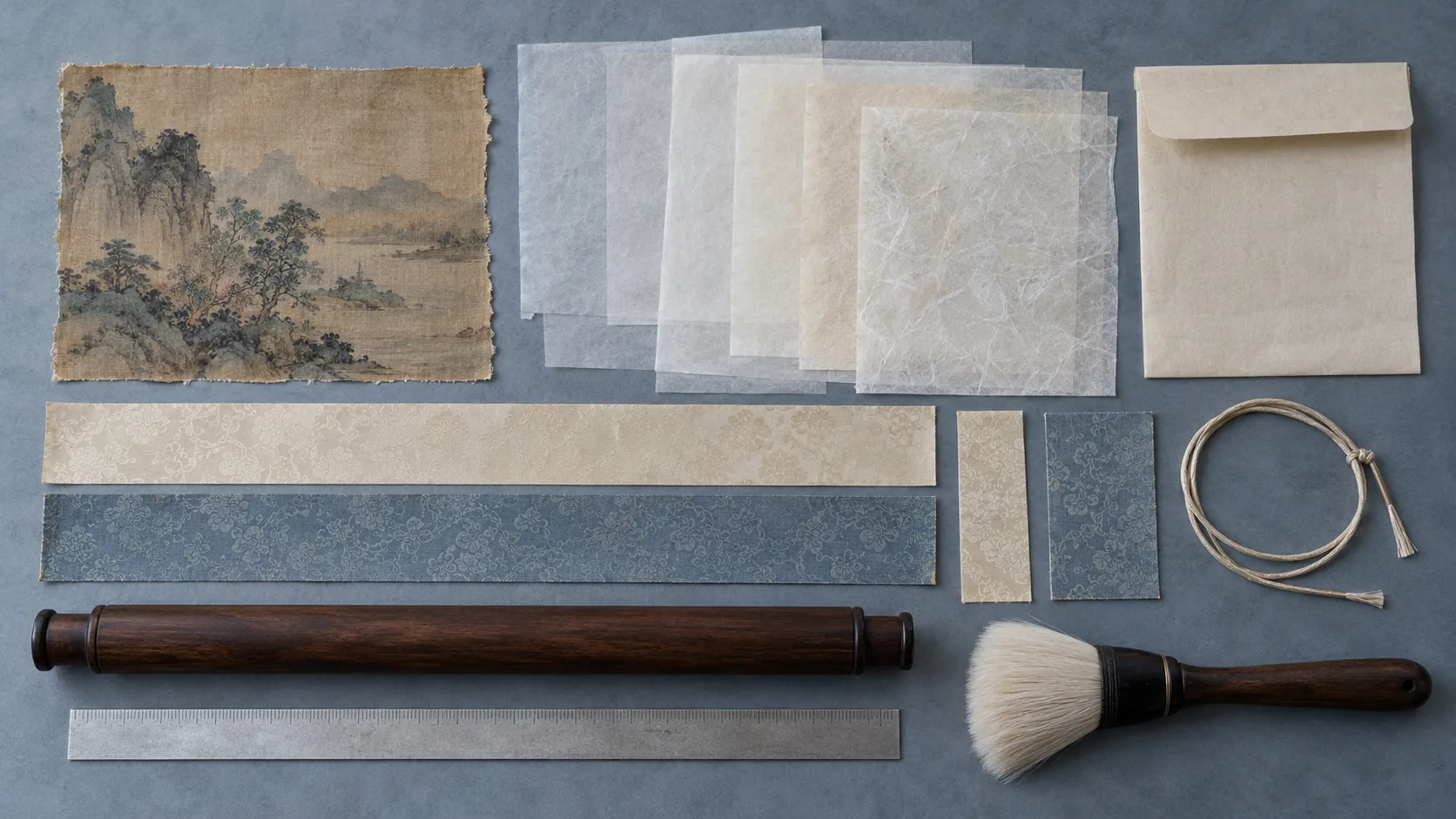
Lining paper is adhered behind the painting to add support and help it behave as part of a larger flexible structure. Further papers may back mounting silks or strengthen the completed object. The exact papers, fibres, number of layers and paste are treatment choices, not a universal recipe. Age, format, pigments, earlier repairs and the intended way of viewing all matter.
Format changes movement, scale and storage
A handscroll is opened on a table in sections, so rolling and unrolling create a sequence. A hanging scroll is suspended vertically and addresses a wall or room. An album divides viewing into leaves, while a screen joins painting to a rigid or folding support.
These formats are not neutral containers for the same image. A long landscape experienced a handspan at a time differs from one displayed fully on a wall. A screen changes movement through a room. Mounting therefore participates in composition, pace, touch, visibility and storage even when the painted surface itself is unchanged.
Read the layers without pretending to see inside
Begin with the painting and its immediate lining
The painted support is sometimes called the painting core or image field. Behind it may be one or more linings attached with starch paste. On an open-weave silk painting, the tone of the first backing paper can affect what a viewer sees from the front. That makes backing colour an aesthetic as well as structural decision.
Do not infer hidden layers from a catalogue photograph. Look instead for visible edges, joins, repaired creases, changes in thickness and the way the object lies. Technical examination may reveal more, but even specialists do not remove a lining merely to satisfy curiosity: every intervention carries risk.
Silk borders carry design and history
Mounting silks can separate the image from its surroundings, balance proportions and protect vulnerable edges. Their weave, pattern, colour and width affect the finished object. The National Museum of Asian Art notes that mounting fabrics and materials are reproduced and studied within Chinese painting conservation, while the Metropolitan Museum of Art treats mounting as a specialist part of East Asian painting care.
A border that looks newer than the painting is not automatically false or careless. Paintings may be remounted several times, and a later mount can become evidence of collecting, taste, repair or institutional history. Conversely, an old-looking silk is not proof that it was attached when the image was painted. Date the painting, mount and inscriptions separately when the evidence allows.
Rods, covers and ties control how a scroll works
A hanging scroll normally carries a top stave from which it hangs and a lower roller around which it closes. A handscroll has its own beginning cover, joins and roller arrangement. Pockets, cords, knobs and wrapping protect or operate the structure. They also concentrate stress: torn top edges, frayed cords and misaligned rollers can endanger the painting.
The roller must sit parallel so the layers wind evenly. A scroll rolled too tightly, too loosely or around a damaged core can crease, telescope or abrade. The Asian Art Museum’s care guidance therefore emphasizes condition checks, clean flat handling, brief low-light display and secure rolled storage rather than permanent exhibition.
Conservation is a decision before it is a technique
Condition evidence comes before a new mount
Conservators ask whether damage belongs to the painting, the mount or both. They record cracks, losses, lifting pigment, stains, distorted papers, weakened cords and earlier repairs. They also consider the mount’s documentary and aesthetic value. Minor reinforcement, safer storage or a shorter display may sometimes reduce risk without replacing the whole structure.
A mount is not judged only by whether it looks fresh. A well-made older mount may still function; a visually tidy one may contain poor paper, uneven tension or damaging adhesives. The Museum of Fine Arts, Boston shows why support quality matters: an inadequate screen core with too few lining layers distorted and discoloured the painting it was meant to carry.
Complete remounting is major intervention
The British Museum’s account of Chinese scroll mounting describes full remounting as highly interventive: old silks may be removed, the painting treated and relined, losses repaired, and new surrounds constructed. Such work combines traditional craft knowledge, conservation judgment, documentation and materials testing.
Remounting can make safe display and storage possible, but it can also remove evidence or alter the painting’s appearance if poorly conceived. There is no responsible do-it-yourself shortcut using household tape, spray adhesive, ironing, wet cleaning or ordinary picture framing. A valuable or uncertain object should remain stable and untouched until a qualified East Asian painting conservator examines it.
Drying, flexibility and rolling must work together
Paper, silk and paste respond to moisture. During professional mounting, lined components are dried and flattened under controlled conditions before they are joined and given final backings. The completed scroll must be strong enough to support the painting yet flexible enough to roll without forcing one layer against another.
That balance changes with size, material and condition. More layers are not automatically better, and a stiff scroll is not necessarily safer. Good work is judged through the whole system: flatness when displayed, even rolling, appropriate tension, sound attachments and a surface that does not endanger fragile ink or colour.
A six-step way to read a mounted painting
Move from format to evidence
- Name the format. Is it a handscroll, hanging scroll, album leaf, screen, panel or later frame?
- Locate the image field. Separate painted support from borders, inscriptions, title slips and later additions.
- Follow the joins. Notice where papers and silks overlap, change thickness or meet rods and covers.
- Read movement. Ask how the object opens, hangs, turns, folds or rolls and where that movement creates stress.
- Look for different ages. Compare wear, fading, weave, repairs and hardware without assigning dates from appearance alone.
- Check the record. Use catalogues and conservation reports to distinguish observation, attribution and documented treatment.
Respect distance, duration and specialist boundaries
In a gallery, observe whether the scroll is fully extended, supported in a case or shown only for a limited rotation. Display decisions may reflect light sensitivity, structural weakness or curatorial purpose. An absent work may be resting rather than forgotten; a short exhibition is often part of preventive care.
Do not touch silk, test a roller, lift an edge or try to flatten a crease. Photographs can record visible condition, but they do not authorize a repair. Continue through the Chinese Painting gateway and compare formats before treating the mount as background.
Sources and limits. This guide draws on the Metropolitan Museum of Art and Cleveland Museum of Art conservation laboratories, the Museum of Fine Arts Boston’s support study, the British Museum’s account of Chinese scroll remounting, the Asian Art Museum’s preventive-care guidance, and the Smithsonian’s demonstration of two professional lining methods. These records explain principles and selected treatments; they are not instructions for repairing an individual object.