Chinese Painting Masters: A Guided Path
中国画名家与进阶研习
Names are useful when they open a route into paintings, not when they become a list to memorise. This guide selects artists and texts that illuminate changes in format, brushwork, patronage and self-understanding. For the longer chronology, begin with Origins and History of Chinese Painting.
Attribution needs care. A museum label may say “by,” “attributed to,” “formerly attributed to,” “after,” or “in the style of.” These phrases are evidence, not small print: copying, later inscriptions, remounting and changing connoisseurship are part of an object’s history.
1. Begin with objects, not reputations
Record the work’s format, material, dimensions, date range, attribution wording and collection number before reading a biography. A handscroll asks for sequential viewing; a hanging scroll establishes a field at once; an album leaf creates a smaller, more intimate encounter.
Then describe what is visible without borrowing the label’s conclusions. Where does the eye enter? How do dark and pale ink, line, wash, blank paper and seals organise attention? Only after that should a famous name or school guide interpretation.
2. Early figure painting and the problem of survival
Gu Kaizhi (about 344–406) is central to histories of figure painting, yet works associated with him survive through later copies. The British Museum’s Admonitions Scroll, for example, is catalogued as a fifth- to seventh-century painting illustrating a text, rather than as an untouched fourth-century original.
Wu Daozi, active in the eighth century, is known largely through texts and later tradition because no securely accepted original survives. Together these cases show why artistic reputation, physical object and present attribution must be kept distinct.
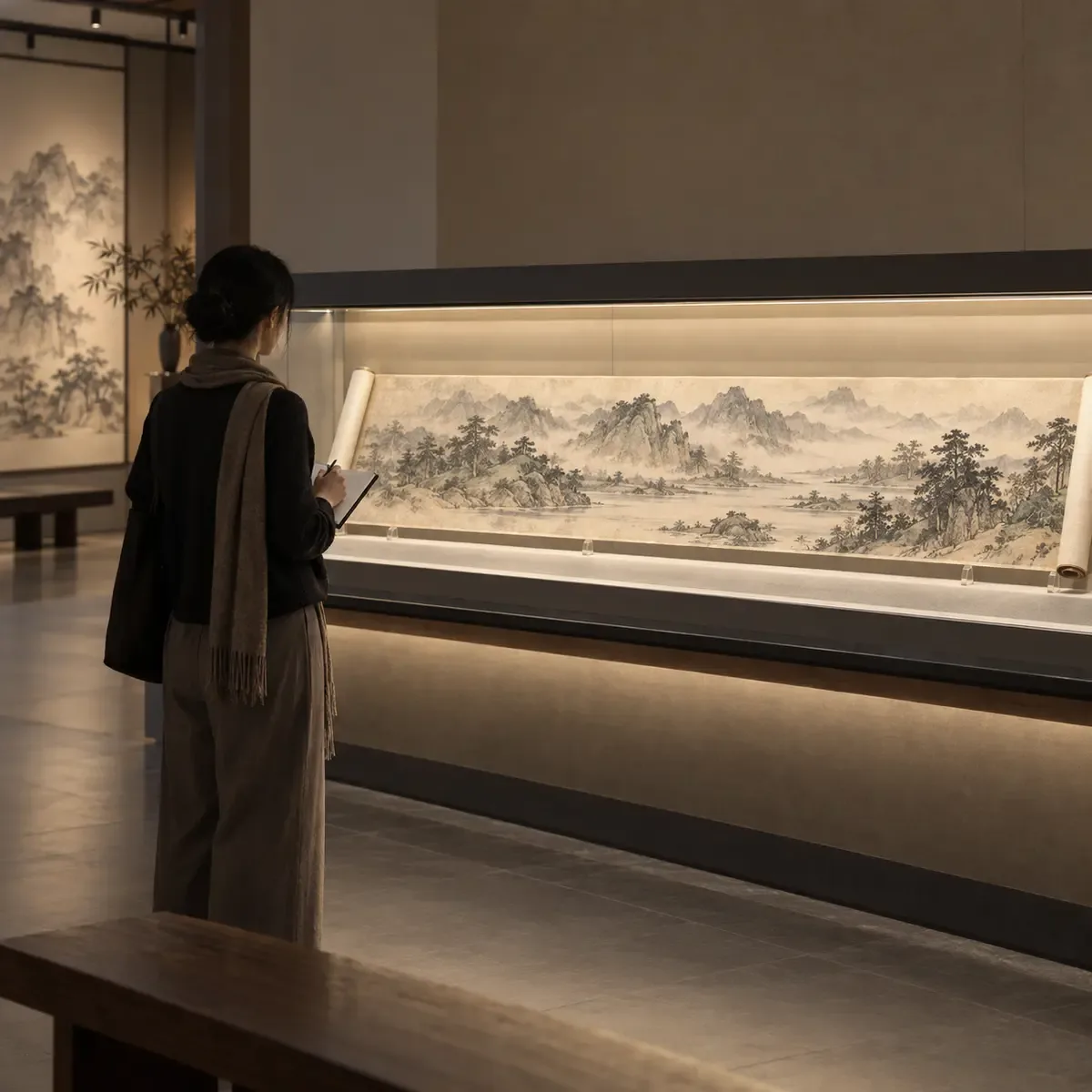
Close looking begins with the object: format, scale, material, attribution and visible brushwork. AI-generated for Wudang.Org; not a real museum display.
3. Northern and Southern Song landscapes
Fan Kuan and Guo Xi offer two influential approaches to monumental Northern Song landscape: mass, recession, weather and paths through mountains. Southern Song painters associated with the court, including Ma Yuan and Xia Gui, often concentrate sharply described forms within broader zones of mist or open space.
These are not fixed national formulas. Compare individual works and their stated dates, formats and attributions. The Shanshui guide provides a closer method for reading scale, moving viewpoints and inhabited space.
4. Zhao Mengfu and Yuan conversations with the past
Zhao Mengfu (1254–1322) made archaism a resource for new work. In Twin Pines, Level Distance, the Metropolitan Museum identifies a handscroll in ink on paper, around 1310; its format, measured line and deliberately spare forms reward comparison with the artist’s calligraphy.
Huang Gongwang, Wu Zhen, Ni Zan and Wang Meng were later grouped as the Four Masters of the Yuan. The label is useful for comparison, but it should not imply that Yuan painting had only four voices or that later painters copied them in a single way.
5. Ming lineages and Dong Qichang’s map
Shen Zhou and Wen Zhengming are strong entry points into the network of scholar-painters around Suzhou. Their works make friendship, collecting, poetry, calligraphy and acts of homage visible, so inscriptions and colophons belong to the viewing experience rather than sitting outside the image.
Dong Qichang (1555–1636) proposed influential “Northern” and “Southern” lineages of painting. His scheme shaped later collecting and criticism, but it was a retrospective argument, not a neutral map or a simple division by geography.
6. Seventeenth-century alternatives
Bada Shanren (Zhu Da, 1626–1705), born into the Ming imperial clan, developed compressed images of birds, fish, plants and rocks after the dynasty’s fall. Shitao (1642–1707), also connected to the fallen Ming house, combined varied painting with forceful reflections on method and creative transformation.
They are often called “Individualists” in contrast with painters described as “Orthodox.” Treat those categories as aids to a historical debate, not personality tests. Close looking may reveal quotation, discipline and inherited method even in work praised for originality.
7. Women painters and the shape of the record
Guan Daosheng (1262–1319) and Wen Shu (1595–1634) provide important routes into bamboo, plants, family workshops and elite networks. Their presence also makes a basic problem visible: surviving histories reflect unequal access to training, collecting, publication and institutional recognition.
Do not add women as a detached appendix to an otherwise unchanged canon. Ask who commissioned, exchanged, inscribed, mounted, collected and preserved each work. A collection history can explain both what survives and what remains difficult to see.
8. Read painting theory beside paintings
Xie He’s Six Laws, Zhang Yanyuan’s historical writing, Guo Xi’s landscape discussions, Dong Qichang’s lineage arguments and Shitao’s Remarks on Painting address different periods and purposes. No single phrase from them explains all Chinese painting.
Use a scholarly translation with notes, then return to one object. Test a term against line, texture, composition and format—the practical concerns introduced in Ink and Brush—and note what the text clarifies or leaves unresolved.
9. Build a museum-based study route
Start with collection databases that publish dimensions, medium, attribution, provenance, exhibition history and zoomable images. The National Palace Museum, Palace Museum, Shanghai Museum, Liaoning Provincial Museum, Metropolitan Museum, Smithsonian National Museum of Asian Art, British Museum, Museum of Fine Arts Boston, Cleveland Museum of Art and Musée Guimet all provide useful points of entry, though online depth varies.
Displays rotate, fragile works may appear only briefly and collection records change as research develops. Before travelling, check the museum’s current exhibition page. Online, save the permanent object record rather than relying on a search-result image or an undated repost.
10. A repeatable close-looking practice
Choose one work and spend ten minutes before reading commentary. Write five observations about format, scale, brushwork, ink or colour, and the path of attention; then read the object record and revise one observation. Compare a second work only after the first has a clear description.
For a focused route, pair one landscape with the Shanshui guide, one plant or bird painting with Birds, Flowers and the Four Gentlemen, and one object record with its bibliography. Return to the Painting gateway to choose the next question rather than the next famous name.