Chinese Portrait Painting: Likeness, Role and Ancestral Memory
中国肖像画:形神、身份与祖先记忆
Chinese portrait painting is not one fixed genre. An imperial image, a scholar’s informal likeness, a family group and a portrait used to honour an ancestor could ask different things of a painter and a viewer. Some were made from life; others were completed after death, copied for later generations or reconstructed in a workshop. A careful reading therefore begins with function, material and provenance before it turns clothing or expression into a story.
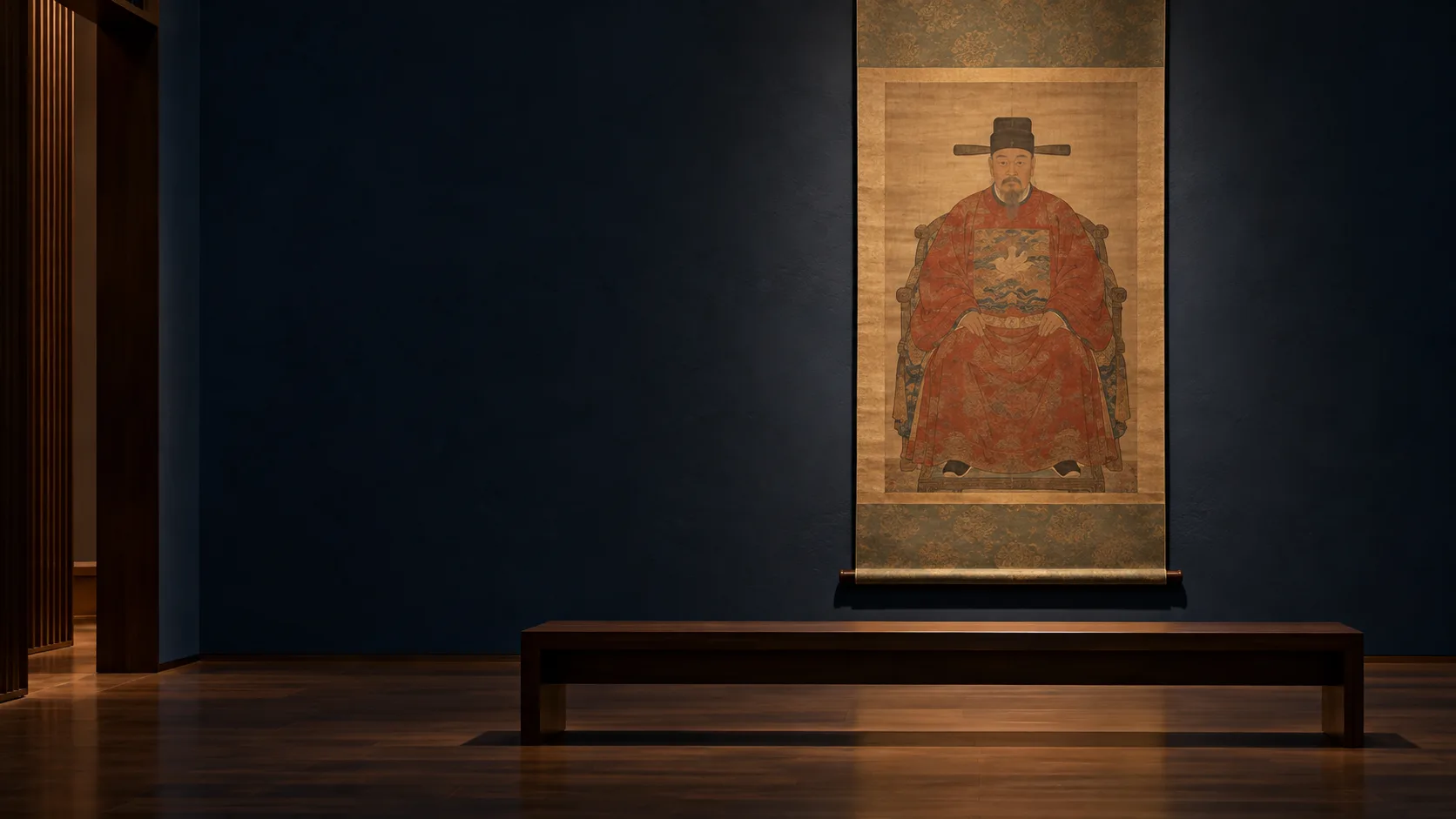
This guide builds on Chinese Painting: Materials, Formats and Ways of Looking. It focuses on questions a museum visitor can actually test: what kind of object is present, how the sitter is posed, which details are individualized, what the costume and furniture may communicate, and what the record says about making, display and later repair.
Portraiture had more than one job
Likeness, status and memory could work together
A portrait may preserve recognizable features, present a social role, commemorate a life or make a person present within a family practice. These purposes are not mutually exclusive. The National Museum of China’s survey of Ming- and Qing-dynasty portraits includes imperial relatives, officials, scholars, literati gatherings and women in different settings. That range warns against using the seated ancestral portrait as a template for all Chinese portraiture. It also shows why portrait paintings can be evidence for dress, furnishings and social ideals as well as faces.
The old critical language of transmitting both outer form and inner spirit should not be reduced to a contest between “realism” and “symbolism.” A carefully modelled face can coexist with a highly ordered robe, frontal pose and standardized chair. Individual features and social decorum may occupy different parts of the same image.
A lifetime portrait is not automatically an ancestor portrait
The Metropolitan Museum’s portrait of the artist’s great-grand-uncle Yizhai records, through its inscription, a sitter at the age of eighty-five and identifies the work as painted from life. The Met contrasts it with posthumous ancestor portraits, while also noting their shared formal vocabulary. That distinction matters: frontal pose, full-length format or solemn dress alone cannot prove that a painting served ancestral rites.
Ask what the catalogue, inscription and provenance actually establish. “Portrait,” “commemorative portrait,” “official portrait” and “ancestor portrait” name overlapping but not identical categories. When the sitter or original use is unknown, uncertainty is part of the object’s history, not a gap to fill with costume-based guesswork.
Portraits of people differ from images of deities
A human portrait and an icon of a deity may both face the viewer, occupy a hanging scroll and appear in ritual settings, but they represent different kinds of presence. Do not identify a painted figure as an ancestor, priest, immortal or official from posture alone. Attributes, inscriptions, documented title, provenance and the wider image program all matter. The site’s guide to the Taoist pantheon offers a separate route for religious images; it should not be used to turn an unidentified human sitter into a divine figure.
Read the image as a constructed social body
Begin with face, gaze, pose and scale
Look before decoding. Is the head painted with small tonal changes while the robe is described by strong outlines and repeated patterns? Does the sitter meet the viewer, turn slightly or appear within an activity? Is the body full-length, half-length or one figure within a group? Scale affects the encounter: a large hanging portrait can establish a formal presence very differently from an album leaf or hand-held likeness.
Do not treat stillness as lack of personality. A frontal, composed posture may answer the work’s ceremonial or commemorative task. Conversely, an informal hat, sideward glance or garden setting is not direct access to a private self. These are pictorial decisions shaped by patron, painter, format and convention.
Clothing and furniture communicate, but they do not identify by themselves
Robes, rank badges, hats, jewellery, carpets, chairs and tables can locate a portrait within systems of office, wealth, gender, age and aspiration. Compare them carefully with the object record and with securely dated examples. A badge may have been accurately observed, conventionally rendered, added later or copied from another image. Furniture can help connect works from one workshop or family set, yet a similar chair does not prove common ownership.
The Smithsonian’s record for the portrait of Shi Wenying identifies the sitter through collection research and describes the image as probably serving ancestral commemoration. That is stronger than saying “the robe looks official.” Start with the documented name and date; then use visual details to ask better questions, not to overrule the record.
Mounting, inscriptions and seals belong to the evidence
A portrait painting and its present mounting need not be the same age. Silk borders, backing papers, hanging rods and rollers can be renewed when a scroll is remounted. An inscription may name a sitter or occasion, but it may also be later, copied or incomplete. Seals can record makers, owners or collectors without necessarily proving the first commission.
Use the hanging-scroll guide for format and temporary display, the mounting guide for layered supports, and the seal guide for the difference between an impression and a complete chain of attribution. Read all three layers together: image, writing and object structure.
Ancestor portraits joined painting to family ritual
Display made a remembered person present for a time
Most works in the Smithsonian exhibition Worshiping the Ancestors were portraits used by families in periodic rites of veneration. The museum’s object record for Shi Wenying notes domestic display during ceremonies, especially around the Lunar New Year, and on occasions when family news was addressed to deceased parents. The portrait was therefore not merely decoration kept permanently on a wall. Hanging, approaching and storing it formed part of its social life.
This does not mean that every family in every region followed one procedure. Household practice varied, and museum collections preserve only part of that history. Use a documented object to understand one case, then compare rather than universalize.
Workshops, posthumous making and copies complicate authorship
Ancestor portraits were sometimes produced in workshops, and some were recopied for descendants. A posthumous image might draw on an earlier likeness, family information or established face and body patterns. “Anonymous” therefore does not mean careless, and “schematic” does not mean that likeness was irrelevant. It signals that the making process and the division of labour may differ from the modern idea of a single artist expressing an individual encounter.
The Smithsonian publication by Jan Stuart and Evelyn Rawski treats these works through both art history and social practice, focusing especially on Ming and Qing material. It is a better basis than projecting one workshop method onto all periods. When a museum gives a broad date, keep that range rather than turning costume into an exact year.
Material study can reveal how the portrait was built and repaired
A peer-reviewed conservation study of the Smithsonian group records portraits on silk, paper and cotton, with mineral pigments and animal-glue binder identified in sampled works. It found thick paint in some costume areas and thinner washes on faces and hands. Those findings apply to examined objects, not to every Chinese portrait, but they explain why robe and face can behave differently under light, rolling and age.
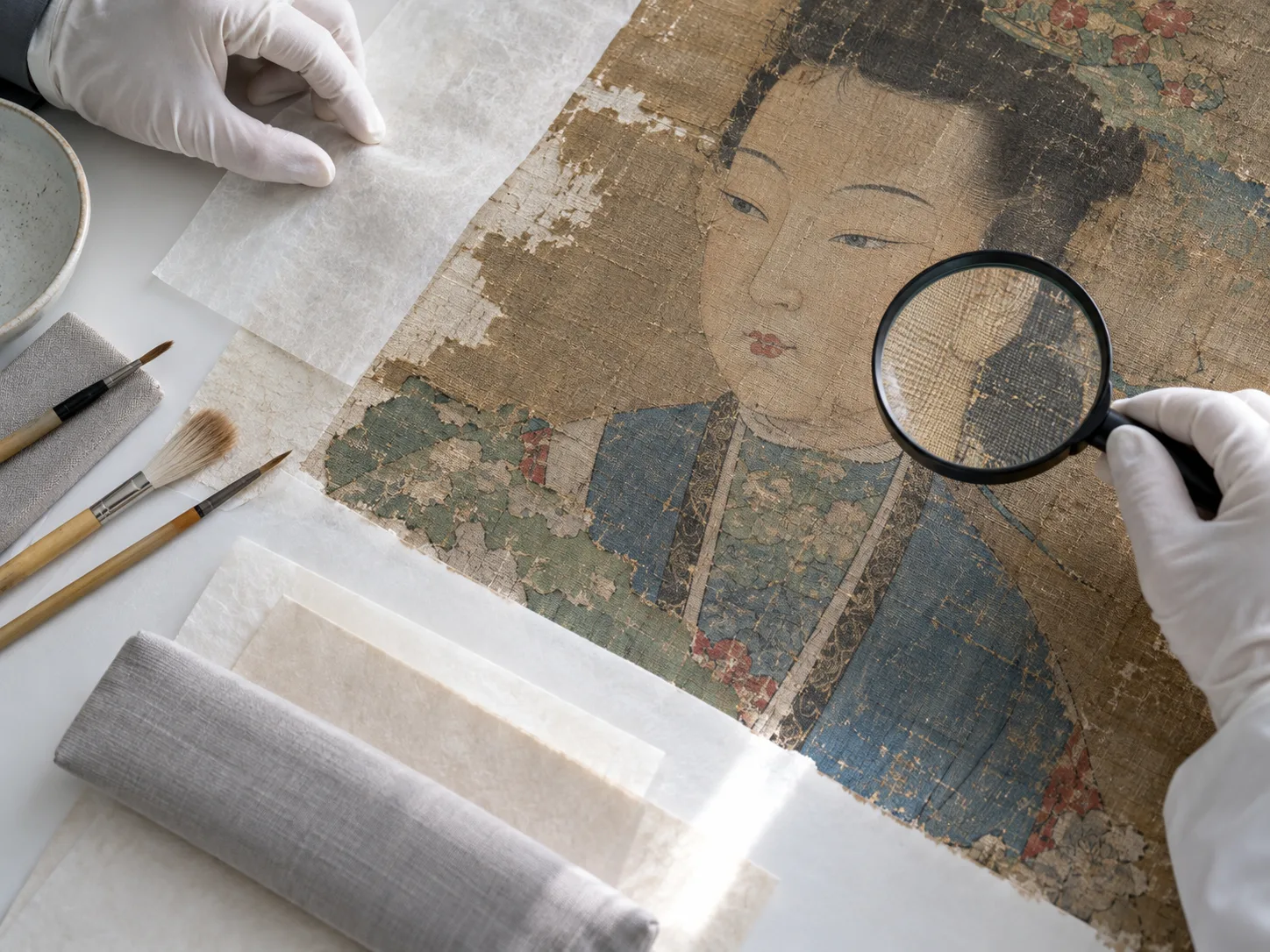
Creases, flaking, stains and replacement mountings are historical evidence as well as conservation problems. Do not flatten, clean, roll, wet or remount an old family portrait yourself. Photograph it without strong light, record dimensions and inscriptions, support it safely, and consult a qualified painting or paper conservator.
A six-step method for looking without overclaiming
Move from the catalogue to the face, then back to the object
- Record the label. Note title, sitter, attributed maker, date range, material, format, dimensions and every qualifier.
- Identify the proposed function. Ask whether the record says court, lifetime, commemorative, ancestral, family, scholar or another use—and whether that function is certain or inferred.
- Observe the body. Describe face, gaze, pose, scale and relation to other figures before interpreting expression.
- Map social details. List clothing, badges, jewellery, furniture and setting, but separate what is visible from what comparison suggests.
- Inspect the object layers. Distinguish painted field, inscriptions, seals, silk borders, backing, rods and later repairs.
- State the limit. End with what remains unknown: sitter, painter, original mounting, workshop, date, ritual use or sequence of copies.
Compare works with the same question, not the same answer
Comparison is most useful when it preserves difference. Put a court portrait beside a scholar’s likeness and ask how each constructs authority. Compare a couple portrait with two separate spouse scrolls and ask how family relation is visualized. Set a portrait painted from life beside a posthumous commemorative work and ask which parts claim individual likeness and which establish role.
The history of Chinese painting helps place portraits beside tomb images, court commissions and later exhibition works without forcing a single origin story. The handscroll guide provides a contrasting viewing experience in which sequence and handling operate differently from a large frontal portrait.
Keep names, dignity and uncertainty together
A museum portrait may have lost its sitter’s name through sale, displacement, remounting or incomplete records. “Unidentified” should not turn the person into a generic costume type. Describe the object precisely, acknowledge the sitter’s dignity and avoid inventing personality, ethnicity, rank, religion or biography from appearance.
Useful starting points include the Smithsonian publication on commemorative portraits, its record for Shi Wenying, the National Museum of China’s Ming–Qing portrait survey, the Met’s object-led painting gallery, and the conservation study in the Journal of the American Institute for Conservation. Together they show why likeness, role, ritual, workshop practice and material history must be read as related evidence rather than collapsed into one formula.