Daoist Talismans: Script, Ritual Action and the Limits of Looking
道教符箓:书写、科仪行动与观看边界
A Daoist talisman, often called a fu (符), is not simply a mysterious design on yellow paper. In ritual settings it can join writing, divine names, seals, diagrams, spoken formulas, bodily preparation and a precisely defined purpose. The visible sheet is therefore one moment in a larger action. This guide, read with the overview of Taoist festivals and rituals, explains what can responsibly be learned from surviving papers, manuals, photographs and museum labels—and what remains invisible without a named tradition and context.

1. A Talisman Is a Document in Action
Fu and lu are related but not interchangeable
The compound fulu (符箓/符籙) is often translated loosely as “talismans.” Its two parts, however, point to different kinds of ritual authority. A fu may be a written or inscribed sign used in a rite. A lu is a register: a transmitted record of divine names, offices or powers that can also mark a priest’s ritual rank and authorization. A register is not merely a larger talisman, and a single sheet cannot by appearance alone prove that its maker received a particular transmission.
This distinction connects talismanic papers to the site’s account of Daoist ordination and lineage today. In both cases, ritual capacity is not reduced to attractive handwriting. Community, teacher, ordination, manuals and the circumstances of use all matter.
Lines can behave as names, commands, seals and diagrams
Some talismanic writing includes recognizable Chinese graphs; other passages compress, combine or transform strokes. Seal-like forms, divine names, star patterns and diagrammatic structures may occupy one field. Calling all of this “secret calligraphy” is too simple. The visual marks can perform several jobs at once, and the same-looking component may be understood differently in different textual or liturgical systems.
A viewer should therefore resist a one-stroke-one-word decoding exercise. Without a recoverable manual, title, lineage or ritual explanation, an isolated mark may remain unidentified. Uncertainty is not a failure: it is more accurate than borrowing a key from an unrelated talisman found online.
The written object is only one part of efficacy claims
Joshua Capitanio’s study of Daoist manuals shows that ritual texts do not all explain efficacy in the same way. Some emphasize conditions outside the officiant, while others emphasize the practitioner’s internal preparation and disposition. This means the visible design is not treated, even within historical Daoist sources, as a free-standing mechanism that works independently of production and performance.
Claims that a talisman protects, summons, heals or transforms belong to religious discourse. They can be studied historically and respectfully, but they are not medical evidence or a reason to delay professional care. This article neither reproduces operative designs nor teaches their manufacture.
2. From Tally and Register to Liturgical Systems
Bureaucratic language supplied an important analogy
The ordinary word fu could refer to a matching tally or token of authorization in early China. Later religious uses drew on a wider documentary world of warrants, registers, petitions and seals. The analogy is useful: a document is meaningful because of who issues it, who receives it and which system recognizes it—not because paper and ink possess one universal message.
This documentary perspective complements Daoist ritual seals. A seal matrix, an impression and a talisman are not the same thing, but both can participate in the ceremonial language of office, authentication and communication.
Organized Daoist communities transmitted texts and ritual authority
Terry Kleeman’s history of Daoism and popular religion describes the organized religion that emerged around the Celestial Masters as transmitting sacred texts, talismans and ritual regalia through ordination. That history does not make every Chinese charm “Daoist,” nor does it establish one unchanged design from the second century onward. It does show why lineage and authorized transmission became central to understanding religious documents.
Later Shangqing, Lingbao, Zhengyi, Thunder Rite and local traditions developed different textual repertoires and ritual programs. The history is cumulative and branching rather than a straight line toward a standard modern sheet. A title from one canon or manual is evidence for that textual setting, not a universal template.
Printing and circulation changed access without ending secrecy
Hand copying, woodblock printing, commercial manuals and modern reproductions created new paths of circulation. Some designs moved beyond the communities that produced them; others remained restricted, fragmentary or intelligible only with oral instruction. A printed page may preserve an old title while reflecting a later edition, commentary or market.
Dates must therefore be attached carefully. The date of a ritual attributed inside a text, the date of a surviving manuscript, the date of a printed edition and the date an object entered a collection are different facts. None should silently replace another.
3. Materials, Handling and Ritual Sequence
Paper colour and ink are evidence, not an authentication test
Yellow paper and red pigment are familiar in modern images, but Daoist talismanic materials are more varied. Historical sources and collections also preserve marks on white paper, silk, wood, stone and other supports, using black or coloured media. Even when yellow and red appear together, they do not identify a date, lineage or purpose by themselves.
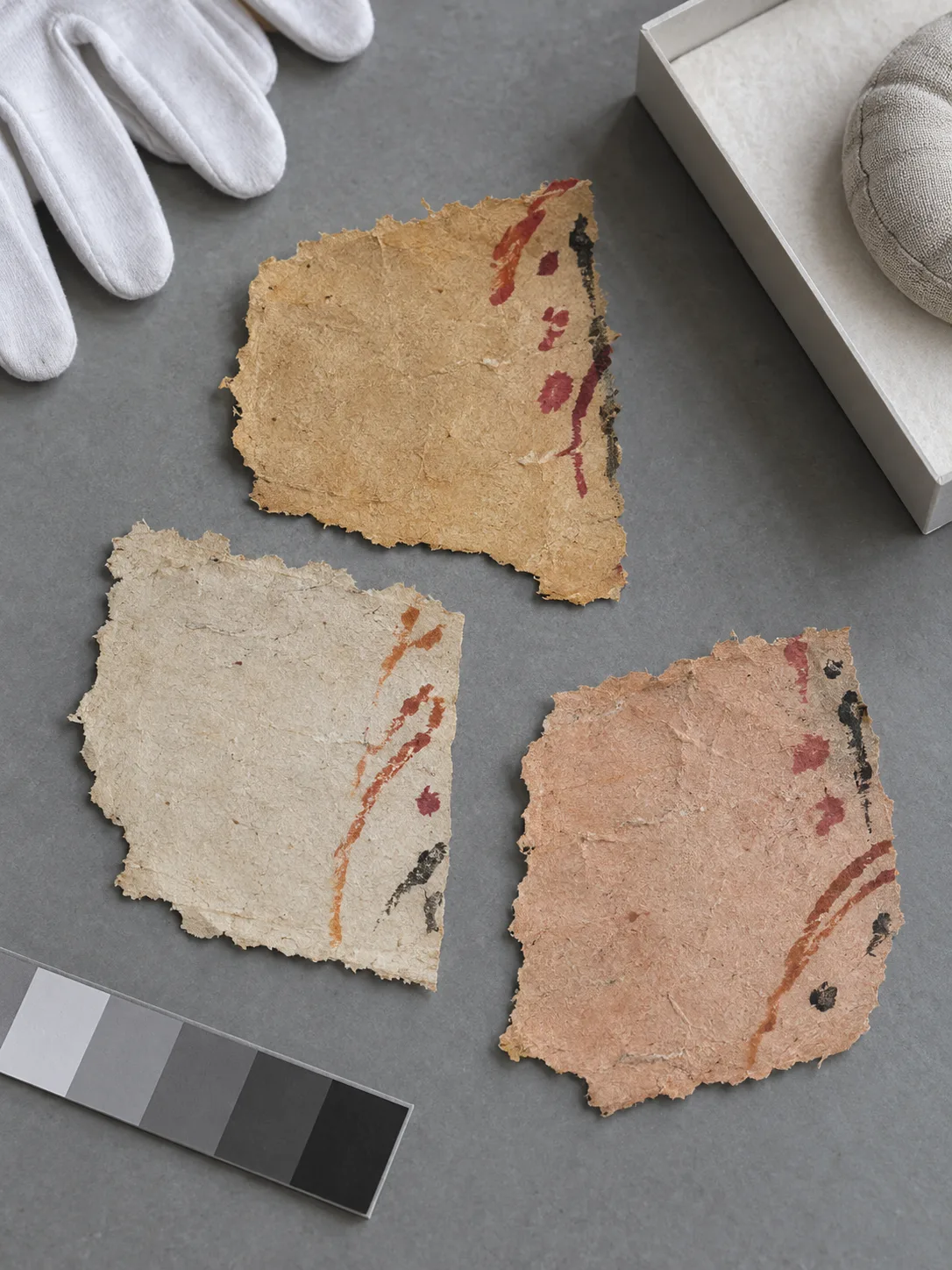
Material questions remain useful: Was the sheet brushed, printed, stamped or copied? Are folds, holes, scorching, paste or edge wear present? Do these features belong to original handling, later storage or modern mounting? Answers require close examination and provenance, not colour symbolism alone.
Making can be a timed ceremonial act
Ritual manuals may coordinate the preparation of the officiant, brush and support with invocations, gestures, visualizations or breaths. The order can matter as much as the finished lines. As with Daoist ritual music and lamp liturgies, a photograph freezes one instant while the rite unfolds in time.
Not every tradition uses the same sequence, and public descriptions rarely transmit every element. A responsible article can explain the relationship among writing, authorization and performance without turning restricted knowledge into a do-it-yourself recipe.
Use may change or consume the sheet
Depending on the rite, a talisman may be carried, worn, displayed, affixed, placed with another object, folded, sealed, buried or burned. In some historical settings, ashes entered a further ritual process. These uses are not interchangeable, and a charred edge does not by itself reveal which one occurred.
Consumption complicates the archive: the most fully used objects may not survive. Museum collections can therefore overrepresent sheets that were stored, collected or never completed. Absence from a collection is not proof that a practice did not exist.
4. How to Look Without Flattening the Tradition
Use a six-part evidence method
- Name the object cautiously: distinguish a talisman, register, petition, seal impression, printed charm, manuscript diagram and later copy.
- Record the support: note material, size, folds, mounting, media and condition before interpreting the design.
- Map visible zones: describe headers, central fields, borders, seals or diagrams without pretending every stroke is readable.
- Locate the context: identify the manual, collection history, ritual title, officiant, community and date when evidence allows.
- Separate sources: distinguish an object label, ritual manual, later commentary, practitioner explanation and modern commercial claim.
- Preserve the boundary: do not copy, activate, sell, wear or circulate a design as “authentic” merely because it looks old.
This method works in a museum, archive or published catalogue. It directs attention from visual excitement toward provenance and relation. It also prevents a single dramatic sheet from standing in for all Daoist traditions.
Do not confuse talismans with every Chinese charm
Buddhist, popular-religious, household and commercial objects can share paper, seals, divine names or apotropaic aims with Daoist materials. Exchange among traditions is historically important, but resemblance is not identity. The best label names the community, text or collection history that supports an attribution.
The same caution applies to contemporary tattoos, décor and online graphics. A design removed from its source may combine unrelated fragments or invert them. Visual similarity cannot restore lost authorization or ritual setting.
Courtesy matters in living ritual settings
During zhai or jiao observances, documents may be prepared, carried or burned as part of a larger service. Visitors should not cross an altar boundary, move papers, request private designs, interrupt officiants or assume photography is permitted. The sequence may also involve the garments discussed in Daoist ritual robes.
A respectful question is concrete: “How is this document named in this rite?” That is better than asking for a universal symbol key. Sometimes the most accurate answer will remain partial because transmission, privacy and local practice set legitimate limits.
Research note: The discussion of ritual efficacy follows Joshua Capitanio, “Discourses of Efficacy in the Ritual Use of Daoist Talismans”, Journal of the American Academy of Religion 91.1 (2023). The historical distinction between organized Daoism and the wider field of Chinese popular religion follows Terry Kleeman’s “Daoism and Popular Religion in Imperial China”. The placement of talismans among Daoist artistic and ritual forms draws on Shih-shan Susan Huang’s “Taoism and the Arts”. The comparison with non-Daoist talisman traditions is bounded by Sujung Kim’s “Buddhist Talismans”. These sources support contextual history, not a universal decoding chart or instructions for ritual use.