Daoist Lamp Rituals: Light, Cosmic Patterns and Ceremonial Space
道教灯仪:光明、星象秩序与科仪空间
A lamp in a Daoist rite is more than a practical source of light. Once flames are counted, positioned, kindled, addressed and withdrawn according to a liturgy, illumination becomes part of the ceremony’s language. Lamps can mark directions, articulate a ritual field, correspond to celestial patterns and accompany acts of remembrance or salvation. Yet no single arrangement explains every Daoist lamp rite. Read alongside the overview of Taoist festivals and rituals, this guide shows how to examine the evidence without turning a complex liturgical tradition into a universal code.
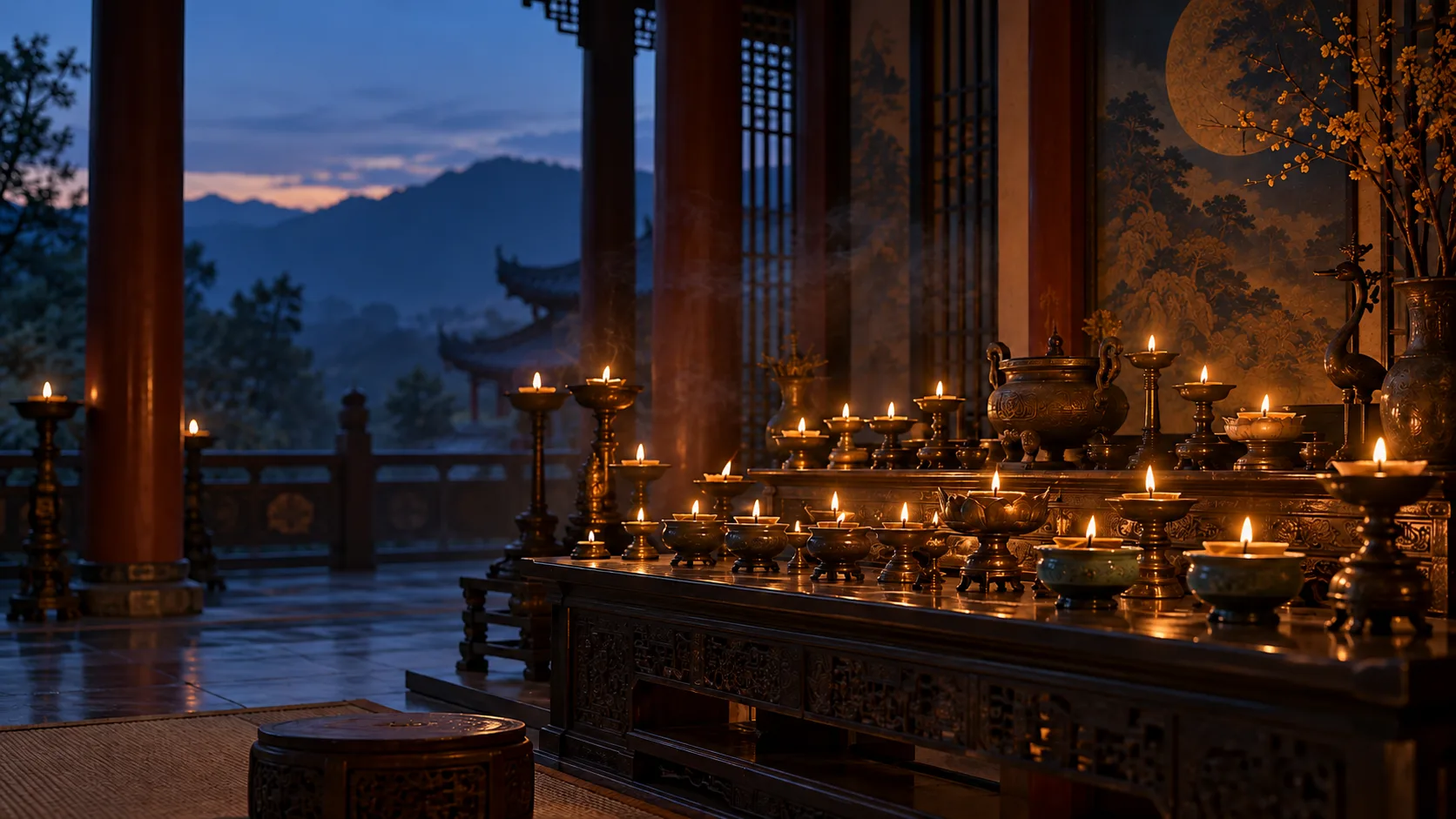
1. From Illumination to Liturgical Action
A lamp becomes ritual through order
Oil, wick, vessel and flame are ordinary materials. Their ceremonial significance arises from trained action: where a lamp is placed, when it is lit, which text is recited, who tends it and how it relates to other parts of the altar. In this respect, lamps resemble the implements discussed in Daoist ritual seals. Neither object carries one complete meaning in isolation; authority and function emerge in use.
The Chinese term dengyi (灯仪/燈儀), “lamp liturgy” or “lamp ritual,” refers to prescribed ceremonial forms rather than merely decorating a hall with lanterns. Historical manuals specify attendants, sequences, spatial arrangements and invocations. A visitor may see flames, but the full rite also includes words, gestures, movement and a body of transmitted knowledge.
Kindling, dividing and withdrawing light
Scholarly accounts describe lamp rites as processes. Light may be introduced into a darkened or prepared space, distributed from one flame to others, honored through recitation, and finally withdrawn. The verbs matter: kindling and “dividing the lamps” create a sequence in time, while extinguishing or collecting them closes it. The ceremony is therefore not a static tableau.
This temporal structure connects lamps with the sounds explored in Daoist ritual music. A struck bell, a sung text and a newly lit flame may each mark a transition, but none should be interpreted apart from its position in the liturgy.
Light is not a universal symbol with one definition
It is tempting to translate every flame as “wisdom,” “life” or “the Dao.” Such associations may be meaningful in a particular text, but they are not interchangeable labels. In different rites, lamps can illuminate a path, make a celestial order present, accompany petitions, address the living, aid the dead or support purification and offering.
The safest method is to move from the specific outward: identify the ritual name, date, community, manual or practitioner explanation before assigning meaning. Similar-looking lamp practices also occur in Buddhist, popular-religious and household settings. Shared materials do not erase differences in texts, clergy, pantheons or aims.
2. A History Written in Manuals and Altars
Early medieval sources place lamps in Daoist ritual space
The surviving record does not support a timeless origin story. The Daoist Culture Centre’s reference account notes no lamp ritual in the earliest Daoist sources, then points to lamps entering ritual space in the Southern and Northern Dynasties. It identifies Lu Xiujing’s fifth-century liturgical regulations as evidence for a “lantern attendant,” and the sixth-century compendium Wushang miyao as evidence for lamps in several fasting rites.
These texts matter because they document organization, not simply the presence of fire. A named attendant implies responsibility within an ordered ceremonial team. Readers can compare that developing liturgical structure with the broader history of the Lingbao tradition, whose communal rites became central to later Daoist ritual.
Tang and Five Dynasties compendia systematized lamp liturgies
By the late Tang and Five Dynasties, manuals associated with Du Guangting included rites for paying homage to lamps. The historical claim should be kept modest: this does not prove that all temples performed the same service, but it does show that lamp rites had become explicit, textualized components of larger liturgical systems.
The categories “Golden Register” and “Yellow Register” in later materials connect different lamp liturgies with different ceremonial aims. Register here is not a modern attendance list. It belongs to a religious vocabulary of petitions, cosmic administration and rites directed toward communities, rulers, the living or the dead. For the role of communal offering, see the guide to jiao rituals.
Later canons preserve plurality, not one master design
The Ming Daoist Canon and its supplement preserve multiple lamp liturgies with titles associated with the Jade Emperor, the Mysterious Emperor, the Three Mao Brothers and Yellow Register salvation. This variety is itself important evidence. “The Daoist lamp ritual” is a convenient umbrella, not the name of one unchanging ceremony.
Local traditions continued to transmit, combine or adapt materials. Modern ethnography likewise records variation in altar construction and performance. A printed manual, an observed rite and a museum object answer different questions; none by itself supplies a complete history of practice.
3. Lamps as Maps of Ceremonial Space
Number and position can make relationships visible
Lamps are often arranged rather than scattered. Rows, rings, directional groups or gridded fields can relate a prepared floor or altar to cosmological models. Some manuals organize lights around directions, trigrams, palaces or stellar groupings. In one historical description of an altar, lanterns represented the four directions, eight trigrams and twenty-eight lunar lodges.
These correspondences do not turn the altar into a simple diagram with a key. The same number can enter different systems, and an arrangement may be completed by recitation, pacing or visualization that a photograph cannot show. Count only what is visible, then look for an identified ritual source before naming the pattern.
Nine-fold fields link center, directions and movement
One well-documented salvation liturgy organizes nine ritual zones in relation to the Nine Palaces and Nine Hells. Accounts describe lamps placed around an octagonal field or on tiered stands, while the ritual master moves through directions and center. The spatial pattern is activated by performance; it is not merely an ornament representing “nine.”
Such descriptions should not be treated as instructions for home reconstruction. They belong to trained, transmitted rites with clerical roles and liturgical texts. The public can study their history and spatial logic without imitating restricted or context-dependent procedures.
The altar coordinates light with text, sound and bodies
A lamp field becomes legible through relationships. An attendant tends flames; a high priest recites or moves; musicians punctuate stages; petitions and offerings occupy defined places. The article on zhai rites explains how preparation and purification frame ceremonial action, while incense in Daoist ritual shows another material whose use is inseparable from timing and context.
Light also changes what participants can see. A sequence of flames can reveal a center, trace a route or create a threshold between ordinary and ritual space. That perceptual effect is real, but claims about supernatural efficacy belong to religious teaching, not to empirical demonstration.
4. How to Read a Lamp Rite Responsibly
Use a six-part observation method
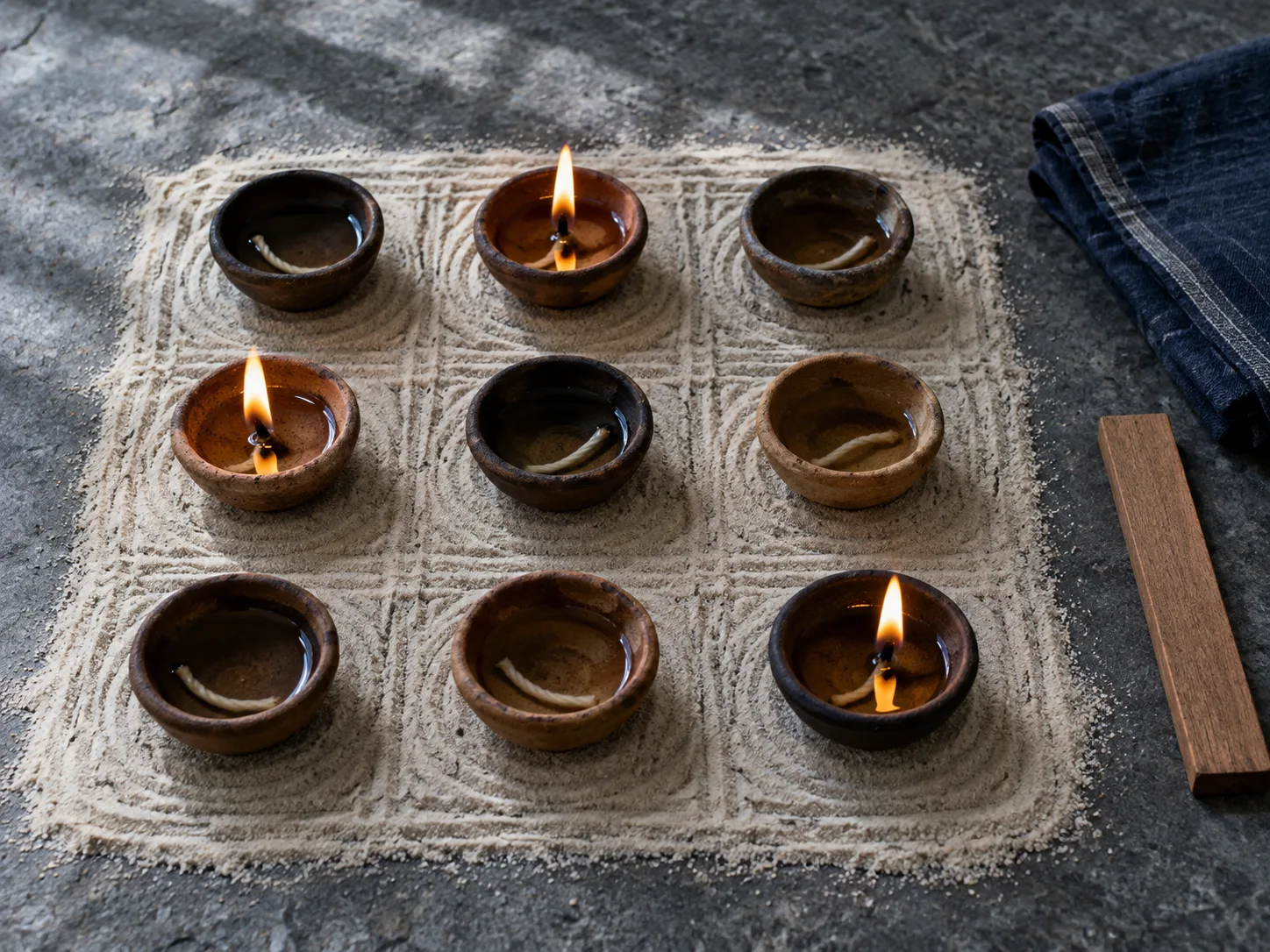
- Name the setting: distinguish a liturgy, festival display, memorial service, ordinary shrine lamp, heritage demonstration and theatrical performance.
- Record the arrangement: note rows, circles, tiers, directions and center without immediately decoding them.
- Follow the sequence: observe which light is kindled first, how flame is distributed and when lamps are withdrawn.
- Connect actions: relate changes in light to recitation, music, offerings, movement and handling of documents.
- Identify the evidence: separate what you saw from labels, manuals, practitioner explanations and later interpretation.
- Respect the boundary: do not cross a prepared field, move a vessel, light a wick or imitate a procedure.
This method produces a useful record without pretending to decode everything. It also prevents the visual drama of fire from eclipsing less conspicuous work performed by attendants, readers, musicians and sponsors.
Distinguish lamp rites from the Lantern Festival
The annual Lantern Festival can include public display, riddles, processions and local temple observances. A Daoist dengyi is a liturgical category. The two may intersect in a particular community, but the shared object “lantern” does not make them historically or ritually identical. Date, sponsor, officiants and texts are better guides than appearance alone.
The same caution applies to “Big Dipper lamps,” long-life lamps and water lanterns. These phrases can refer to different practices across regions and religious environments. Use the community’s own name where it is available, and preserve uncertainty where it is not.
Safety, photography and religious courtesy come first
Open flames present ordinary risks: hot oil, unstable vessels, smoke and crowded movement. Visitors should never touch or relight a ritual lamp, and should follow barriers and staff instructions. Lamp rites are not health treatments; historical promises of merit, longevity or salvation are religious claims and must not replace medical care.
Photography is not automatically permitted. Avoid flash, tripods in circulation routes and close views of worshippers without consent. The guidance on Taoist pilgrimage and temple etiquette applies here: sometimes the most accurate and respectful observation is made with the camera put away.
Research note: The historical outline and terminology follow the Daoist Culture Centre’s reference article on Lantern Rituals for the Destruction of Hell, checked against Zhang Zehong’s peer-reviewed overview of Daoist dignified liturgies in Religions 14.6 (2023). Descriptions of lighting and dividing lamps in a salvation service draw on the scholarly chapter “Performing the Salvation Ritual”; the broader account of early Lingbao ritual and Lu Xiujing draws on “The Sacred Jewel Retreat”. The article treats these as evidence for particular texts and settings, not as proof of one universal Daoist practice.