PEAKS · 奇峰

72 Peaks, 36 Cliffs, and 24 Streams: The Mathematical Cosmology Connecting Wudang Mountain to the Human Body 七十二峰、三十六岩与二十四涧:连接武当山与人身小宇宙的数理宇宙观

Why traditional gazetteers organize Wudang’s terrain around 72, 36, and 24 — and how those same seasonal numbers (72 pentads, 36 half-months, 24 solar terms) link the mountain’s ridges, cliffs, and waters to daily cultivation.

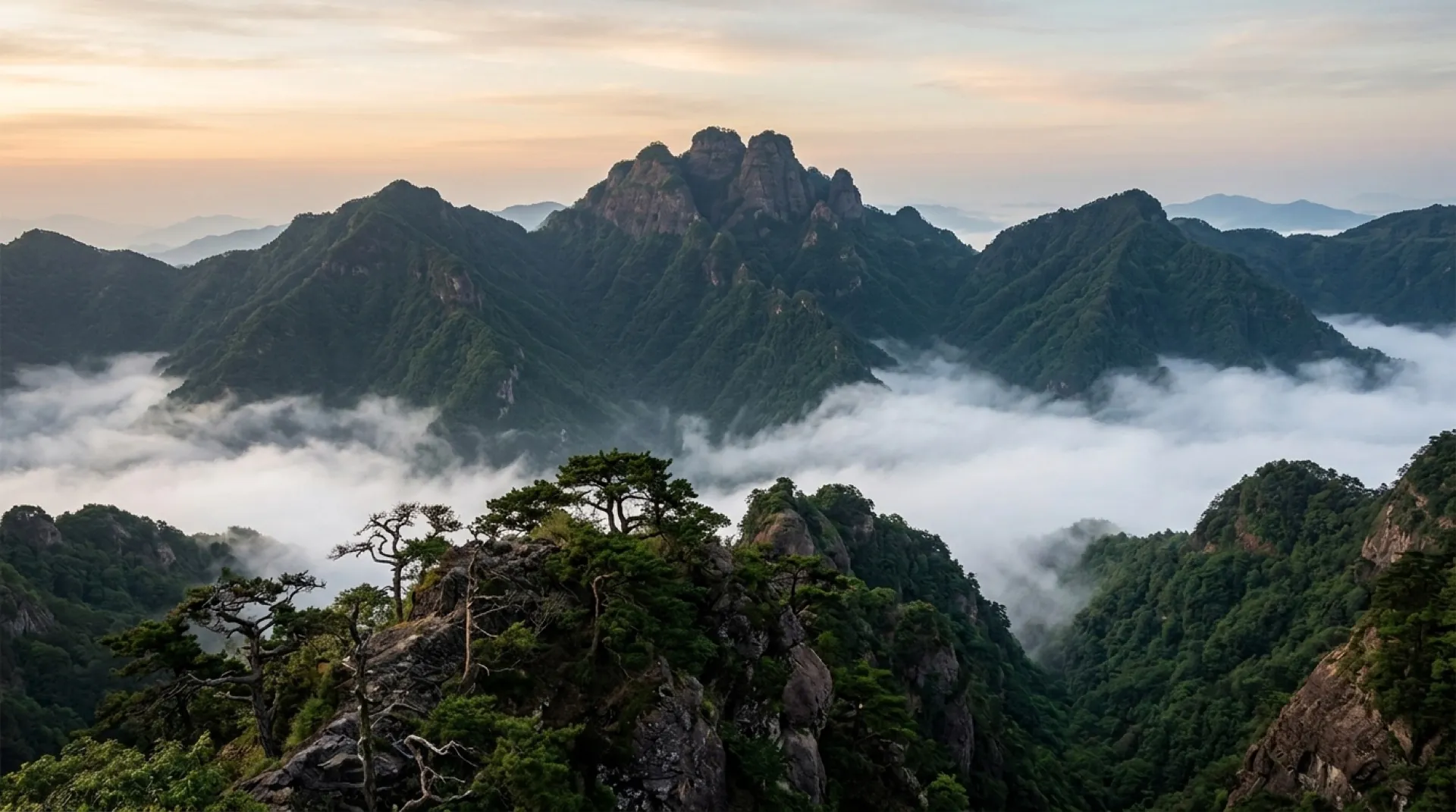
Forested mountain peaks rising above a sea of clouds at dawn, with weathered pines on the foreground ridge.

Anyone who opens a traditional guide to Wudang Mountain’s natural landscape meets three numbers right away: 72 Peaks (七十二峰), 36 Cliffs (三十六岩), and 24 Streams (二十四涧). First-time visitors sometimes ask whether a modern geologist with a GPS would count seventy-two summits and stop there. That question misses what a classical Chinese mountain catalogue is doing. Since the Yuan-dynasty Taoist Liu Daoming (刘道明) compiled the Wudang Fudi Zongzhen Ji (《武当福地总真集》), these numbers have served as a cosmological framework linking the mountain’s ridges, rock recesses, and waters to the solar year and the human body.

1. Where the numbers 24, 36, and 72 come from in Chinese timekeeping

In classical Chinese astronomy and calendar science — which you can explore live on our Wellness and Book of Changes hubs — the solar year is divided by multiples of twelve:

  • 24 Solar Terms (二十四节气) → 24 Streams: The sun’s annual path is marked by 24 fortnightly nodes (Beginning of Spring 立春 through Major Cold 大寒). Naming 24 principal mountain ravines and streams turns the mountain’s water network into a living calendar of circulating fluid.
  • 36 Ten-Day Weeks / Trigram Measures (三十六旬 / 三十六宫) → 36 Cliffs: Thirty-six ten-day periods (xun 旬) make up the 360-day ritual year, and in Song–Yuan cosmology Shao Yong spoke of the “thirty-six palaces are all spring” (三十六宫都是春). On Wudang, the 36 Cliffs mark the sheltered alcoves and rock ledges across the middle slopes where hermits sat out the seasons.
  • 72 Pentads (七十二候) → 72 Peaks: Each of the 24 solar terms divides into three five-day pentads (hou 候), making 72 pentads in a year. Arranged around the central axis of Tianzhu Peak (1,612 m) in the formation known as “seventy-two peaks bowing to the Great Summit” (七十二峰朝大顶), the peaks mirror the 72 seasonal transformations revolving around the pole star.

2. How Taoist texts map the mountain onto the human body

In Taoist correlative thought (Yin-Yang and the Five Phases) and scriptures like the Huangting Jing (Yellow Court Classic), the human body is a miniature mountain (人身小天地), and the mountain is a macrocosmic body:

  • Peaks as bone structure and the crown (百会与脊梁): Just as the surrounding ridges incline toward Tianzhu Peak, in Taoist meditation and Wudang Taijiquan the joints of the body align around a single upright central axis (zhongding 中定) rising to the crown.
  • Cliffs as internal cavities and chambers (岩洞与丹田窍穴): A cliff overhang shelters a hall from wind and rain while opening outward to light. In Guarding the One (Shouyi) and Inner Observation (Neiguan), the body’s internal spaces are treated with that same quiet, sheltered spaciousness.
  • Streams as breath, blood, and seasonal circulation (涧水与气血津液): As our guide From Ravine to Reservoir: Reading Water at Wudang notes, mountain water gathers from high mist into streams that nourish the valleys below — the exact image classical texts use for clear breath and fluid circulation across the twelve two-hour periods of the day.

3. How to hold the numbers honestly

Notice what a good teacher tells you here: the numbers 72, 36, and 24 are canonical catalogues, not a claim that nature only formed seventy-two rock summits. Different historical gazetteers (such as Liu Daoming’s Yuan catalogue and the Ming imperial gazetteers) occasionally vary on individual minor peak or stream names while preserving the 72 / 36 / 24 framework. Honouring the cosmology means understanding why the tradition organized the landscape this way, without inventing modern measurements that the texts never made.

To try today: Open the interactive Sacred Geography explorer below and switch between the Peaks, Cliffs, and Streams filters, then check today’s solar term on the Wellness hub to see which of the 24 seasonal nodes and 72 pentads you are standing in right now.

Seeker’s Q&A · Frequently Asked Questions

Why does Wudang tradition group the mountain into 72 Peaks, 36 Cliffs, and 24 Streams?

Since Liu Daoming’s Yuan-dynasty gazetteer Wudang Fudi Zongzhen Ji, the mountain’s landforms have been catalogued using the numbers of the traditional solar calendar: 24 solar terms (24 Streams), 36 ten-day weeks (36 Cliffs), and 72 five-day pentads (72 Peaks surrounding Tianzhu Peak).

What does “seventy-two peaks bowing to the Great Summit” (七十二峰朝大顶) mean?

It describes how Wudang’s surrounding ridges incline visually toward the central summit of Tianzhu Peak (1,612 m), and in cultivation practice it serves as an image for aligning the body’s joints and attention around a quiet, upright central axis.

Do all historical Wudang gazetteers list the exact same 72 peak names?

No. While the canonical framework of 72 Peaks, 36 Cliffs, and 24 Streams stays constant across Yuan and Ming gazetteers, individual minor peak or stream names occasionally differ between editions — showing that the numbers function as a structured cosmological catalogue rather than a modern geological survey.

Sacred geography

Explore the mountain, place by place

Choose a place on the mountain. Read what the record says, then what you can try there, and follow the links to the full articles.

Celestial Summit The highest ground and the end of the climb.

Middle Cliffs The middle slopes, where palaces are built on and against the rock.

Mountain Foot The way in: gate, first abbey, and the water at the foot.

Recorded, but not placed on the drawing

A schematic, not a map: it is not to scale and gives no heights or distances. The three zones are a reading order. Order within a zone is not claimed, and the places are not one continuous footpath: Taiziyan is a spur behind Zixiao, Wulong a western branch, Qiongtai an alternative approach, and Jingle needs a separate visit to Danjiangkou.

A catalogue or an unplaced entry

The 72 Peaks 七十二峰

A cultural catalogue, not a modern survey. The peaks are read in relation to Tianzhu Peak, and they are not mapped one by one here because the names cannot all be tied securely to places on today’s map.

Classical record

Practice connection

The site does not yet tie a practice to this place. The related reading below is the nearest thing.

Festival date

No festival date is tied to this place on the site. Wudang’s two principal dates are the third day of the third lunar month (Zhenwu’s birthday) and the ninth day of the ninth lunar month (his ascension).

Dates are lunar and are not converted to the Gregorian calendar, because a conversion table would be wrong within a year.

The dated documents in the two Daozang books on Zhenwu
  1. No dateXuantian shangdi qisheng lu (玄天上帝启圣录)

    Juan 1 tells of Zhenwu’s birth, his training on Taihe Mountain (the older name of Wudang), his investiture by Heaven and his return to his post in the sky. The later juan are miracle stories. The book has no date and no named author; read it as devotional writing.

  2. 1270Xuantian shangdi qisheng lingyi lu (玄天上帝启圣灵异录)

    Xu Shilong’s record of the Zhenwu temple (second month) and two steles for the Zhaoying Palace (ninth month). The texts do not say which present-day building is meant, so none is named here.

  3. 1304Xuantian shangdi qisheng lingyi lu (玄天上帝启圣灵异录)

    An edict conferring a title on Zhenwu.

  4. 1311–1312Xuantian shangdi qisheng lingyi lu (玄天上帝启圣灵异录)

    Prefaces to an illustrated record of the revelations, among them those of Zhao Mengfu and Yu Ji.

  5. 1314Xuantian shangdi qisheng lingyi lu (玄天上帝启圣灵异录)

    Edicts for Zhenwu, for the Holy Mother and for the Taoist Zhang Shouqing.

  6. 1315Xuantian shangdi qisheng lingyi lu (玄天上帝启圣灵异录)

    Cheng Jufu’s stele (third month) for the Great Tianyi Zhenqing Wanshou Palace. It says a master built a palace at Nanyan “making the rock itself the palace” (即巖為宮), five li from the Zixiao Palace; the court gave it that plaque in 1310 and added “Great” in the tenth month of 1314. It also tells how the Wudang Taoist Zhang Shouqing prayed for rain in the capital: a story told to explain why the court rewarded the mountain.

  7. 1325Xuantian shangdi qisheng lingyi lu (玄天上帝启圣灵异录)

    Two edicts for generals.