PEAKS · 奇峰

From Xuanyue Gate to the Golden Summit: How Wudang’s Ancient Pilgrim Steps Were Engineered to Pace Your Breath 从玄岳门到金顶:武当山古神道石阶如何顺应地形与行者呼吸

Why the stone Sacred Way does not climb in a straight line — and how ridges, level landings, gates, and steep final stairs teach a walker to regulate stride and breath from the mountain foot to Tianzhu Peak.

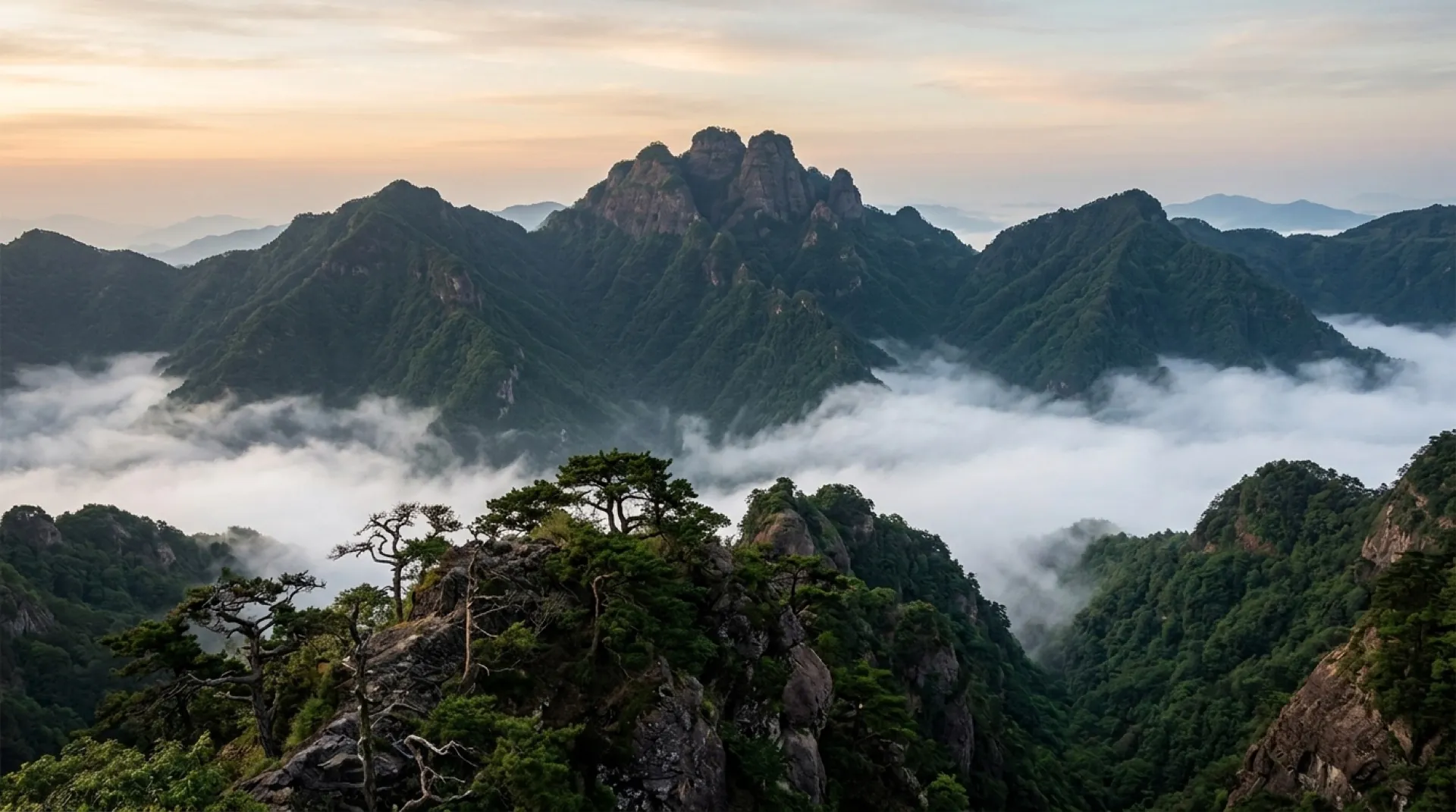
Forested mountain peaks rising above a sea of clouds at dawn, with weathered pines on the foreground ridge.

If you try to climb a mountain staircase the way people rush up an urban escalator, your calves burn and your breath turns shallow within ten minutes. Walk Wudang Mountain’s old stone Sacred Way (Gu Shendao 古神道) with a teacher, however, and you quickly notice something built into the path itself: the route from Xuanyue Gate at the mountain foot up to the Golden Summit atop Tianzhu Peak (published summit height 1,612 metres) never climbs at one relentless angle. Instead, it alternates rises, valley crossings, level courtyard thresholds, and steep final flights in a rhythm that naturally paces your stride and your breath.

1. The threshold at the foot: Xuanyue Gate to Yuanhe Guan and Yuxu Palace

The old approach begins at the 1552 stone archway of Xuanyue Gate (玄岳门), carved with the plaque Zhi Shi Xuan Yue (治世玄岳). Passing beneath it is not yet a steep climb: the path leads past Yuanhe Guan and across the broad basin of Yuxu Palace. Why does a mountain pilgrimage start on gentler ground? Because a walker arriving from town carries a fast pulse and high shoulders. The lower valley gives your stride twenty to thirty minutes to lengthen before the real gradient begins.

Notice here that historical pilgrims did not walk every Wudang site in one unbroken line: as our Landscape, Temples, and Routes and Map and Route Guide explain, Jingle Palace lay in old Junzhou (now Danjiangkou), Wulong Palace sits on its own western route, and Qiongtai is a separate slope approach to the summit.

2. The middle slopes: Taizipo, Zixiao Palace, and Nanyan

As the path rises into the middle mountain through Taizipo (Fuzhen Guan), Zixiao Palace, and Nanyan Palace, the builders used two terrain principles that every hiker feels in their lungs:

  • Following the ridge and ravine contours (随山就势): Rather than cutting straight up a slope, the stone steps curve along spurs and cross bridges over the mountain streams. Each bridge or shaded level section acts as a natural recovery interval where your heart rate settles without your having to stop dead.
  • Courtyard gates as breathing pauses: At Taizipo’s curving red walls (the “Nine-Turn Yellow River Wall”) and Zixiao Palace’s terraced courts, every gatehouse and stone landing forces you to lift your eyes from your feet to the horizon. When your gaze lifts and your chest uncoils, a cramped upper-chest breath drops back down toward the lower abdomen.

3. The final ascent: Chaotian Palace, the Three Heavenly Gates, and Tianzhu Peak

Beyond Nanyan and the 七星树 (Seven-Star Tree) valley, the trail climbs to Chaotian Palace (朝天宫) — the ritual threshold where pilgrims traditionally paused before entering the "heavenly court" of the summit — and then rises through the First, Second, and Third Heavenly Gates (一天门、二天门、三天门) toward the Golden Summit on Tianzhu Peak (1,612 m).

Here the steps narrow and steepen sharply, flanked by iron chains on stone pillars. Beginners make the mistake of leaning their upper body far forward and gasping through the mouth to conquer the flight. Seasoned walkers do the opposite:

  • Shorten the step, land the whole sole: On steep flagstones, place the entire foot flat on each tread rather than pushing off the toes alone, which exhausts the calves.
  • Match steps to an unforced exhale: Let the exhale be slightly longer than the inhale (for example, inhaling smoothly over two steps and exhaling softly over three or four steps, or slowing to one step per breath on the steepest pitches), breathing through the nose whenever comfortable.
  • Rest at the landings, not mid-flight: Use the level stone platforms at the Heavenly Gates to stand upright, soften the shoulders as in standing meditation, and let the breath quiet before starting the next flight.

Try this on your next staircase walk

You do not need to wait until you are in Hubei to practise this. Next time you walk up three flights of stairs at home or in Singapore, resist the urge to lean forward and rush. Keep the crown gently suspended as in Taoist meditation, place your whole foot on each step, and count two steps on the inhale, three steps on the exhale. Notice how you reach the top landing with steady breath instead of a racing pulse.

Seeker’s Q&A · Frequently Asked Questions

Where does the traditional Wudang Sacred Way (Shendao) begin and end?

The classical stone Sacred Way begins at the 1552 stone archway of Xuanyue Gate at the mountain foot, passes Yuanhe Guan, Yuxu Palace, Taizipo, Zixiao Palace, Nanyan, and Chaotian Palace, and climbs through the Three Heavenly Gates to the Golden Summit on Tianzhu Peak (1,612 m). Sites like Jingle Palace, Wulong Palace, and Qiongtai lie on separate branches or approaches.
How should beginners pace their breathing on Wudang’s steep stone steps?

Place the whole sole of your foot flat on each tread rather than pushing off your toes, keep your spine upright instead of hunching forward, and pair your stride with an unforced longer exhale (such as two steps on the inhale and three to four steps on the exhale), pausing on level gate landings to settle your shoulders.

What is the verified elevation of Wudang’s Golden Summit on Tianzhu Peak?

Tianzhu Peak’s published official summit figure is 1,612 metres (as cited by the Hubei provincial portal and our Tianzhu Peak guide). Because complex temple precincts along the lower and middle slopes lack uniform survey benchmarks, our Sacred Geography map cites only Tianzhu Peak’s 1,612 m figure.

Sacred geography

Explore the mountain, place by place

Choose a place on the mountain. Read what the record says, then what you can try there, and follow the links to the full articles.

Celestial Summit The highest ground and the end of the climb.

Middle Cliffs The middle slopes, where palaces are built on and against the rock.

Mountain Foot The way in: gate, first abbey, and the water at the foot.

Recorded, but not placed on the drawing

A schematic, not a map: it is not to scale and gives no heights or distances. The three zones are a reading order. Order within a zone is not claimed, and the places are not one continuous footpath: Taiziyan is a spur behind Zixiao, Wulong a western branch, Qiongtai an alternative approach, and Jingle needs a separate visit to Danjiangkou.

Mountain Foot

Xuanyue Gate 玄岳门

The stone archway where the old pilgrim road begins. Learn to read its “three bays, four pillars, five roofs” (三间四柱五楼) before you climb.

  • Ordered in the Jiajing reign (1552) and finished the next year; part of the UNESCO-inscribed complex (1994).

Classical record

  • Inscription治世玄岳

    The plaque reads 治世玄岳: Xuanyue is a name for the mountain, and 治世 means to bring order to the age. It is an imperial voice speaking to the mountain.

Practice connection

Before you walk on, decide silently what you are leaving behind and what you hope to notice higher up. It is a way of paying attention, not a rite from any source.

Festival date

No festival date is tied to this place on the site. Wudang’s two principal dates are the third day of the third lunar month (Zhenwu’s birthday) and the ninth day of the ninth lunar month (his ascension).

Dates are lunar and are not converted to the Gregorian calendar, because a conversion table would be wrong within a year.

The dated documents in the two Daozang books on Zhenwu
  1. No dateXuantian shangdi qisheng lu (玄天上帝启圣录)

    Juan 1 tells of Zhenwu’s birth, his training on Taihe Mountain (the older name of Wudang), his investiture by Heaven and his return to his post in the sky. The later juan are miracle stories. The book has no date and no named author; read it as devotional writing.

  2. 1270Xuantian shangdi qisheng lingyi lu (玄天上帝启圣灵异录)

    Xu Shilong’s record of the Zhenwu temple (second month) and two steles for the Zhaoying Palace (ninth month). The texts do not say which present-day building is meant, so none is named here.

  3. 1304Xuantian shangdi qisheng lingyi lu (玄天上帝启圣灵异录)

    An edict conferring a title on Zhenwu.

  4. 1311–1312Xuantian shangdi qisheng lingyi lu (玄天上帝启圣灵异录)

    Prefaces to an illustrated record of the revelations, among them those of Zhao Mengfu and Yu Ji.

  5. 1314Xuantian shangdi qisheng lingyi lu (玄天上帝启圣灵异录)

    Edicts for Zhenwu, for the Holy Mother and for the Taoist Zhang Shouqing.

  6. 1315Xuantian shangdi qisheng lingyi lu (玄天上帝启圣灵异录)

    Cheng Jufu’s stele (third month) for the Great Tianyi Zhenqing Wanshou Palace. It says a master built a palace at Nanyan “making the rock itself the palace” (即巖為宮), five li from the Zixiao Palace; the court gave it that plaque in 1310 and added “Great” in the tenth month of 1314. It also tells how the Wudang Taoist Zhang Shouqing prayed for rain in the capital: a story told to explain why the court rewarded the mountain.

  7. 1325Xuantian shangdi qisheng lingyi lu (玄天上帝启圣灵异录)

    Two edicts for generals.