Chinese Private Libraries (Cangshulou): How Collectors Built Paths for Books to Survive
中国藏书楼导读:私人收藏怎样为典籍延续开辟路径
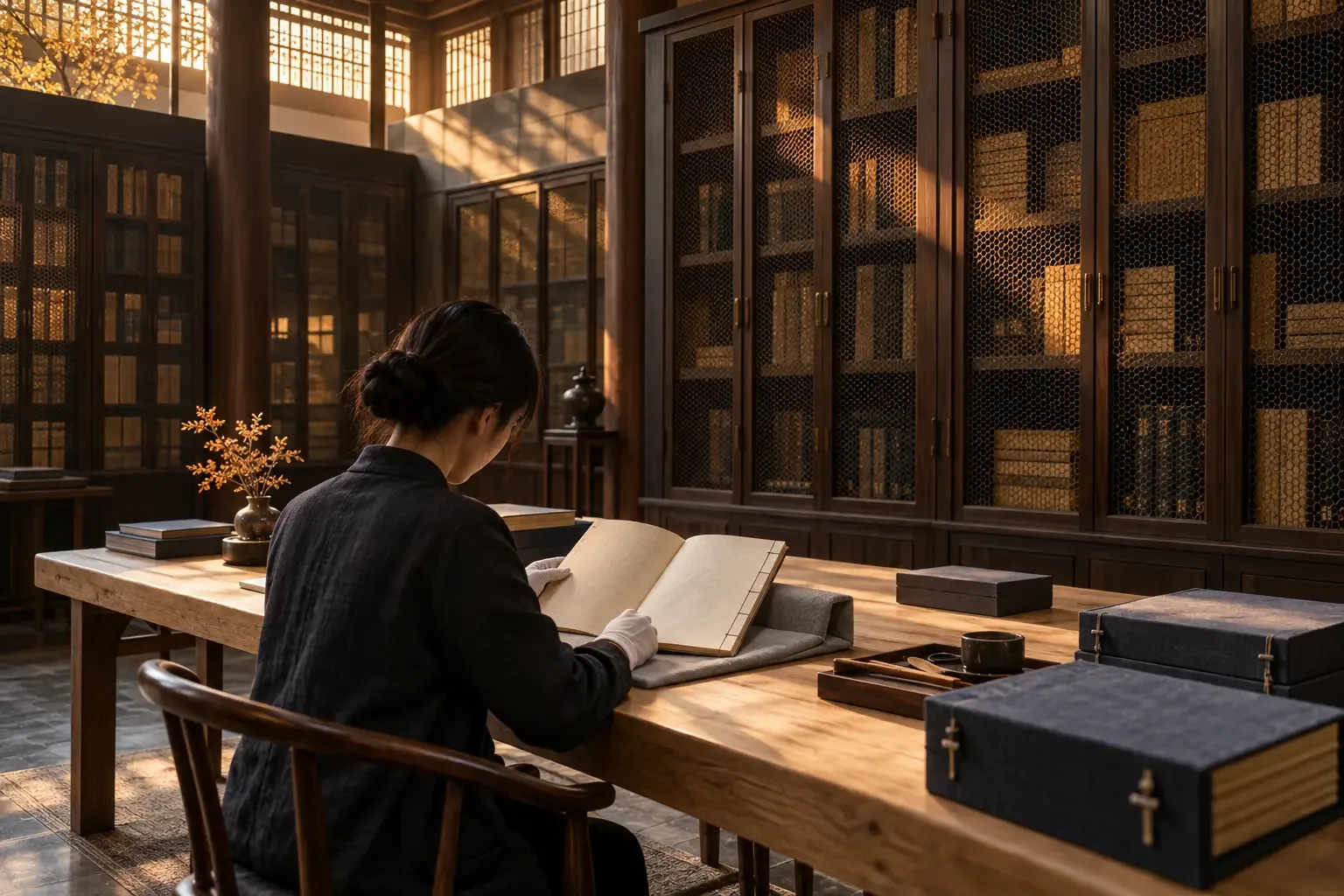
A cangshulou was a collection, a room and a household project
“Private library” needs historical qualification
藏书楼 (cángshūlóu) literally suggests a building for storing books, but the term can point to more than architecture. It may name a collection, its dedicated rooms, or a household enterprise organized by one or several generations. “Private library” is convenient only if we do not imagine a modern public lending service. Begin with our Chinese literature reading paths, then ask who gathered the books, who could enter, and which tasks kept the collection usable.
Collecting was selection, not neutral accumulation
Books arrived through purchase, copying, gifts, inheritance and exchange. Money mattered, but so did proximity to book markets, scholarly contacts and the collector’s interests. A collection might emphasize classics, local writings, medical works, rare editions or working reference books. Its shelves therefore preserve choices and opportunities, not a complete map of knowledge. The absence of a title may reflect taste, cost, loss or a gap in the surviving evidence.
Collections were assembled across regions and generations
Continuity depended on many acts of transfer
A Peking University study of private collecting in the Yuan period follows collectors who preserved and transmitted earlier editions while also building new holdings. Such evidence discourages a single golden-age story. Chinese book collecting developed through repeated moments of acquisition, copying, dispersal and recovery; the path of an individual copy could cross dynasty, province and household.
The physical book records repeated care
Bindings were replaced, leaves repaired, volumes regrouped and labels renewed. Our guide to Chinese thread-bound books explains why the form visible today may be much later than the printed or manuscript leaves inside. Repair can enable survival while obscuring an earlier arrangement. Condition is thus historical evidence, not merely a measure of beauty or value.
Architecture managed risk rather than guaranteeing safety
Storage separated books from some everyday hazards
Dedicated rooms or buildings could limit handling, organize shelving and reduce exposure to kitchens, lamps and crowded living areas. Official accounts of historic Chinese book-storage buildings discuss Tianyi Pavilion’s siting and fire-conscious design. Those details belong to a particular building history, not a universal blueprint: many collections occupied adapted domestic spaces, and surviving examples are an unusually fortunate sample.
Tianyi Pavilion is an exceptional case, not the definition
Fan Qin (1506–1585) established the Tianyi collection in Ningbo during the Ming. The institution’s official research history and site description document family stewardship, architecture and later preservation. Its long survival makes it invaluable, but also atypical. One should not project its plan, family rules or present museum form onto every cangshulou.
Catalogues turned shelves into arguments about knowledge
A catalogue is an intellectual map
Late-imperial private catalogues grouped titles, named editions, added judgments and sometimes recorded missing or incomplete volumes. A Brill study of library catalogues in late imperial China identifies 167 known Ming private-library catalogues, of which 48 survive in full manuscript or print. The imbalance is itself evidence: catalogues, like books, were vulnerable, and the surviving corpus cannot represent all collectors evenly.
A list is not a photograph of one day’s shelves
Catalogues may combine inherited entries, desired titles and records made at different moments. Books could be loaned, sold, lost or acquired after compilation. Classification also interprets: placing a title among classics, histories, masters or collections makes a claim about how it should be read. Compare classified books and dictionaries and rhyme books to see how ordering systems answer different scholarly needs.
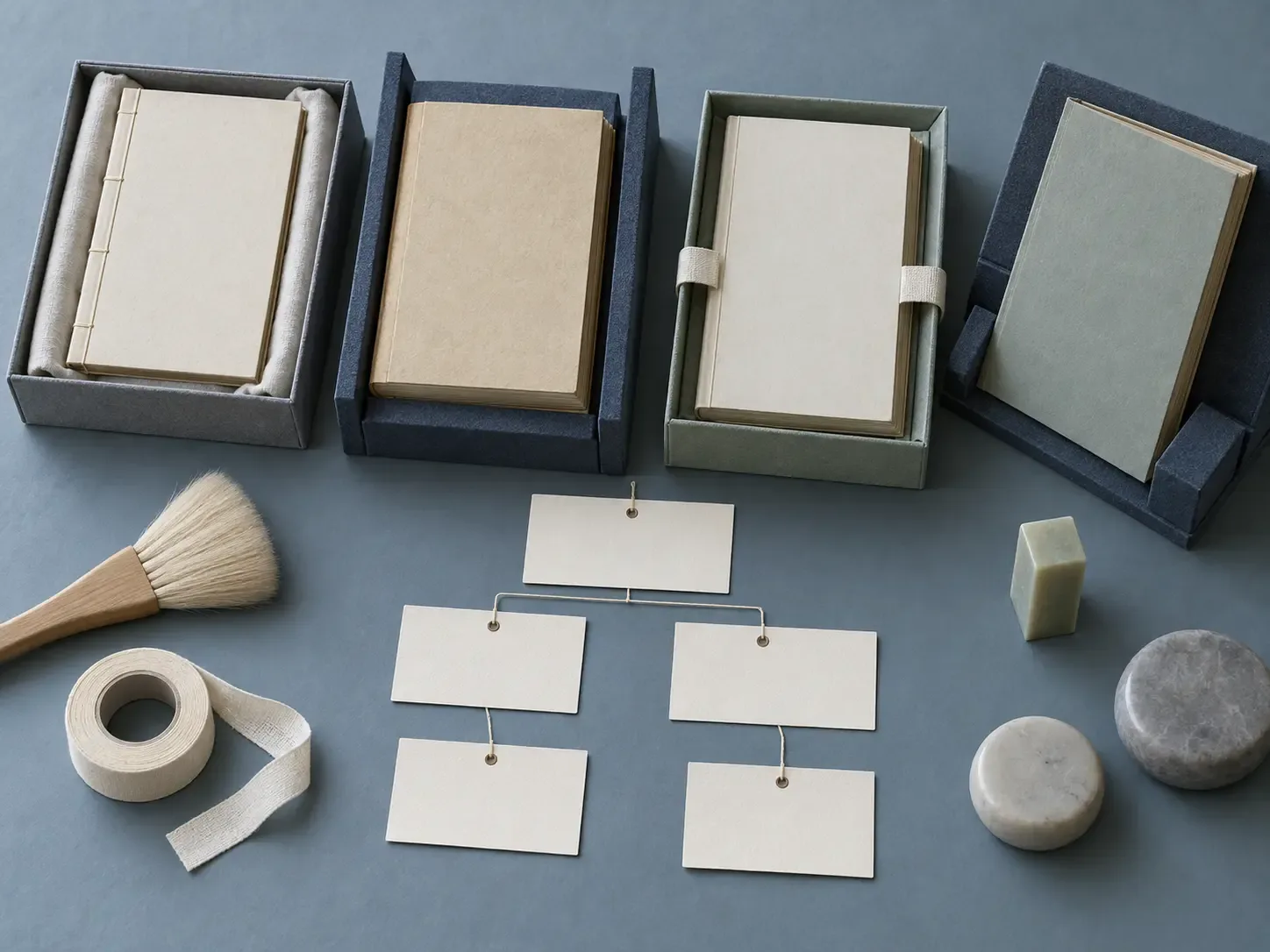
Marks of ownership help reconstruct a book’s itinerary
Seals, inscriptions and notes are evidence with limits
A collector’s seal, handwritten collation note, shelf label or repair annotation can connect a copy to a person and practice. Prefaces and afterwords may also explain acquisition or transmission; our guide to Chinese xu and ba shows how such framing texts address future readers. Yet one mark supplies one point, not a complete chain. Seals can be copied, added late or misread, and an unmarked book may still have travelled widely.
Modern cataloguing makes provenance searchable
Cataloguers compare edition, paper, printing, bindings, annotations and previous descriptions. Princeton University Library’s account of cataloguing Chinese rare books shows how copy-specific features become structured records rather than decorative curiosities. Digital images widen comparison, but do not replace examination of paper, ink, sewing and erased or hidden marks.
Protection and circulation pulled in opposite directions
Restriction could preserve a collection and narrow its public
Household rules might limit removal, division or borrowing because a lost volume was hard to replace. Such controls could strengthen continuity while excluding readers without family or scholarly connections. The cangshulou should therefore not be romanticized as an open republic of letters. Access was negotiated through kinship, reputation, patronage and trust, and women’s or non-elite reading is often less visible in the surviving records.
Copying, lending and printing let texts travel
Even guarded collections could support circulation when visitors copied a rare work, collated another edition or prepared a text for printing. An anthology can detach selected pieces from their earlier setting; our guide to Chinese poetry anthologies traces that productive loss of context. Preservation and access were never simple opposites: careful use could reproduce a text, while unlimited movement could scatter the collection that explained it.
Fire, war, insects, inheritance and markets reshaped collections
Dispersal destroyed contexts but sometimes opened new routes
Collections suffered fire, damp, insects, conflict, theft, family division and forced sale. When volumes entered the market, the original shelf order and household record could vanish. Yet some copies then reached another collector or an institution that preserved them. “Lost collection” and “surviving book” can therefore describe the same event from different scales; survival must not be confused with an intact library.
Texts themselves also changed after leaving the shelf
A later owner might collate, reprint, excerpt or punctuate a work. Our guides to individual collected works and punctuation and reading marks show why a transmitted text is never only its author’s first act. Collectors, editors and readers all leave decisions that modern editions may silently regularize.
Private collections acquired institutional afterlives
Modern libraries often grew from multiple dispersed holdings
A Shandong University essay on late-Qing private collections follows major holdings into twentieth-century public institutions, while Zhejiang University’s account of the provenance of its rare books records purchases and donations from named collections. These are not stories of a seamless handover: selection, sale, political change and recataloguing altered the original wholes. Institutional custody created new access and new descriptions.
Eight questions turn a famous name into a research path
Ask: (1) who formed the collection, and when? (2) how were books acquired? (3) where were they stored? (4) who could consult or borrow them? (5) what does the catalogue classify or omit? (6) which seals and notes belong to this copy? (7) when was it repaired, recopied or reprinted? (8) how did it reach its present custodian? Those questions connect the cangshulou to the academy without confusing a household collection with a teaching institution.