Chinese Academies (Shuyuan): How Books, Teaching and Ritual Made a Scholarly Place
中国书院导读:书籍、讲学与礼仪怎样构成学术空间

A shuyuan was more than a classroom
The name covered changing institutions
書院/书院 (shūyuàn) is commonly translated as “academy,” but it did not name one fixed school type across every dynasty. Steven B. Miles’s review of late-imperial academy research emphasizes a central historical question: how academies related to the state. Some were closely supported or supervised by officials; others grew from local scholarly initiatives. Their balance of teaching, collecting books, ritual, property and examination preparation changed over time.
Books and readers formed the durable core
A lecture hall alone did not make an academy. A Yuelu Academy lecture on what shuyuan were and did describes them as organizations formed around books and reading people, with teaching, collections, ritual and endowed land among their recurrent institutions. That formulation is more useful than imagining a modern university in old dress. Begin with our Chinese literature reading paths, then ask how texts acquired a place, schedule and community.
The institution developed through repeated founding and refounding
Song growth did not erase earlier meanings
The term had earlier associations with book work and private study, while academies became a prominent educational form during the Song. Research on Song local government schools also warns against a simple story in which “private academies” replaced a single uniform public system. Schools, academies, officials and scholars overlapped. A useful history therefore follows particular foundations and restorations rather than treating all shuyuan as one continuous network.
Yuelu offers a long case, not a universal model
Hunan University’s official account of Yuelu Academy traces the institution from the Song through later dynasties, its conversion into a higher school in 1903 and its eventual place within Hunan University. That remarkable continuity makes Yuelu valuable, but exceptional. Its own institutional chronology records reconstruction, teaching, collections, ritual and endowed land. Other academies were shorter-lived, differently funded or repeatedly abandoned.
Site and landscape helped define a scholarly community
Retreat was an intellectual position as well as a location
Many academies occupied foothills, gardens or sites associated with earlier scholars. Distance from the busiest urban street could support concentrated reading, but “retreat” did not mean isolation from society. Patrons, teachers, students, books and funds still moved through wider political and commercial worlds. Landscape framed attention and memory; it did not remove the academy from government, lineage or local networks.
Courtyards separated functions without fixing one plan
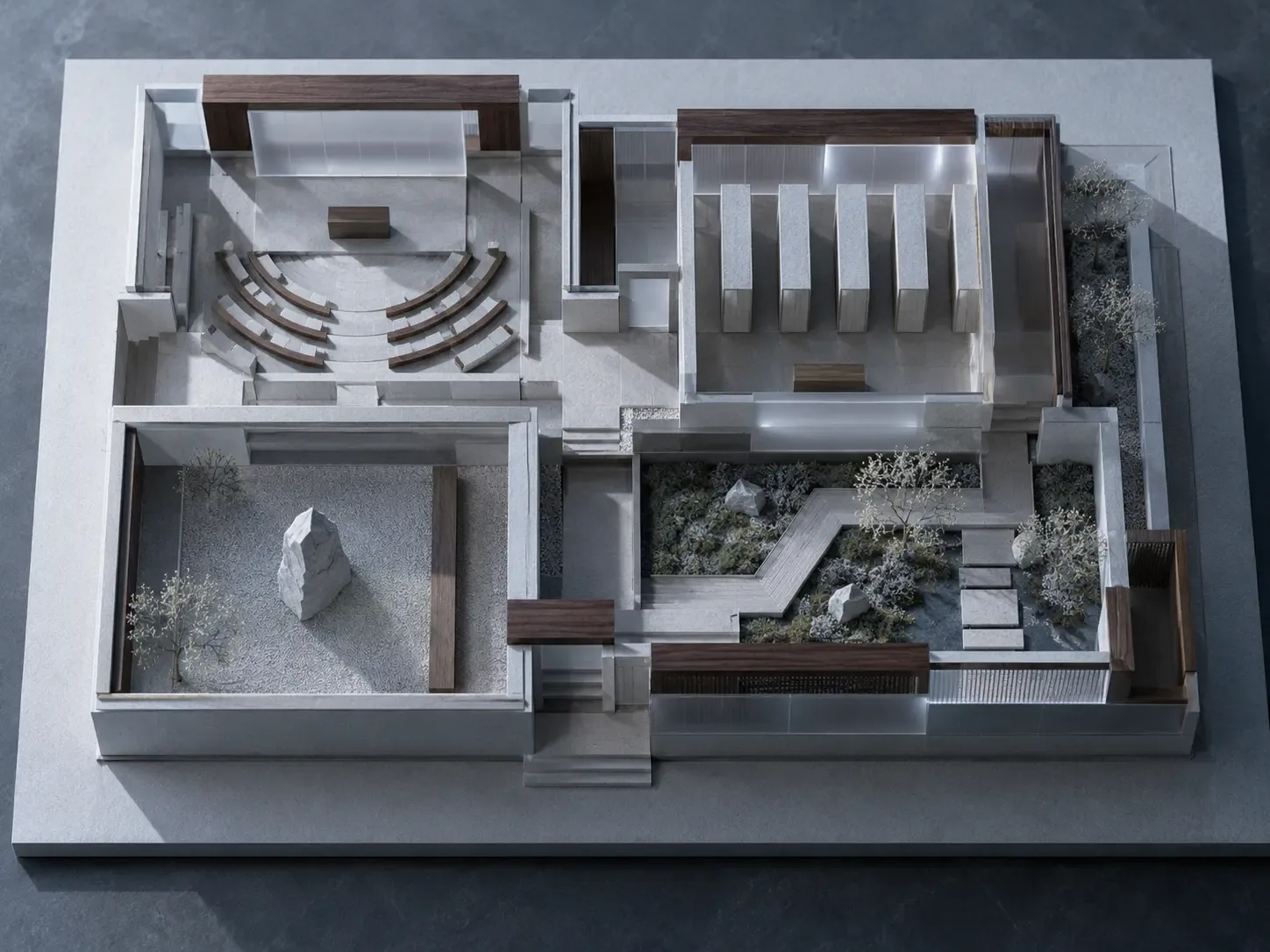
Surviving complexes may include gates, lecture spaces, study rooms, libraries, commemorative halls, residences and gardens arranged along axes and side courts. Their plans reflect rebuilding as much as original intention. Compare our guide to sacred architecture: both may use courtyards and axial order, yet an academy’s program of teaching, books and commemoration must not be read as though it were a Daoist temple.
Teaching joined reading, questioning and public explanation
A lecture could be an argument, not merely delivery
Academy teaching often centered on classical texts, commentaries and moral cultivation, but methods and positions varied. Yuelu’s history remembers the 1167 discussions of Zhu Xi and Zhang Shi as an important inter-school exchange. The point is not to romanticize unrestricted debate: access and authority were structured. Yet a shuyuan could create a setting where interpretation was spoken, questioned and attached to a named community.
Elementary literacy and advanced inquiry were different stages
Students arrived through unequal routes of family teaching, local schools and private tutors. Recognizing characters or memorizing primers did not equal participation in advanced commentary. Our guide to the Three, Hundred and Thousand primers separates basic literacy from comprehension; academy study likewise required sustained comparison, explanation and judgment rather than recitation alone.
Rules linked learning to conduct
The White Deer Grotto articles framed a program of study
The White Deer Grotto Academy Articles associated with Zhu Xi list broad relationships, then a sequence of extensive learning, careful questioning, deliberate thinking, clear discrimination and earnest practice. The text explicitly opposes studying merely for literary display, reputation or office. It is a prescriptive statement, not a diary of how every student behaved, and it should not be projected unchanged onto every academy.
Commemoration made intellectual lineages visible
Offerings and memorial halls could honor Confucius, earlier teachers, founders or local worthies. Such ritual located present learning within a claimed succession and gave architecture a calendar. It also selected whom a community remembered. A commemorative hall therefore supplies evidence about institutional identity, not automatic proof of unbroken teaching descent. This distinction matters on a Wudang cultural site, where educational ritual and Daoist liturgy must remain separate.
Collections and printing made the academy a book institution
A collection was built through gifts, purchase, copying and custody
Academy books could come from imperial or official gifts, private donation, purchase and local copying. Catalogues and gazetteers reveal acquisition and borrowing rules, but survival is uneven. A named collection is not evidence that every student read every title. Use our guides to dictionaries and rhyme books and classified books to see how different tools supported reading and composition.
Printing extended an academy beyond its walls
Yuelu’s account of academy book printing describes editions, catalogues and academy gazetteers that preserve evidence of collecting, publication and use. Printing could circulate curricula, teachers’ writings and local scholarship, but an academy imprint still needs bibliographic checking: blocks were recut, editions revised and copies dispersed. Our guide to individual collected works explains why editor, edition and transmission remain essential questions.
Land, patrons and officials sustained the scholarly ideal
Endowments turned principles into recurring expenses
Teachers, repairs, books, lodging and ritual materials required resources. Endowed land, donations and official allocations could provide income, while stewards and regulations governed its use. Property made continuity possible but also exposed academies to local power and administrative change. “Independent academy” should therefore be treated as a question about degree and period, not as a permanent legal category.
State connection could support and constrain
Official recognition, plaques, books, appointments or rebuilding funds could strengthen an institution; regulation or political conflict could narrow it. Miles’s historiographical review treats the academy–state relationship as a major theme precisely because neither “private freedom” nor “government school” describes every case. Read patrons, directors and rules alongside the ideals stated in inscriptions.
Academies and examinations were related but not identical
Moral learning could coexist with examination preparation
Some academy teachers criticized education reduced to examination technique. A Cambridge study of Li Yuanyang records his hope that academies would cultivate Confucian learning beyond skills for passing tests. Yet candidates and families still lived within an examination society. Compare the eight-legged essay and the examination compound: a shuyuan might prepare, redirect or criticize that pathway, but it was not the examination site itself.
Eight questions help read a surviving academy
Ask: (1) when was this phase built? (2) who funded it? (3) who could study or teach? (4) which texts were collected? (5) how did lectures and questioning work? (6) whom did ritual commemorate? (7) what property sustained the institution? (8) what did later restoration or museum display add? These questions keep landscape, buildings, books and ideals together without mistaking one celebrated academy for the whole tradition.