CLIFFS · 幽岩

Sanctuaries in the Living Rock: Why Wudang’s Deepest Cultivation Sites Are Hidden in the 36 Cliffs, Not the Imperial Palaces 寄迹幽岩:为何武当山最深邃的修真处藏在三十六岩,而非敕建大宫?

How Song and Yuan hermits chose Wudang’s 36 Cliffs — from Nanyan (“making the rock itself the palace”, 即岩为宫) to Yinxian Rock and Taiziyan — as sheltered microclimates for quiet sitting long before the Ming court built its grand ceremonial halls.

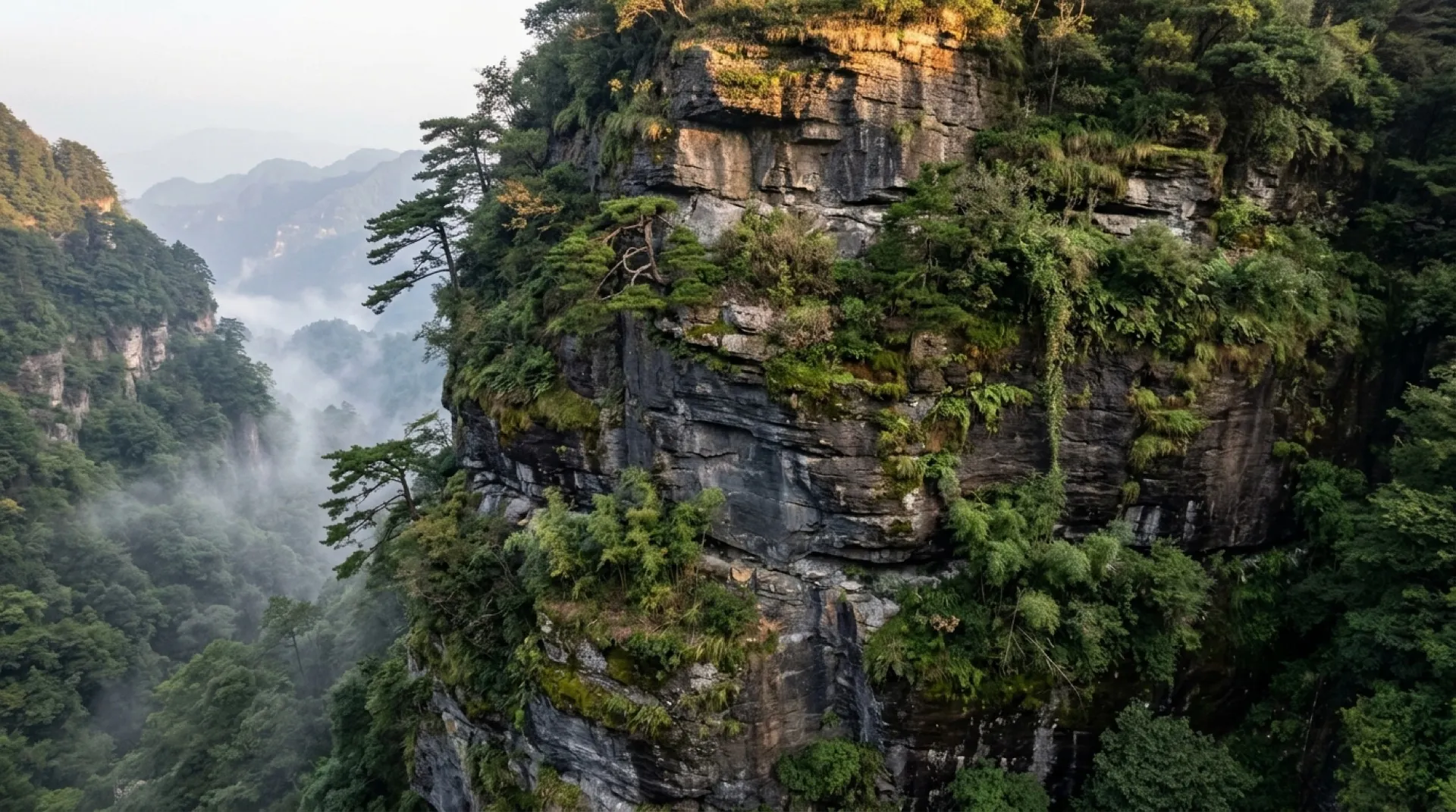
A sheer layered rock cliff with pines and ferns clinging to its face above a misty valley.

When visitors picture Wudang Mountain, they usually think first of the grand Ming-dynasty imperial complexes built under the Yongle Emperor: the sweeping courtyards of Yuxu Palace, the tiered axial terraces of Zixiao Palace, or the gilded Golden Hall on Tianzhu Peak. Yet if you ask where Wudang’s hermits actually sat in long retreat during the Song, Yuan, and early Ming periods, the answer points away from the open ceremonial avenues and straight into the 36 Cliffs (三十六岩).

1. Two different architectures for two different jobs: Palace (宫) vs. Cliff (岩)

To read Wudang’s landscape like an insider, start by distinguishing what an imperial palace (gong 宫) was built to do from what a cliff sanctuary (yan 岩) was built to do:

  • The great palaces are ceremonial stages: Built along broad valleys or stepped mountain axes, they were designed to host state liturgies (jiao 斋醮), imperial envoys, and hundreds of pilgrims during major festivals such as Zhenwu’s birthday on the third day of the third lunar month (see Temple Fairs and Pilgrimage).
  • The 36 Cliffs are quiet cultivation cells: A yan (岩) on Wudang is not merely a bare vertical precipice; it is typically a weathered horizontal recess, overhang, or shallow cave band in the middle mountain rock face. It shields a solitary practitioner from rain, snow, and wind from behind while opening out over a sea of clouds and pines in front.

2. Three classic cliff sanctuaries on the mountain

Walk through three of the best-documented cliff sites on this website and notice what they share:

  1. Nanyan Cliff & Nanyan Palace — “Making the rock itself the palace” (即岩为宫): In Liu Daoming’s Yuan-dynasty gazetteer Wudang Fudi Zongzhen Ji (《武当福地总真集》), the first of the thirty-six cliffs is listed as Zixiao Rock (紫霄岩, the historical name associated with Nanyan, distinct from the Zixiao Palace complex beneath Zhanqi Peak). Cheng Jufu’s 1315 stele in the Lingyi Lu records how the hermit Lu Dayou and then Zhang Shouqing’s community settled here, “carving into the sheer cliff and making the rock itself the palace” (刊在穷崖,即岩为宫). The surviving Yuan stone hall (Tianyi Zhenqing Stone Hall) still sits wedged directly beneath the cliff overhang.
  2. Yinxian Rock (隐仙岩, “Rock of the Hidden Immortals”): Tucked away from the main tourist thoroughfare, Yinxian Rock preserves the older ideal of a secluded cliff recess associated with classical hermits such as Yin Xi and Chen Tuan — a place for quiet scripture recitation and breath cultivation far from courtly traffic.
  3. Taiziyan (太子岩, Prince’s Cliff): Set on the slope behind Zixiao Palace beneath Zhanqi Peak, Taiziyan encloses a small cave shrine attributed in hagiography to Zhenwu’s early years of solitary sitting. Even after Zixiao Palace grew into the mountain’s largest ceremonial centre below, the cliff cave above remained a quiet reminder that practice begins in simplicity.

3. Why a rock overhang suits Taoist meditation

Beyond historical shelter, why did Taoist teachers favour a cliff recess over an ornate hall? Three practical reasons connect the rock face directly to Taoist meditation:

  • Solid backing, open horizon (背实面虚): Sitting with a solid rock wall behind your back and an open valley in front calms the nervous system’s vigilance while keeping the mind from feeling boxed in. It is the physical model for Guarding the One (Shouyi): firm, grounded support in the lower body, and unclouded space in the heart-mind.
  • Acoustic stillness and steady temperature: Deep stone recesses buffer both summer heat and winter wind, and their natural quiet makes the sound of your own breath immediately audible — the starting point of Inner Observation (Neiguan).
  • Freedom from display: In a grand hall, it is easy to perform for onlookers; on a narrow cliff ledge, there is no audience.

Bringing the cliff sanctuary into your own room

Most of us live in apartments in Singapore or other busy cities, not in a stone recess on Wudang. Yet you can arrange your daily ten-minute sitting spot on the same principle of bei shi mian xu (背实面虚 — solid behind, open in front): place your cushion or chair with a quiet wall behind you, clear the floor in front of you of clutter and screens, let your spine rest upright, and sit for five minutes observing the breath as described on our Zuowang and Shouyi guides.

Seeker’s Q&A · Frequently Asked Questions

What does the Yuan-dynasty phrase “making the rock itself the palace” (即岩为宫) refer to?

It comes from Cheng Jufu’s 1315 stele in the Xuantian Shangdi Qisheng Lingyi Lu and describes how Taoist practitioners at Nanyan (South Cliff), five li from Zixiao Palace, built the Tianyi Zhenqing stone hall directly into the natural cliff overhang.


Why did Wudang hermits prefer the 36 Cliffs over the large valley palaces for meditation?

While the large palaces served public festivals, state rituals, and pilgrim crowds, the 36 Cliffs offered sheltered rock overhangs with stable microclimates, acoustic quiet, and the posture setting of “solid behind, open in front” (背实面虚).

How are Zixiao Palace, historical Zixiao Rock, and Taiziyan distinguished on Wudang Mountain?

As Liu Daoming’s Wudang Fudi Zongzhen Ji shows, historical “Zixiao Rock” (紫霄岩) can refer to Nanyan, whereas Zixiao Palace (紫霄宫) is a separate temple complex beneath Zhanqi Peak, and Taiziyan (太子岩) is a cliff-cave sanctuary on the slope behind Zixiao Palace.

Sacred geography

Explore the mountain, place by place

Choose a place on the mountain. Read what the record says, then what you can try there, and follow the links to the full articles.

Celestial Summit The highest ground and the end of the climb.

Middle Cliffs The middle slopes, where palaces are built on and against the rock.

Mountain Foot The way in: gate, first abbey, and the water at the foot.

Recorded, but not placed on the drawing

A schematic, not a map: it is not to scale and gives no heights or distances. The three zones are a reading order. Order within a zone is not claimed, and the places are not one continuous footpath: Taiziyan is a spur behind Zixiao, Wulong a western branch, Qiongtai an alternative approach, and Jingle needs a separate visit to Danjiangkou.

Middle Cliffs

Nanyan, the Southern Cliff 南岩

The most dramatic place on the mountain: a palace built along and against a sheer south-facing cliff. The cliff is the landform; Nanyan Palace is what was built on it.

  • Its most important building is a Yuan stone hall carved to imitate timber. The Dragon-Head Incense Beam, about three metres long, was banned by a Qing official, who recorded the ban on a stele. The principal timber hall was lost to fire in the twentieth century. Nearby is the cliff from which Zhenwu is said to have ascended.

Classical record

  • TextWudang Fudi Zongzhen Ji, Liu Daoming, 1291

    First entry in the catalogue of the 36 cliffs. The text gives three names for one formation: Zixiao Rock, Nanyan and Duyang Rock.

  • SteleXuantian shangdi qisheng lingyi lu (玄天上帝启圣灵异录)· 1315

    Cheng Jufu’s stele says the palace at Nanyan was built “making the rock itself the palace” (即巖為宮), five li from the Zixiao Palace. The court gave it the plaque Tianyi Zhenqing Wanshou Palace in 1310 and added “Great” in the tenth month of 1314.

  • Tradition, not documented factXuantian shangdi qisheng lu (玄天上帝启圣录)· 紫霄圆道

    The Qisheng Lu (juan 1, 紫霄圆道) tells of Zhenwu’s attainment at the rock that the 1291 catalogue and the 1315 stele link with Nanyan. It is devotional writing; the stele is a separate document and is not a record of that event.

Practice connection

For centuries pilgrims crept out along the Dragon-Head Incense Beam to set incense at its tip, and the value of the offering lay in the risk. It is now fenced off and you cannot go out on it. Read the practice as history, then offer your incense safely, on firm ground.

Festival date

Zhenwu’s ascension: The ninth day of the ninth lunar month, the other principal date at Wudang (autumn).

Where tradition places his ascent.

Dates are lunar and are not converted to the Gregorian calendar, because a conversion table would be wrong within a year.

The dated documents in the two Daozang books on Zhenwu
  1. No dateXuantian shangdi qisheng lu (玄天上帝启圣录)

    Juan 1 tells of Zhenwu’s birth, his training on Taihe Mountain (the older name of Wudang), his investiture by Heaven and his return to his post in the sky. The later juan are miracle stories. The book has no date and no named author; read it as devotional writing.

  2. 1270Xuantian shangdi qisheng lingyi lu (玄天上帝启圣灵异录)

    Xu Shilong’s record of the Zhenwu temple (second month) and two steles for the Zhaoying Palace (ninth month). The texts do not say which present-day building is meant, so none is named here.

  3. 1304Xuantian shangdi qisheng lingyi lu (玄天上帝启圣灵异录)

    An edict conferring a title on Zhenwu.

  4. 1311–1312Xuantian shangdi qisheng lingyi lu (玄天上帝启圣灵异录)

    Prefaces to an illustrated record of the revelations, among them those of Zhao Mengfu and Yu Ji.

  5. 1314Xuantian shangdi qisheng lingyi lu (玄天上帝启圣灵异录)

    Edicts for Zhenwu, for the Holy Mother and for the Taoist Zhang Shouqing.

  6. 1315Xuantian shangdi qisheng lingyi lu (玄天上帝启圣灵异录)

    Cheng Jufu’s stele (third month) for the Great Tianyi Zhenqing Wanshou Palace. It says a master built a palace at Nanyan “making the rock itself the palace” (即巖為宮), five li from the Zixiao Palace; the court gave it that plaque in 1310 and added “Great” in the tenth month of 1314. It also tells how the Wudang Taoist Zhang Shouqing prayed for rain in the capital: a story told to explain why the court rewarded the mountain.

  7. 1325Xuantian shangdi qisheng lingyi lu (玄天上帝启圣灵异录)

    Two edicts for generals.

