Taoist Temple Fairs and Seasonal Pilgrimage
道教庙会与朝山:宗教、集市与季节性朝圣
A temple fair is what a Chinese festival looks like from outside the hall. Inside, clergy conduct a liturgy. Outside, in the courtyards and along the approach road, there is a market, food, opera, performance, and a crowd that may run to tens of thousands.
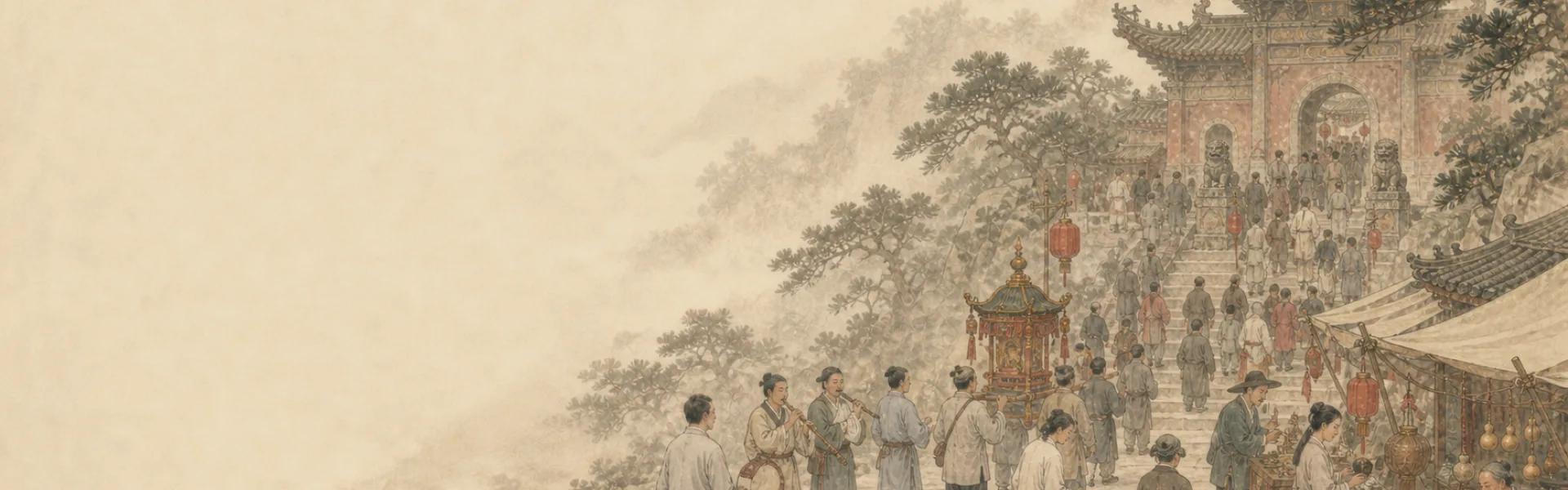
Visitors sometimes read this as a religious occasion that has been overtaken by commerce. That reading is wrong, and understanding why is one of the more useful things a foreign reader can learn about Chinese religion. The market and the liturgy are not competitors. They grew up together, and each is part of why the other survived.
What a Taoist Temple Fair Is
The Chinese term joins two words: temple and gathering. The gathering is the point. A temple fair is a periodic assembly at a religious site, held on fixed dates, combining worship with trade, entertainment and social business.
Its components are consistent across regions. There is the liturgy in the hall. There is incense offering by lay visitors in the courtyard. There is a market, historically of goods difficult to obtain locally at other times. There is theatre, usually on a permanent or temporary stage. There is food. And there is the whole range of activity that a large crowd makes possible: hiring, matchmaking, moneylending, gossip, recruitment, litigation avoided or begun.
Historically the fair was often the largest regular gathering in a rural district, and for many people the only occasion when they left their own village. Its social functions were not incidental to its religious ones; a peasant economy with poor transport and no permanent shops needs periodic markets, and dates that everyone already observes are the obvious ones to use.
This is why the combination is so old and so stable. The temple provided a reason to assemble, a neutral site, a calendar and an authority to keep order. The market provided the traffic that made the temple viable. Neither had to be sincere about the other's purpose for the arrangement to work.
Why Markets and Temples Meet at Temple Fairs
Several practical mechanisms link the two, and they are worth spelling out because they explain features of temple sites that otherwise look arbitrary.
Temples were sited where people could reach them: at road junctions, river crossings, mountain passes, the edges of market towns. Sacred geography and transport geography overlap heavily, because a shrine that nobody can reach does not attract offerings.
Guilds and trade associations attached themselves to particular deities and particular temples, holding annual meetings on the deity's festival, settling accounts, admitting members and adjudicating disputes. A carpenters' guild, a salt merchants' association or a boatmen's association might effectively own a hall. The donor inscriptions on temple stelae are, among other things, commercial directories.
Temple management often included the letting of stall space, which produced income for maintenance. This is documented for centuries and is one of the standard ways a temple funded its own repairs. The modern situation in which concessions are leased to commercial operators is a continuation of an old practice, though with a difference worth noting: a lessee with a revenue target and no accountability to the temple behaves differently from a guild that has worshipped there for generations.
Opera at Temple Fairs and the Deity as Audience
Theatre at a temple fair is not entertainment that happens to be held at a temple. It is an offering, and the physical layout says so.
In a temple with a permanent stage, the stage faces the main hall. The deity is the primary audience; the human audience stands between the two, watching what is being performed for the god. This arrangement is standard and, once noticed, changes how a visitor reads the whole courtyard.
The repertoire matters historically. A great deal of what ordinary people knew about deities, immortals and legendary history they learned from temple opera rather than from scripture. The Eight Immortals are the clearest case: the individual figures are old, but the standard group of eight was assembled and fixed largely through Ming drama, and the attributes by which they are identified are stage properties. Religious iconography and theatrical costume influenced each other continuously.
Opera was also expensive, which made sponsoring a performance a public act. Sponsorship was recorded, and a troupe's engagement was one of the ways a community demonstrated that its fair was significant. Puppet theatre, shadow plays, storytelling, acrobatics, stilt walking, lion and dragon dances and drum troupes all appear in the same context, with regional specialisation.
Seasonal Pilgrimage to Taoist Sacred Sites
Mountain sites have seasons rather than single dates, and the pattern is worth knowing if you intend to visit one.
Pilgrimage in China was typically organised, sociable and collective rather than solitary and penitential. The organising body was the incense association: a voluntary group, often neighbourhood or trade based, which collected subscriptions, arranged transport and lodging, carried a banner, and travelled together. Membership was often lifelong and sometimes hereditary. Associations had names, seniority, and standing relationships with particular temples along the route.
Seasons cluster in spring and autumn, for the obvious reasons of weather and the agricultural calendar. Spring pilgrimage follows the New Year period and precedes intensive fieldwork; autumn follows the harvest. At Wudang the principal dates are the third day of the third month, Zhenwu's birthday, and the ninth day of the ninth month, his ascension — spring and autumn respectively.
The etiquette that visitors are asked to observe at major temples exists partly because of this system. Principal mountain temples were open monasteries, obliged to receive clergy of any lineage and to accommodate pilgrims, as distinct from family temples which had no such duty. An institution that must house strangers in large numbers needs codified rules, and that is what temple etiquette largely is.
Well-Known Taoist Temple Fairs and Pilgrimages
A few observances are large enough to be worth naming, though the list is nowhere near exhaustive.
White Cloud Temple, Beijing. The New Year fair at this Quanzhen monastery, seat of the national Taoist association, is among the best known in north China. Its customs include touching stone monkeys carved at particular points in the walls and throwing coins at a target on the bridge over the former moat.
Miaofengshan, west of Beijing. A spring pilgrimage to a temple of the Princess of the Azure Clouds, historically served by dozens of incense associations that also performed martial and acrobatic displays as offerings along the route. It has been intensively documented since the early twentieth century and is one of the best-studied pilgrimages in China.
Mount Tai. The Princess of the Azure Clouds at the summit eclipsed the Great Emperor of the Eastern Peak in popular devotion, and her pilgrimage was historically one of the few socially sanctioned occasions for long-distance travel by women in the rural north.
Mazu pilgrimages in Taiwan and Fujian. The largest are multi-day processions covering long distances on foot, with hundreds of thousands of participants at some stages. These are not Taoist in a narrow institutional sense but they are the largest religious processions in the Chinese world and are recognised as intangible cultural heritage.
How Modernisation Changed Temple Fairs
Temple fairs were suppressed or reduced for much of the mid-twentieth century on the mainland and revived from the 1980s. The revival has not been a simple restoration, and the changes are worth naming honestly.
Some fairs were revived primarily as cultural events, organised by local government or tourism bodies, with the religious content present but not central. Others were revived by their own constituencies and remain religiously driven. Many are a mixture, and the balance can shift from year to year with local politics and funding.
Intangible cultural heritage listing has been a significant factor. Listing brings funding, protection and prestige, and it also brings pressure toward standardisation, performance for audiences and documentation in fixed forms. This is a real tension and practitioners discuss it themselves.
At major mountain sites there are usually two administrations: the Taoist association responsible for the halls, liturgy and clergy, and a secular scenic-area administration responsible for ticketing, transport, paths and heritage. Fairs sit awkwardly across this division, which is one reason the commercial and the religious can feel unintegrated in a way they were not historically.
How to Attend a Taoist Temple Fair Respectfully
A few practical points. Expect crowds, noise and congestion, particularly on approach routes and ascent paths at mountain sites; the date is the whole reason the crowd exists, so this cannot be avoided by arriving early in the day, only by choosing a different date.
The liturgy inside the hall follows the usual expectations: enter by a side door, step over thresholds, keep to the sides, leave the exact-centre cushion for the officiant, and no circumambulation, which is a Buddhist practice. Incense is offered at the burner in the courtyard, normally three sticks, extinguished by waving rather than blowing, inserted with the left hand. More is not better.
During liturgy: no flash, no video with sound, nothing photographed from the front along the axis past the officiant. Ask before photographing individuals, and be particularly careful with pilgrims in association dress, who are frequently photographed without consent.
The one real expectation is quiet inside the hall — not silence, and not solemnity, since Chinese temple courtyards are sociable places. You are not being asked to keep the rule. You are being asked not to interrupt people who are.
Sources and limits. This page draws on early twentieth-century and modern ethnographies of north Chinese pilgrimage, studies of temple economy and guild patronage, work on temple theatre, and current heritage designations. Practices vary greatly by site and region; what is described is common rather than universal. No prices, timetables or journey times are given here, as these change.
Key Points About Taoist Temple Fairs and Pilgrimage
A temple fair combines liturgy, incense offering, market, theatre and food; the market and the religion grew up together rather than competing.
Periodic markets were an economic necessity in a rural economy, and dates everyone already observed were the natural ones to use.
Temples sit where transport allows; guilds attached themselves to particular deities, and donor stelae function partly as commercial directories.
Letting stall space to fund maintenance is centuries old; what is new is lessees with revenue targets and no accountability to the temple.
At a temple with a permanent stage, the stage faces the hall: the deity is the audience and the human crowd stands between.
Much popular knowledge of deities came from opera rather than scripture — the standard group of Eight Immortals was fixed largely through Ming drama.
Pilgrimage was collective and sociable, organised by incense associations with banners, subscriptions and lifelong membership.
Mountain seasons cluster in spring and autumn; at Wudang the key dates are the third of the third month and the ninth of the ninth.
Temple etiquette is codified because principal mountain temples were open monasteries obliged to receive strangers in large numbers.