Where to Start with the Tao Te Ching: Ten Chapters for Your First Month
《道德经》从哪里读起:第一个月的十章
The Tao Te Ching (Dao De Jing) has eighty-one chapters, and most people who pick it up feel they ought to start at the beginning and keep going. This page suggests a gentler way in: ten chapters, read slowly over about a month. It is a path to try, not a rule, and you can change it as soon as you know what you like.
Why not start at chapter 1 and read straight through
The book is not a story or an argument that builds from page to page. It is a collection of short chapters, each of which can stand alone, and it keeps coming back to the same few images (water, emptiness, softness, returning) from different sides. Read at one sitting, the chapters blur together, and it is easy to put the book down after a couple of dozen chapters feeling you have understood nothing.
There is a second reason. Chapter 1 is one of the most abstract chapters in the book. It is worth reading, and it is on our list, but it asks a lot of a first-time reader. The short guide on the Tao Te Ching page explains what the book is; the page on Laozi explains who is traditionally said to have written it. This page is only about how to begin reading.
Something to try: before you start, decide that you are not trying to finish the book. Ten chapters, understood a little, are worth more than eighty-one skimmed.
Ten chapters, four weeks
The order below moves from how the book looks at words and opposites, to its main images, to the questions it asks about a life, and ends with two chapters you can put into practice. Each link goes to the full chapter on this site, with the Chinese, an English rendering and a short note.
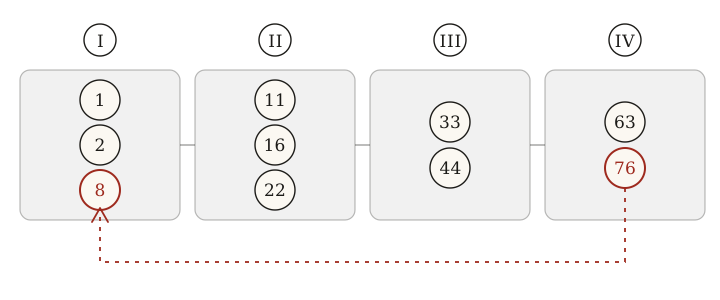
Ten chapters over four weeks; chapter 76 leads back to chapter 8.
- Week one: chapters 1, 2 and 8
- Week two: chapters 11, 16 and 22
- Week three: chapters 33 and 44
- Week four: chapters 63 and 76
Week one: how the book looks at the world
Chapter 1, the opening. Look for the idea that "a name that can be named is not the enduring name". The chapter does not say names are bad; it says every description leaves something out. It is a good first chapter because it tells you how to read everything after it.
Chapter 2, opposites. Look for "being and non-being generate one another" and the other pairs: long and short, high and low. Notice that the chapter treats opposites as partners rather than enemies, and that this is where the sage who "teaches without relying on words" first appears.
Chapter 8, water. The chapter begins "The highest goodness is like water". Look at the list that follows (the right ground, depth of mind, trust in speech, the right time) and ask which item you find hardest. Beginners often read this chapter as advice to always give way. The site's own note says it is not: it is about fitting your action to place and time. For the wider idea, see Wu wei and natural living.
Something to try this week: read one chapter for two or three days, then move on. On the last day, write one sentence about what you noticed.
Week two: emptiness, stillness and bending
Chapter 11, empty space. Thirty spokes, a lump of clay, a room: in each, the useful part is the empty part. Look for the closing line that what is present gives advantage and what is absent gives use. Then look around the room you are sitting in.
Chapter 16, returning. "Reach the utmost openness; guard stillness deeply." Look for the sentence about things flourishing and each returning to its root. It repays being read several times.
Chapter 22, bending. "Bend and remain whole." Look at the four things the sage does not do (display, declare right, boast, exalt the self). A common mistake is to read this as a call to give up your principles; the site's note reads it as adjusting your form so that your purpose survives.
Week three: yourself and enough
Chapter 33, knowing yourself. "One who knows others is intelligent; one who knows the self is illuminated." Look at how the chapter ranks being clever about others against understanding yourself, and what it says about contentment.
Chapter 44, life before reputation. It begins with questions: which is more intimate, reputation or life? Do not hurry to answer them. The chapter closes on "knows where to stop", which is a more demanding idea than it sounds.
Something to try this week: take one of the questions in either chapter and carry it through an ordinary day, without trying to settle it.
Week four: small beginnings and softness
Chapter 63, beginning small. "Plan for the difficult while it is still easy." Look for the warning about light promises. This is the chapter that is easiest to use at once, in the next task you have been putting off.
Chapter 76, the living are soft. A person in life is soft; in death, hard. Look at how the chapter moves from the body to plants to an army. It makes a good last chapter for the month because its softness echoes the water of chapter 8 (chapter 78 makes that link explicit), and so closes the circle.
How to read slowly
Stay with one chapter for several days. Read it aloud once; many readers find that the ear catches repetitions your eye skips. Read the Chinese too, even if you cannot read it: the page shows it beside the English, and a short chapter in the original is a few lines you can look at. Copy the chapter out by hand once. Copying slows you to the speed of the text, and you will find yourself pausing at words you had read past.
Read the English first as plain sentences. Then read the site's note and see whether it changes what you thought the chapter said. Where you disagree with the note, that is worth keeping: it is the beginning of your own reading.
Keeping a short note
Keep it small enough that you will actually do it: the chapter number, the date, one phrase that stayed with you, and one question. Leave a line for "I don't understand this". Come back to the note after the month and read it from the top. Beginners are often surprised that a chapter they found flat in week one has become the one they remember.
Do not turn the notes into advice for other people. The chapters were written about governing and living; it is easy to read them as a way to tell your colleagues, your family or your boss what they should do. Ask first what the chapter says about you.
When one chapter seems to contradict another
It will. Chapter 22 says to bend; chapter 33 speaks of resolve; chapter 76 says the hard belong to death, yet the book prizes the person who "overcomes the self". Beginners often take such moments as a sign they have misunderstood. Usually the chapters are looking at different sides of the same thing, and the apparent contradiction is the book working as intended: chapter 2 has already told you that opposites arise together.
When it happens, write both lines in your note side by side, and ask what situation each one is speaking to. Do not try to settle it that evening. Scholars have argued about the book for centuries, and the guide reminds you that no single English wording can settle every line.
After the month
Choose the chapter that resisted you most and read it again, then go to the full text and read the chapters on either side of the ones you liked. You will find the book has become less daunting, because you now have a few places to stand in it.


