
INTERNAL MARTIAL FOUNDATIONS · 内家拳基础

Wudang Longhua Quan Fundamentals (Dragon-Splendor Fist): Undulating Dragon Spine, Cloud-Stepping Footwork, and Spiraling Palm Issuance 武当龙华拳基础指南:游龙身法、云步穿闪与升降开合劲路

A comprehensive practitioner's guide to Wudang Longhua Quan (Dragon-Splendor Fist), detailing the three-dimensional undulation of the 'Swimming Dragon Spine' (Youlong Jizhu), continuous rising-and-sinking postures (Sheng-Jiang Kai-He), Cloud-Stepping evasion (Yunbu), and threading palm mechanics.


Layered mountain ridges fading into golden mist at sunrise, with pines in the foreground.

1. Heritage & Character of Wudang Longhua Quan: The Dragon as Spinal Elasticity and Fluid Change

Within the classical barehand curriculum of Wudang internal martial arts (Neijiaquan), Wudang Longhua Quan (武当龙华拳, 'Dragon-Splendor' or 'Dragon-Transmutation Fist') is celebrated for its sweeping elegance, vertical-and-horizontal undulation, and seamless integration of martial agility with Daoyin longevity mechanics. In Taoist and classical Chinese thought—from the Book of Changes Hexagram 1 (Qian, where the six stages of Yang are depicted as a submerged, appearing, leaping, and soaring dragon) to Wudang internal alchemy—the Dragon (龙, Long) represents the capacity to coil small or extend vast, rising into the clouds or diving into the abyss without ever losing axial continuity. Taught across the historical training terraces associated with Wudang Mountain's UNESCO World Heritage ancient Taoist temples and in structured internal boxing classes at Lee Wudang International Pte. Ltd., Longhua Quan trains the practitioner to move the entire spine like a single undulating wave.

2. 'The Swimming Dragon Spine' (Youlong Shenfa): Three-Plane Vertebral Wave Mechanics

Whereas beginner routines maintain a simple upright torso, Longhua Quan develops the 'Swimming Dragon Body Method' (游龙身法, Youlong Shenfa), which coordinates the sacrum, lumbar Mingmen, thoracic ribs, and cervical crown across three planes: (1) Sagittal Wave (升降之波, Rising and Sinking): driven by the folding and opening of the ankles, knees, and kua, the spine ripples from tailbone to crown like a dragon surfacing and diving; (2) Horizontal Spiral (缠丝之旋, Left-Right Coiling): the waist turns smoothly around the central axis so the shoulders and hips counter-rotate in figure-eight loops; and (3) Lateral Folding (侧闪之折, Side-Bending Evasion): the ribs open on one side while compacting on the other, allowing the head and torso to slip an incoming linear strike by a hair's breadth while remaining rooted over the supporting foot.

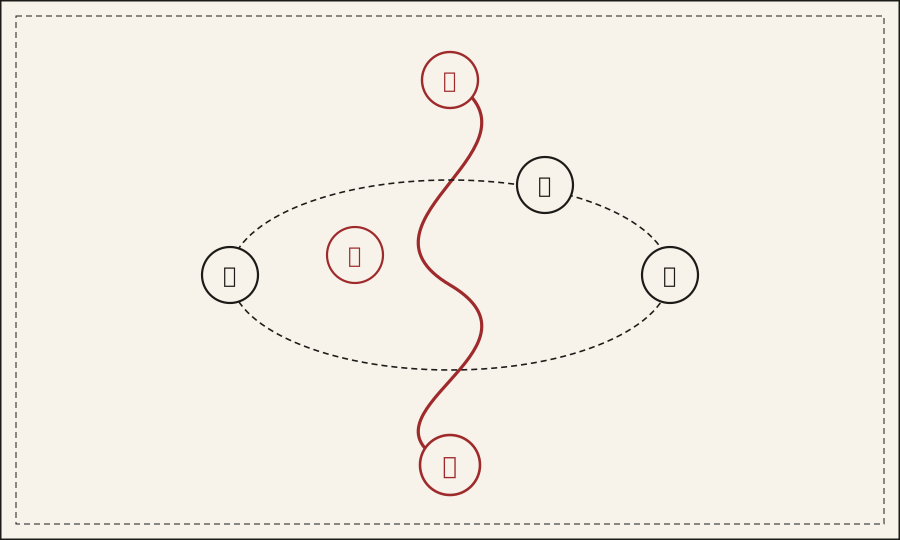
Numbers-only classical Wudang ink-and-cinnabar diagram of Wudang Longhua Quan showing the undulating Dragon Spine wave and horizontal Cloud-Stepping orbit (①–⑥).

Classical Wudang diagram of Longhua Quan (numbers-only SVG key)

  1. ① Crown Suspension & Ascending Piercing Palm (Feilong Chuanzhang — Baihui Leading)
  2. ② Thoracic & Ribcage Spiral Opening (Kai-He Wave)
  3. ③ Mingmen & Kua Coiling Pivot (Youlong Shenfa — Dragon Waist Axis)
  4. ④ Right-Arc Cloud-Stepping Orbit (Yunbu Evasion)
  5. ⑤ Left-Arc Cloud-Stepping Orbit (Yunbu Flanking)
  6. ⑥ Rooted Tailbone & Sinking Coiled Stance (Qianlong — Submerged Dragon Gathering in the Lower Dantian).

3. Cloud-Stepping Footwork (Yunbu) and Threading-Coiling Palms (Chuanzhang & Yunzhang)

Longhua Quan footwork is known as 'Cloud Stepping' (云步, Yunbu) or 'Dragon-Walking Stepping' (龙行步, Longxing Bu): light, continuous arcs that glide around an opponent's perimeter using mud-wading steps, cross-behind hook steps (偷步 / 盖步), and buoyant single-leg knee lifts (提膝独立). Above this mobile base, the hands execute 'Cloud-Waving Palms' (云掌, Yunzhang), 'Threading-Upward Palms' (穿掌, Chuanzhang), and 'Coiling-Pressing Palms' (盘打, Panda). When descending into a low coiled stance, the arms gather inward toward the Dantian like a hidden dragon resting in a deep pool (潜龙勿用); when rising, the waist and spine uncoil to send the lead palm spiraling upward along the centerline like a dragon emerging through mountain clouds.

4. Solo Practice Progression, Safety Checkpoints, and Wudang Curriculum Bridges

Safety note: Because Longhua Quan combines deep rising-and-sinking stance changes with three-dimensional spinal waves, always initiate lateral and rotational waves from the pelvis and kua rather than forcefully twisting the lower lumbar vertebrae or weight-bearing knees, and practice 'knowing when to stop' (知止) within your comfortable range of motion. To connect Longhua Quan with related internal boxing sets and classical texts, explore our Wudang Martial Arts Overview, compare its sister style in Wudang Xuanwu Quan Fundamentals: Tortoise-Snake Body Mechanics, study the philosophy of streams returning to the sea in The Tao Is Eternally Nameless: Zhi Zhi (Tao Te Ching Chapter 32), and nourish the lumbar root after training with Warming the Kidney Court (Mo Shentang / Ca Yaoyan) Daoyin Guide.

Seeker’s Q&A · Frequently Asked Questions

What is the core takeaway of Wudang Longhua Quan Fundamentals (Dragon-Splendor Fist)?

A comprehensive practitioner's guide to Wudang Longhua Quan (Dragon-Splendor Fist), detailing the three-dimensional undulation of the 'Swimming Dragon Spine' (Youlong Jizhu), continuous rising-and-sinking postures (Sheng-Jiang Kai-He), Cloud-Stepping evasion (Yunbu), and threading palm mechanics.
