INTERNAL MARTIAL FOUNDATIONS · 内家拳基础

The Thirteen Postures (Shisanshi) of Wudang Taijiquan: How the Eight Methods (Bafa) and Five Steps (Wubu) Unite Trigrams and Five Phases 武当太极“十三势(八门五步)”详解:掤捋挤按采挒肘靠与进退顾盼定的八卦五行架构

Why early Taijiquan was simply called “The Thirteen Dynamics”—and how four cardinal energies, four corner energies, and five footwork directions form one living compass.

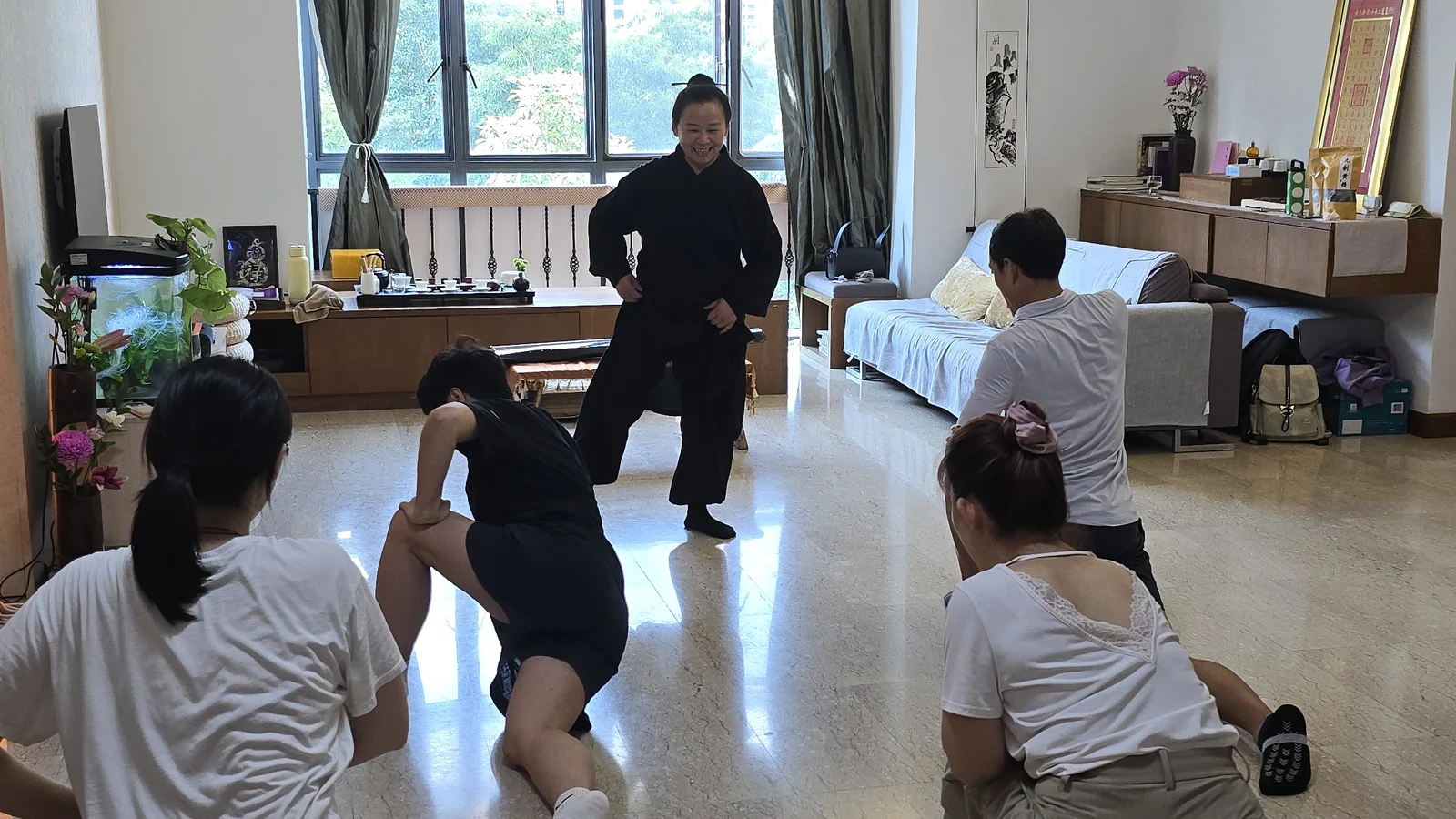
A Wudang taijiquan lesson in a sunlit room: students seen from behind kneel into deep lunges to open the hips while a teacher in black Taoist-style clothing stands in a wide stance, smiling, with an ink-painting scroll on the wall behind.

Before the name Taijiquan became widespread, classical manuals referred to the art simply as “The Thirteen Postures” or “Thirteen Dynamics” (十三势, Shisanshi). Beginners often assume “Thirteen Postures” means a short choreography of thirteen separate static poses. In authentic Wudang internal martial arts (Foundations of Internal Arts), Shisanshi is not a list of dead shapes—it is the structural grammar of every movement in the form, combining Eight Upper-Body Methods or Gates (八门 / 八法, Bamen / Bafa) mapped to the Eight Trigrams (Bagua) with Five Footwork Steps (五步, Wubu) mapped to the Five Phases (Wuxing 五行).

1. What the Classical Song of the Thirteen Postures (《十三势歌》) Says

The foundational Song of the Thirteen Postures opens with a reminder that every practitioner learns by heart:

“Do not take the Thirteen Dynamics lightly; the vital hinge lies entirely within the waist and mental intention (十三总势莫轻视,命意源头在腰隙). Look carefully into every change of full and empty, and let spirit and breath flow throughout the frame without obstruction.”

Just as Chapter 42 of the Tao Te Ching (Dao De Jing) describes how the One gives birth to Two, Two to Three, and Three to the myriad transformations (From Wuji to Taiji), the Thirteen Dynamics show how a single centred axis unfolds into eight spatial vectors and five stepping bearings.

2. Inside the Compass: Four Cardinal Energies, Four Corner Energies, and Five Steps

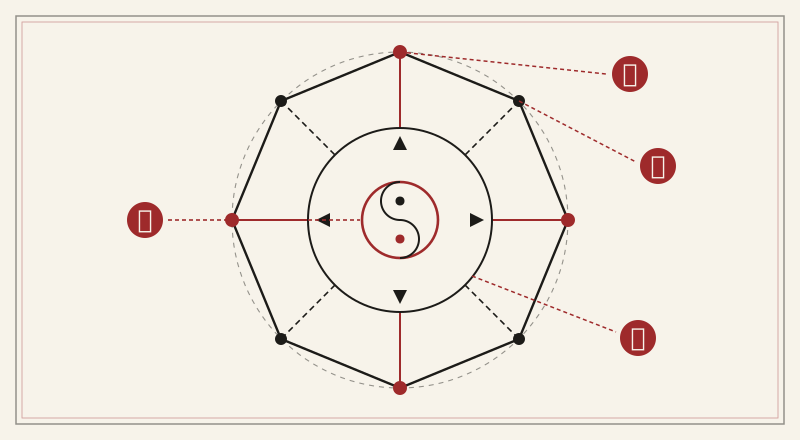
When you stand at the centre of the Thirteen Postures diagram, your feet tread the Five Phases on the ground while your waist and arms express the Eight Gates in space:

Classical ink-and-cinnabar diagram of the Thirteen Postures (Shisanshi) showing Central Equilibrium (Zhongding) at the hub, the Four Cardinal Steps around the inner ring, the Four Cardinal Energies on the N-S-E-W axes, and the Four Corner Energies on the diagonal axes

The structural compass of the Thirteen Postures (太极十三势 · 八门五步): Five Steps on the ground supporting Eight Methods in space.

  1. Central Equilibrium (中定 · Earth at the Pivot): rooted vertical axis and calm awareness ( the Pivot of the Tao) without which the other twelve dynamics lose their anchor
  2. Four Directional Steps (进、退、顾、盼 · Five Steps): Advance (进步), Retreat (退步), Look/Shift Left (左顾), and Gaze/Shift Right (右盼) coordinated with clear weight separation
  3. Four Cardinal Energies (四正手 · 掤捋挤按): Ward-Off (Peng 掤), Roll-Back (Lu 捋), Press (Ji 挤), and Push (An 按) along the four primary directions (Push Hands Fundamentals)
  4. Four Corner Energies (四隅手 · 采挒肘靠): Pluck (Cai 采), Split (Lie 挒), Elbow-Stroke (Zhou 肘), and Shoulder/Body-Stroke (Kao 靠) along the four diagonal corners when the cardinal circle is over-extended or crowded

A. The Four Cardinal Hands (四正手): Peng, Lu, Ji, An

  • Peng (掤 · Ward-Off, Kan ☵ Water): Buoyant, spherical structural expansion from the rooted legs through the waist and rounded arms—like driftwood floating on deep water (Song and Rooting Jin).
  • Lu (捋 · Roll-Back, Li ☲ Fire): Listening (Tingjin) and turning the waist (Chansijin) to guide an incoming force smoothly along its own path into emptiness.
  • Ji (挤 · Press, Zhen ☳ Thunder): Uniting both forearms into a focused wedge supported by the rear leg when a partner’s structure turns sideways.
  • An (按 · Push/Settle, Dui ☱ Marsh): Drawing in slightly to neutralise and releasing a calm, downward-and-forward wave from the feet and waist.

B. The Four Corner Hands (四隅手): Cai, Lie, Zhou, Kao

While beginners spend their first months on the Four Cardinal Hands, the Four Corner Hands explain how the frame stays resilient along diagonal angles and at closer range (always trained gently as structural awareness, never as rough collision):

  • Cai (采 · Pluck/Uproot, Qian ☰): A brief, downward-diagonal weight lever—like plucking a leaf from a branch by dropping the hip crease (kua) rather than pulling with the biceps.
  • Lie (挒 · Split/Spiral Shear, Kun ☷): Two opposing spiral arcs turning from the waist like a spinning wheel throwing off water drops.
  • Zhou (肘 · Elbow Guard, Gen 艮): Keeping the elbow heavy, sunk, and connected to the ribs (Six Harmonies) so the middle gate of the arm is never collapsed.
  • Kao (Kao · Shoulder/Hip Alignment, Xun ☴): Whole-torso alignment in which shoulder and hip arrive together as a single unit if space closes completely.

C. The Five Steps (五步): Why Zhongding (Central Equilibrium) Comes First

In the Wudang teaching proverb, “Hands without steps are empty waves; steps without Central Equilibrium (中定) are disorderly stumbles.” Before you step forward (进步), step back (退步), shift left (左顾), or shift right (右盼), you must first establish Zhongding (中定)—the calm, upright centre nurtured in Zhan Zhuang.

3. How to Practise the Thirteen Dynamics Safely as a Solo Beginner

You do not need a sparring partner to train Shisanshi. In solo form practice (Wudang Tai Chi for Beginners), pick two postures—“Grasp the Sparrow’s Tail” (揽雀尾) and “Single Whip” (单鞭)—and ask three simple questions on every repetition:

  1. Is my weight clearly settled on one supporting leg (Zhongding) before the empty foot moves in any of the four directions?
  2. Does my buoyant ward-off quality (Peng) stay present inside every roll-back (Lu), press (Ji), and push (An)?
  3. Are my shoulders sunk and knees aligned with my toes as the waist turns into the diagonal corners?
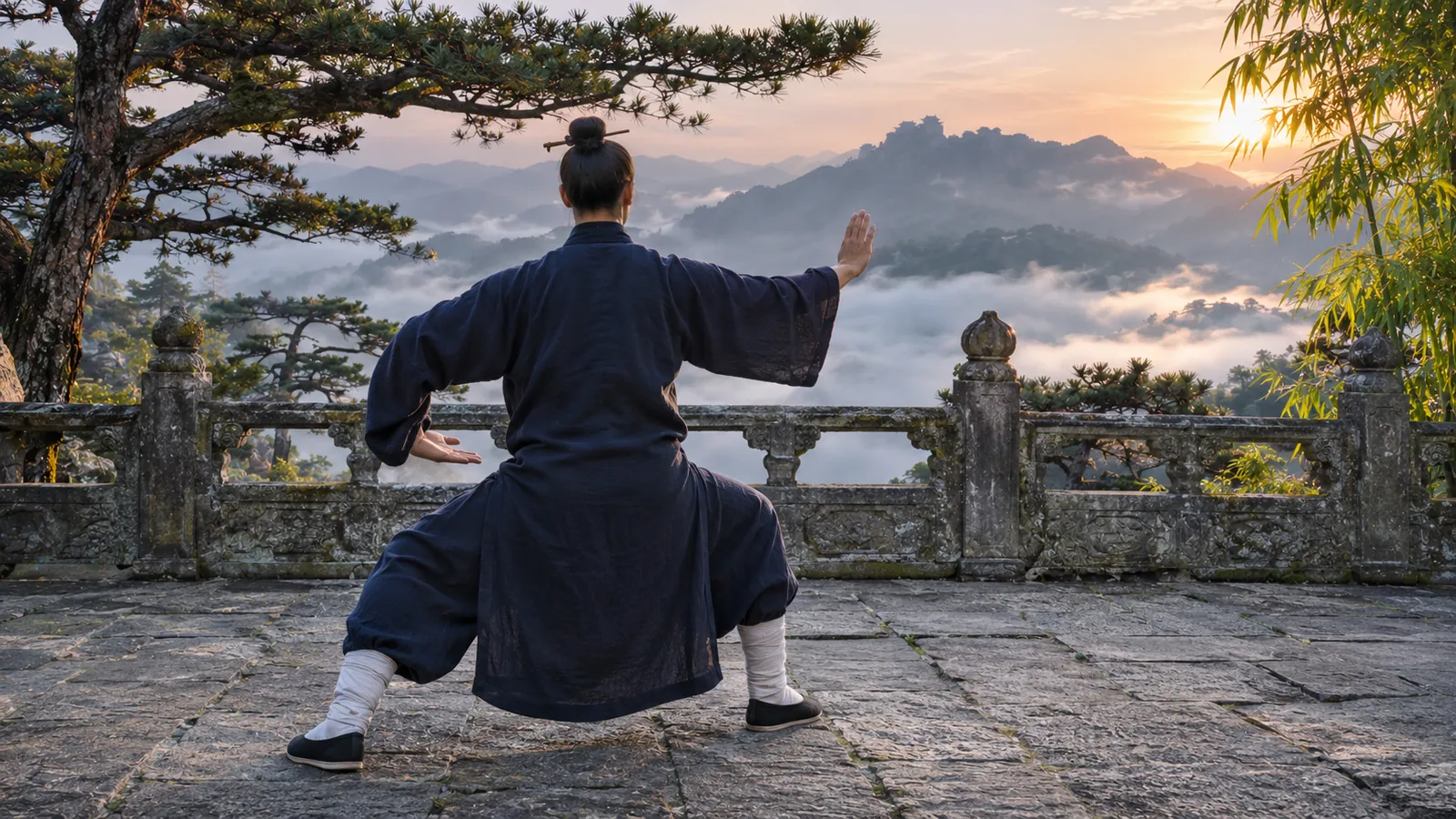
A practitioner in dark indigo Taoist robes and white cotton leg wraps seen from behind in a balanced Wudang Taijiquan Ward-Off (Peng) stance on a stone mountain terrace above morning clouds.

The Thirteen Postures (Shisanshi) in motion: rooted Five Steps on the stone flagstones supporting buoyant Eight Methods through the waist and rounded arms.

4. Training Between Wudang Mountain and Singapore

Connecting the living martial and Taoist heritage near Wudang Mountain’s UNESCO World Heritage ancient Taoist temples with our regular classes in Singapore, Wudang.Org teaches the Thirteen Dynamics step by step—from quiet solo rooting to cooperative sensitivity. Explore our beginner roadmap on Start Here or join our Singapore Tai Chi Retreat Camp.

Safety note: Train all Thirteen Postures slowly, smoothly, and within a comfortable knee-and-hip range; traditional internal martial arts are a cultural discipline of coordination and mindfulness, not a substitute for medical care.

Seeker’s Q&A · Frequently Asked Questions

What are the Thirteen Postures (Shisanshi 十三势) in Wudang Taijiquan?

The Thirteen Postures (also called Eight Gates and Five Steps, 八门五步) consist of Eight Upper-Body Methods—Peng (Ward-Off), Lu (Roll-Back), Ji (Press), An (Push), Cai (Pluck), Lie (Split), Zhou (Elbow), and Kao (Shoulder/Hip)—combined with Five Footwork Steps: Advance, Retreat, Look Left, Gaze Right, and Central Equilibrium (Zhongding).


Why is Central Equilibrium (Zhongding 中定) considered the most important of the Five Steps?

Because Zhongding is the vertical and mental pivot at the centre of the compass: without a settled lower Dantian, upright spine, and clear weight separation, stepping forward, backward, left, or right loses balance and structure.

Do beginners learn all eight methods at once or start with the Four Cardinal Hands?

Beginners always build Central Equilibrium (Zhongding) through standing meditation and slow stepping first, then master the Four Cardinal Hands (Peng, Lu, Ji, An) in solo postures like “Grasp the Sparrow’s Tail” and cooperative single-hand circles before exploring the four diagonal corner methods.
