INTERNAL MARTIAL FOUNDATIONS · 内家拳基础

Wudang Taiyi Wuxing Quan (Supreme Unity Five-Element Fist): Five-Phase Coiling Mechanics, Arc Stepping, and Waist-Led Transitions 武当太乙五行拳入门指南:五行五禽取象、弧形走转与缠丝身法解析

Learn the historical transmission and core body mechanics of Wudang Taiyi Wuxing Quan—how Five-Phase (Metal, Wood, Water, Fire, Earth) and Five-Animal principles unite spiral stepping with Daoyin breathwork.

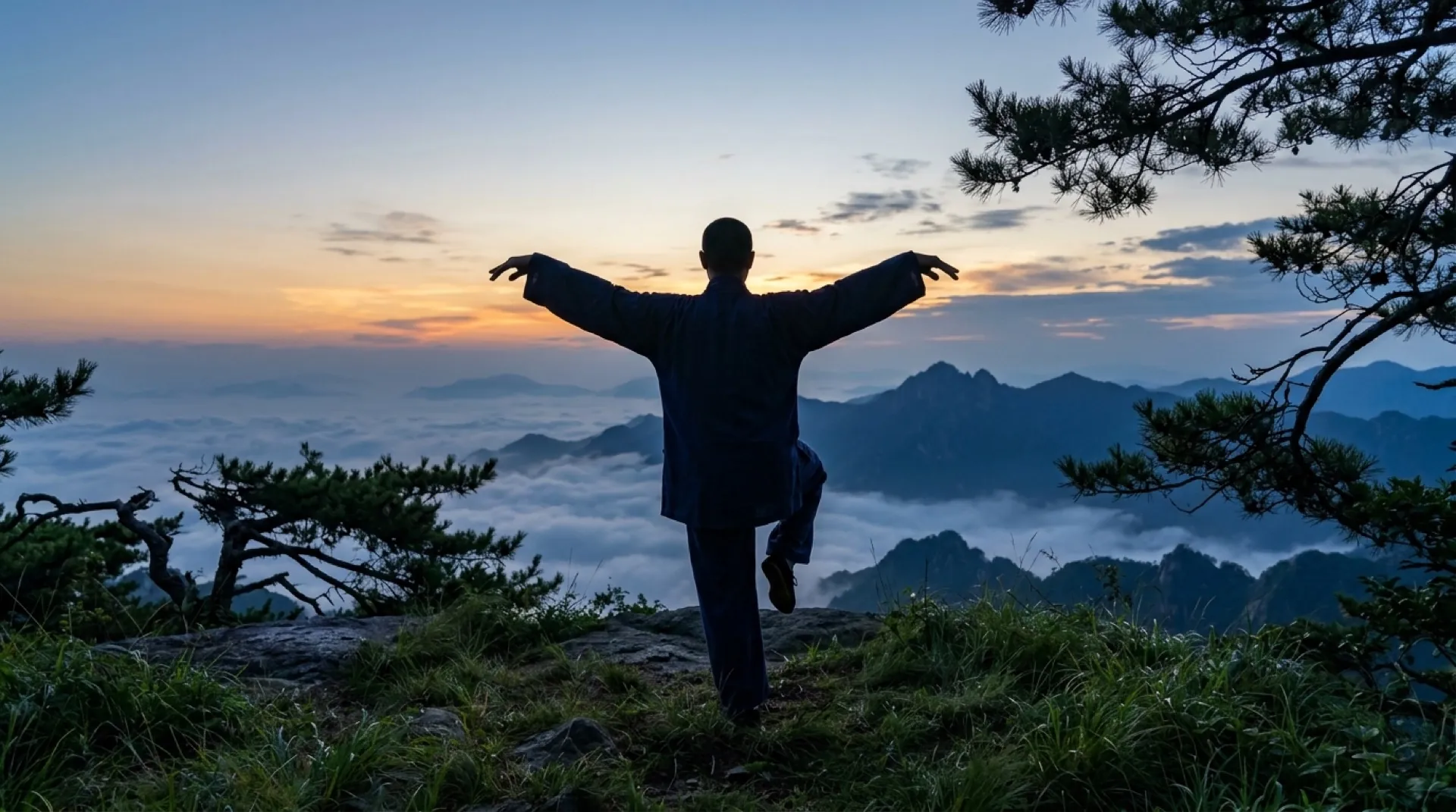
A practitioner seen from behind, standing on one leg with both arms spread wide like wings on a grassy summit among pines, above a sea of clouds at dawn.

1. Historical Context: From Internal Boxing Records to Wudang Taiyi Wuxing Quan

Within the traditional curriculum of Wudang Wushu, Taiyi Wuxing Quan (太乙五行拳, “Supreme Unity Five-Element Fist,” also transmitted as Taiyi Wuxing Qinpu Ershisan Shi 太乙五行擒扑二十三势) stands alongside Wudang Taijiquan, Xuanwu Quan, and Longhua Quan as a signature barehand routine unifying martial structure with longevity breathwork (daoyin yangsheng 导引养生).

Keeping historical archive and lineage memory distinct is essential for serious students. As examined in our study of Huang Zongxi’s 1669 Epitaph for Wang Zhengnan, the Ming-dynasty adept Zhang Songxi (张松溪) of Ningbo is the earliest historically documented master of the Wudang Internal School (Neijiaquan 内家拳). In twentieth-century Wudang temple transmission, Taiyi Wuxing Quan was preserved and taught at Zixiao Palace by the Taoist abbot Xu Benshan (徐本善, 1860–1932) and passed to modern practitioners such as Jin Zitao (金子弢, Ai Shizun) and Zhao Jianying, who documented its twenty-three linked postures in the early 1980s.

2. The Five Phases, Five Visceral Systems, and Five Animal Archetypes

Unlike hard linear Five-Element fist systems, Wudang Taiyi Wuxing Quan takes “Supreme Unity” (Taiyi 太乙—the undifferentiated primordial breath prior to Yin-Yang division) as its center and expresses movement through the Five Phases (Wuxing 五行), paired with five classical animal qualities and the internal landscape of the Huangting Jing (Yellow Court Classic):

  • Metal (金 · Lungs · Crane 鹤): Poised, buoyant opening and closing of the shoulder girdle and upper chest, training empty-step balance and clear inhalation without lifting the shoulders.
  • Wood (木 · Liver · Dragon 龙): Supple spiral coiling through the ribs, flanks, and spine (Dragon-spine undulation), releasing lateral stiffness in the tendons.
  • Water (水 · Kidneys · Snake 蛇 / Turtle 龟): Low, continuous flowing transitions rooted in the waist and lower back (Mingmen), cultivating listening sensitivity (Tingjin) and smooth weight shifts.
  • Fire (火 · Heart · Phoenix / Red Bird 朱雀): Spirited, expansive extension through the forearms and fingertips while keeping Heart-fire settled downward into the lower Dantian.
  • Earth (土 · Spleen · Ape 猿 / Tiger 虎): Centered equilibrium (Zhongding 中定) and whole-body pouncing elasticity anchored through the Five Steps (Wubu).
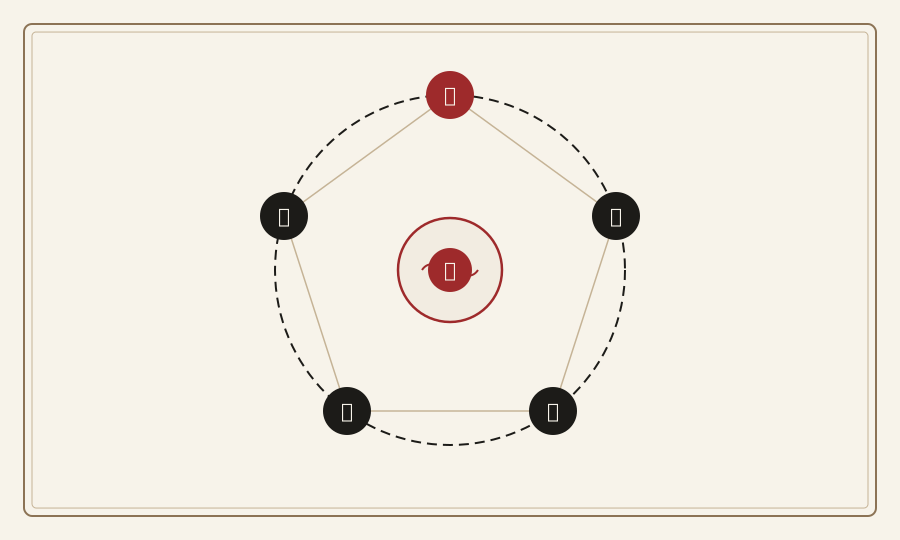
Classical numbers-only diagram of Wudang Taiyi Wuxing Quan showing the five outer elemental nodes (①–⑤) connected along a circular arc-stepping ring around the central Taiyi / Earth pivot (⑥).

Wudang Taiyi Wuxing Quan (numbers-only SVG key): Five-Phase and Five-Animal coiling nodes revolving around the central Taiyi pivot.

  1. ① Fire Phase (Huo · Heart Spirit): Outward expanding and settling wrists, keeping the chest hollow and Heart-fire calm.
  2. ② Wood Phase (Mu · Liver Tendons · Dragon): Spiral coiling of the waist and ribcage that lengthens the sinews without stiffness.
  3. ③ Water Phase (Shui · Kidney Root · Snake/Turtle): Deep, continuous low-stance folding and smooth weight transfer through the hips.
  4. ④ Metal Phase (Jin · Lung Breath · Crane): Buoyant wing-like opening and single-leg root equilibrium.
  5. ⑤ Continuous Arc Stepping (Yin-Yang Hubu): Curved footwork around the perimeter that avoids head-on linear collision.
  6. ⑥ Central Taiyi & Earth Pivot (Zhongding): The quiet lower-Dantian axis governing all twenty-three linked transitions.

3. Core Biomechanical Signature: “Walking in Arcs, Coiling at Every Joint”

In solo practice, Taiyi Wuxing Quan is immediately recognizable by its circular, continuous rhythm—summarized in Wudang teaching manuals as “walking on Yin-Yang arcs, coiling through the three sections” (bu zou yin yang hu, shen chan san jie jin 步走阴阳弧,身缠三节劲):

  1. Arc Stepping instead of Straight Stomping: Each forward or retreating step traces a gentle crescent curve past the supporting ankle (similar to Cat-Walking in Taijiquan), protecting the knee joint while angling off the centerline.
  2. Waist-Led Folding and Coiling: Rather than throwing the arms with isolated shoulder force, every ward-off, press, or spiral deflection begins with loosening the hip crease (songkua 松胯) and turning the waist, fulfilling the Six Harmonies (Liuhe).
  3. Seamless Breath Pacing: Because the form emphasizes soft folding and continuous circular redirection over explosive stamping, the breath stays deep, quiet, and even from opening salute to closing return.

4. Beginner 5-Minute Arc-Step and Coiling Drill & Safety Notes

Before learning the full twenty-three-posture sequence, practice this foundational five-minute coordination drill in a clear space:

Stand in a shoulder-width Zhan Zhuang posture for six calm breaths. Shift 100% of your weight onto the right leg, draw the left foot inward along a soft crescent curve beside the right ankle, and step forward-left at a 45-degree angle, landing heel-to-sole as your waist turns left and both palms coil outward in a soft horizontal circle at chest height. Repeat alternating left and right arc steps for eight slow breaths, keeping your knees aligned with your toes and your shoulders dropped. Safety note: step at a comfortable height without twisting a loaded knee; if you experience joint pain or dizziness, pause and consult a qualified healthcare professional.

Seeker’s Q&A · Frequently Asked Questions

How does Wudang Taiyi Wuxing Quan differ from linear Five-Element fist styles?

Preserved in twentieth-century Wudang transmission through Zixiao Palace abbot Xu Benshan, Wudang Taiyi Wuxing Quan emphasizes circular Yin-Yang arc stepping, continuous three-joint spiral coiling, and Five-Animal Daoyin breathwork rather than rigid linear stamping.


