INTERNAL MARTIAL FOUNDATIONS · 内家拳筑基

The Ten Essentials of Taijiquan (Taijiquan Shiyao): Suspending the Crown, Sinking the Chest, Loosening the Waist and Uniting Mind and Qi 太极拳十要详解:虚领顶劲、含胸拔背、松腰落胯与动中求静的武当身法总纲

Master the classical Ten Essentials of Taijiquan (Taijiquan Shiyao)—from empty-neck crown suspension (Xuling Dingjin) and sinking the shoulders to distinguishing full and empty and maintaining unbroken internal continuity.


A yellow thread-bound book and a celadon cup of tea on a small wooden table beneath a round lattice window, with bamboo shadows on the wall.

Why the Ten Essentials (Taijiquan Shiyao) Govern Every Internal Form

Without structural and energetic principles, a Taijiquan sequence is merely slow choreography. The classical Ten Essentials of Taijiquan (Taijiquan Shiyao 太极拳十要)—crystallized from the Taijiquan Classics attributed to Zhang Sanfeng and Wang Zongyue and transmitted across Wudang and traditional Taijiquan lineages—serve as a diagnostic checklist for every posture in the Wudang 13-Posture (Shisanshi), 28-Posture, and 36-Posture forms. Rather than ten isolated rules, they form five interrelated pairs linking skeletal alignment (Piers 1–5) with internal mind-intent and Qi integration (Piers 6–10).

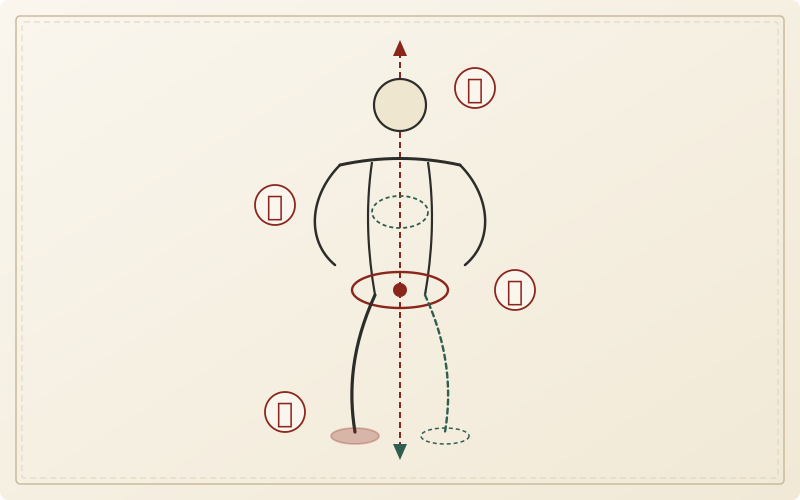
① Suspending the crown with an empty neck (Xuling Dingjin) along the vertical plumb line, ② Containing the chest and rounding the back (Hanxiong Babei) while sinking shoulders and dropping elbows (Chenjian Zhuizhou), ③ Loosening the waist and settling the Kua (Songyao Luokua) as the central steering axle, ④ Clearly distinguishing substantial and insubstantial weight (Fen Qing Xushi) at the rooted feet.

① Suspending the crown with an empty neck (Xuling Dingjin) along the vertical plumb line, ② Containing the chest and rounding the back (Hanxiong Babei) while sinking shoulders and dropping elbows (Chenjian Zhuizhou), ③ Loosening the waist and settling the Kua (Songyao Luokua) as the central steering axle, ④ Clearly distinguishing substantial and insubstantial weight (Fen Qing Xushi) at the rooted feet.

The Five Structural Alignments: From Crown to Root

  1. Empty the Neck and Suspend the Crown (Xuling Dingjin 虚领顶劲): Gently draw the chin slightly inward so the cervical spine lengthens upward as if the Baihui point at the crown were suspended by a silk thread. Never stiffen the neck muscles; stiffness blocks Qi from rising to nourish the spirit.
  2. Contain the Chest and Round the Back (Hanxiong Babei 含胸拔背): Allow the sternum to soften inward by a fraction of an inch—creating the receptive hollow described in Chapter 6 of the Tao Te Ching (Gushen)—so the breath sinks naturally to the lower Dantian while the upper back expands between the shoulder blades.
  3. Loosen the Waist (Songyao 松腰): The waist and lumbar Mingmen gate act as the commander's banner for the entire body. When the psoas and lower back release habitual lordotic gripping, power generated from the feet transmits smoothly to the hands.
  4. Distinguish Substantial and Insubstantial (Fen Qing Xushi 分清虚实): Whenever weight settles into one leg, the other becomes agile without collapsing. Avoiding "double-weightedness" (Shuangzhong 双重) is the secret to effortless stepping and rotational responsiveness.
  5. Sink the Shoulders and Drop the Elbows (Chenjian Zhuizhou 沉肩坠肘): Floating shoulders trap tension in the trapezius and cause the breath to rise into the throat. Letting the shoulder joints hang loose and the elbows point gently downward connects the arms to the latissimus dorsi and spine.

The Five Internal Harmonies: Intent, Continuity, and Stillness

  1. Use Mind-Intent Rather Than Brute Force (Yong Yi Bu Yong Li 用意不用力): Relax unnecessary muscular contraction so the meridians and fascia remain open; where mind-intent (Yi) arrives, Qi and whole-body Jin follow.
  2. Coordinate Upper and Lower (Shang Xia Xiang Sui 上下相随): As detailed in the Six Harmonies (Liuhe), the hands, waist, and feet begin and complete every transition together.
  3. Unite the Internal and External (Nei Wai Xiang He 内外相合): When the spirit opens, the posture expands; when the spirit gathers, the posture closes.
  4. Move with Unbroken Continuity (Xianglian Buduan 相连不断): Like a great river flowing without pause, the end of one posture already contains the seed of the next.
  5. Seek Stillness Within Movement (Dong Zhong Qiu Jing 动中求静): The slower and more composed the movement, the deeper the abdominal breath sinks—linking martial training directly with standing meditation (Zhan Zhuang) and Eight Brocades Qigong (Baduanjin).

Common Training Faults and Self-Correction on the Courtyard Floor

Essential PrincipleFrequent Beginner ErrorSomatic Self-Check
1. Xuling DingjinJutting the chin forward or tensing the neckFeel the occipital base float upward while the jaw and tongue stay soft
2. Hanxiong BabeiCollapsing into a hunched kyphotic slumpSoften only the sternum center while keeping the collarbones wide
3. SongyaoLocking the pelvis or leaning the torsoFold the inguinal crease (Song Kua) so the tailbone hangs plumb
4. Fen Qing XushiSplitting weight 50/50 while trying to stepVerify you can lift the empty foot without shifting the head height

Seeker’s Q&A · Frequently Asked Questions

What is the core takeaway of The Ten Essentials of Taijiquan (Taijiquan Shiyao)?

Master the classical Ten Essentials of Taijiquan (Taijiquan Shiyao)—from empty-neck crown suspension (Xuling Dingjin) and sinking the shoulders to distinguishing full and empty and maintaining unbroken internal continuity.
