QIGONG & YANGSHENG · 气功与导引

Warming the Kidney Court (Mo Shentang / Ca Yaoyan): Laogong Palm Friction over Mingmen and Shenshu in the Yangxing Yanming Lu 摩肾堂(擦腰眼):《养性延命录》与十二段锦温煦命门肾俞导引指南

A primary-source practical guide to the classical Taoist Daoyin method of Warming the Kidney Court (Mo Shentang / Ca Yaoyan), grounded in the Seated Twelve Brocades and Tao Hongjing's Yangxing Yanming Lu, detailing Laogong (PC-8) palm warming over Shenshu (BL-23) and Mingmen (GV-4).


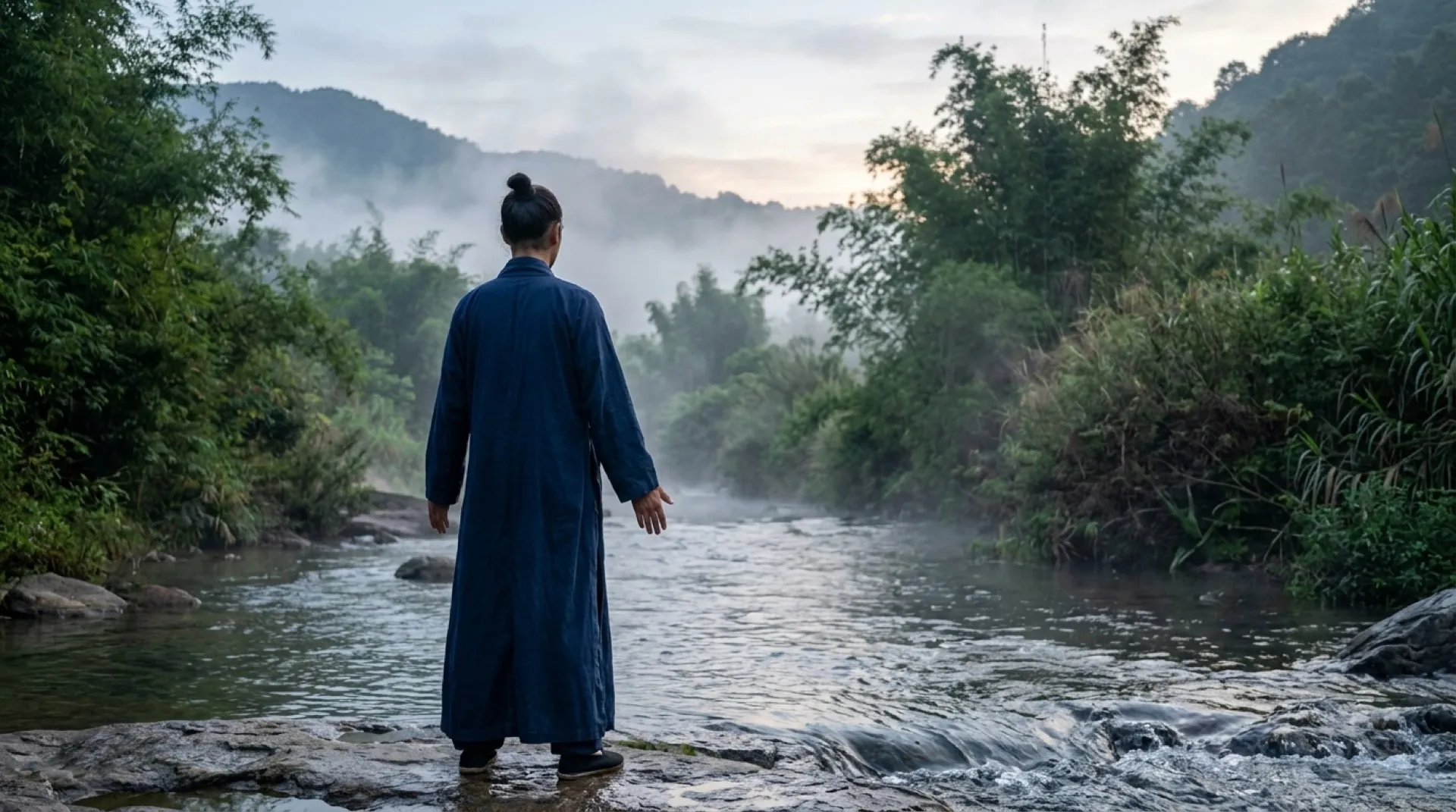
A figure in a long indigo robe with hair tied in a topknot, seen from behind, standing at the edge of a shallow misty mountain stream among bamboo.

1. Primary Textual Foundations: 'Rubbing the Rear Essence Gate' (Bei Mo Hou Jingmen) in Classical Daoyin Manuals

In classical Taoist longevity treatises and the daily cultivation routines of Wudang Mountain, the lower back region flanking the second lumbar vertebra is revered as the 'Kidney Court' (肾堂, Shentang), the 'Rear Essence Gate' (后精门, Hou Jingmen), or the 'Lumbar Eyes' (腰眼, Yaoyan). In the Seated Twelve Brocades (坐功十二段锦) and the Daoyin chapters associated with Tao Hongjing's (陶弘景, 456–536 CE) Yangxing Yanming Lu (《养性延命录》), practitioners are instructed to 'rub the palms hot and press-stroke the Rear Essence Gate / Kidney Court' (背摩后精门 / 两手摩肾堂) after breath and spinal exercises. Song-dynasty commentary notes that whenever the palms are briskly rubbed together until warm and applied directly over the lumbar hollows, the warmth of the Heart-Pericardium channel communicates directly with the Kidney dwelling.

2. Traditional Meridian Anatomy: Mingmen (GV-4), Shenshu (BL-23), and Zhishi (BL-52)

In classical Chinese meridian geography, the horizontal band at the level of the second lumbar spinous process (opposite the navel in front) forms the posterior energetic belt of the Lower Dantian: (1) On the posterior midline sits Mingmen (命门, GV-4, 'Gate of Vitality'), the hinge of ministerial fire on the Governing Vessel; (2) One and a half cun lateral to Mingmen on either side sit the two Shenshu points (肾俞, BL-23, 'Kidney Shu-Transporter') on the inner line of the Foot Taiyang Bladder channel; and (3) Three cun lateral sit the two Zhishi points (志室, BL-52, 'Chamber of Will') on the outer Bladder line, overlapping the muscular hollows known as the 'Lumbar Eyes' (腰眼). Meanwhile, the center of each palm holds Laogong (劳宫, PC-8, Fire phase). Rubbing the lumbar belt with warm Laogong palms embodies the classical Neidan principle of using Heart-Fire to warm Kidney-Water (心肾相交, 水火既济) while soothing postural fatigue in the erector spinae and quadratus lumborum muscles. Safety note: Mo Shentang is a gentle traditional Taoist self-massage and wellness practice and is never a substitute for medical diagnosis or treatment of acute disc herniation, sciatica, or renal disease.

3. Step-by-Step Wudang Execution: Warming Laogong, Thirty-Six Vertical Strokes, and Mingmen Cupping

As practiced at the close of standing meditation and martial sessions connected to Wudang Mountain's UNESCO World Heritage ancient Taoist temples and taught in Singapore at Lee Wudang International Pte. Ltd., perform Mo Shentang standing in a relaxed shoulder-width Wuji posture or seated upright on the front edge of a wooden stool: (1) Relax the shoulders and briskly rub both palms together for ten to fifteen seconds until the Laogong (PC-8) centers feel distinctly warm; (2) Place both palms flat against the lower back on either side of the spine over the Shenshu (BL-23) and Yaoyan hollows, fingers pointing downward toward the sacrum; (3) Rub briskly yet smoothly up and down along the lumbar paraspinal muscles thirty-six times—inhaling on the upward stroke and exhaling on the downward stroke—until a pleasant, penetrating warmth spreads across the lower back and Mingmen (GV-4); (4) Finish by resting both warm palms still over the Shenshu points for three quiet abdominal breaths, imagining the warmth settling inward like mountain streams returning to the deep sea of the Lower Dantian.

4. Daily Regimen Integration & Cross-References Across the Wudang Curriculum

Mo Shentang is the ideal closing seal after spinal undulation sets or head-and-face awakening routines: pair it with Combing the Scalp with Ten Fingers (Jie Fa / Shizhi Shutou) to balance upper cranial clarity with lower lumbar rooting, or practice it immediately after Wudang Longhua Quan Fundamentals (Dragon-Splendor Fist). Explore our full Wudang Wellness & Qigong Overview and reflect on the philosophical image of all streams returning to the sea in The Tao Is Eternally Nameless: Zhi Zhi and Chuan Gu (Tao Te Ching Chapter 32).

Seeker’s Q&A · Frequently Asked Questions

What is the core takeaway of Warming the Kidney Court (Mo Shentang / Ca Yaoyan)?

A primary-source practical guide to the classical Taoist Daoyin method of Warming the Kidney Court (Mo Shentang / Ca Yaoyan), grounded in the Seated Twelve Brocades and Tao Hongjing's Yangxing Yanming Lu, detailing Laogong (PC-8) palm warming over Shenshu (BL-23) and Mingmen (GV-4).
