INTERNAL MARTIAL FOUNDATIONS · 内家拳基础

Storing and Issuing Energy (Xujin and Fajin) vs. Stiff Force (Zhuoli) in Wudang Taijiquan: Drawing the Bow and Loosing the Arrow Safely 武当太极拳“蓄劲与发劲”辨析:何谓“蓄劲如张弓、发劲如放箭”与化去拙力?

Grounded in the Taijiquan classics ('Storing energy is like drawing a bow; issuing energy is like loosing an arrow'), learn how Wudang internal martial arts distinguish elastic whole-body Jin from stiff muscular force (Zhuoli).


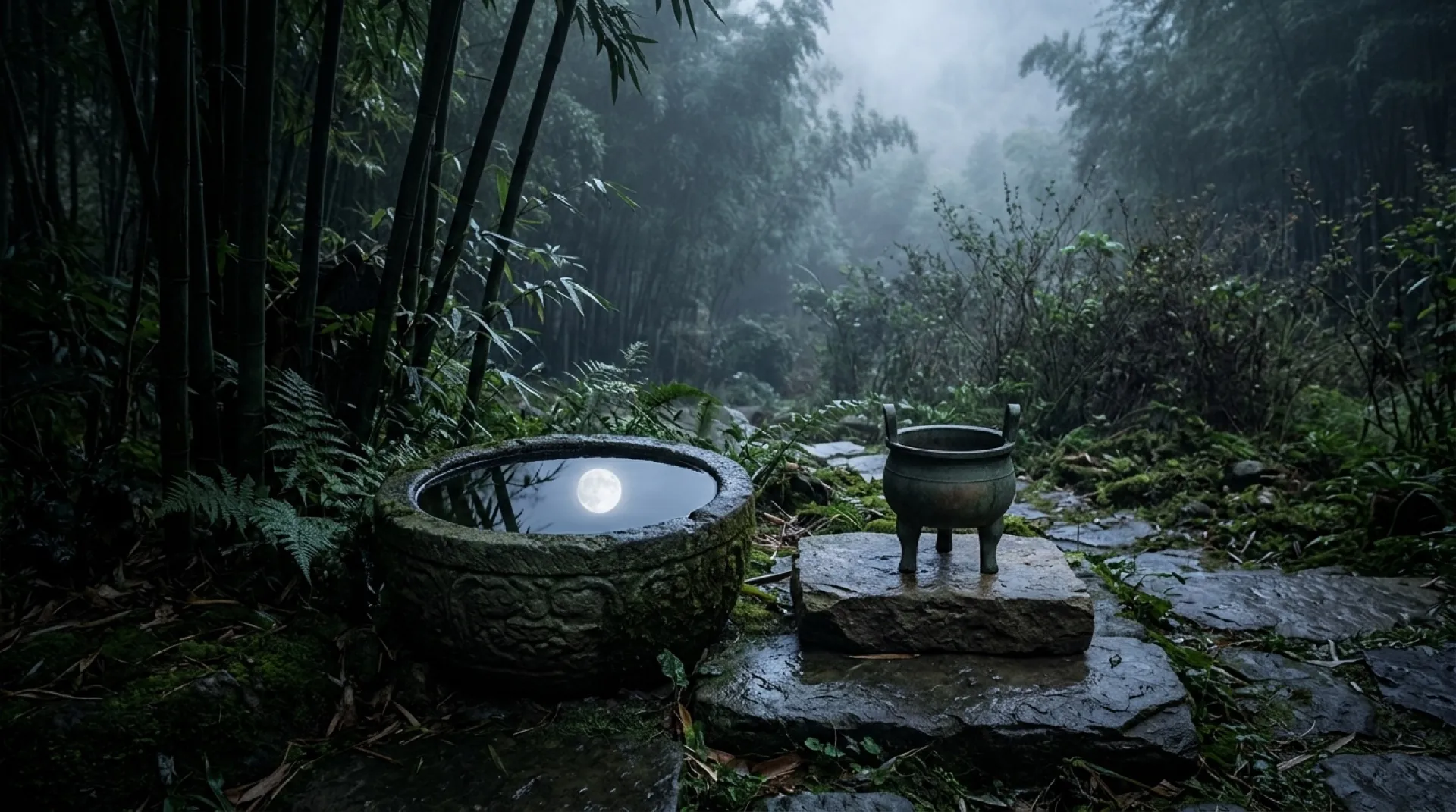
A carved stone basin of still water reflecting the full moon beside a small bronze tripod vessel on a stone slab, in a bamboo grove at night.

1. What the Classics Mean by 'Storing Like Drawing a Bow, Issuing Like Loosing an Arrow'

Few terms in Chinese internal martial arts attract more curiosity—or more misunderstanding—than Fajin (发劲, 'issuing trained internal force'). In Shisanshi Xinggong Xinjie (Mental Elucidation of the Thirteen Postures), the classical treatise preserved in the Taijiquan canon, the mechanism is described with archery imagery rather than mysticism: 'Storing energy is like drawing a bow (xujin ru zhanggong 蓄劲如张弓); issuing energy is like loosing an arrow (fajin ru fangshi 发劲如放箭). Seek straightness within curves; store first and then issue (qu zhong qiu zhi, xu er hou fa 曲中求直,蓄而后发).'

Notice the order of the maxim: before an arrow can fly, the bow stave and bowstring must first be drawn smoothly and evenly (Xujin 蓄劲). Attempting to practice explosive Fajin before cultivating relaxation (Song 松), the Six Harmonies (Liuhe), and Silk-Reeling Energy (Chansijin) simply trains stiff muscular shoving (Zhuoli 拙力), which jars the shoulders, elbows, and lower back.

2. Distinguishing Stiff Force (Zhuoli) from Trained Elastic Force (Jin)

How can a student tell the difference between stiff force (Li 力 / Zhuoli 拙力) and trained internal force (Jin 劲)? In Wudang pedagogy, they differ in four observable ways:

First, origin: stiff force contracts the local shoulder and arm muscles in isolation, whereas Jin originates from the ground reaction under the feet, travels through the legs, is directed by the waist, and arrives at the hands ('its root is in the feet, issued through the legs, governed by the waist, and expressed in the fingers'). Second, joint space: stiff force locks the joints rigid at the moment of exertion, blocking circulation, whereas Jin maintains soft, open joint spaces (Songjian Zhuizhou 松肩坠肘) even at the moment of release. Third, breath: stiff force relies on valsalva breath-holding and facial straining, whereas Jin coordinates with a natural sinking of breath to the lower dantian. Fourth, recovery: after a stiff push, the practitioner falls forward if the target yields; after a balanced Fajin, the practitioner's center remains upright and stable.

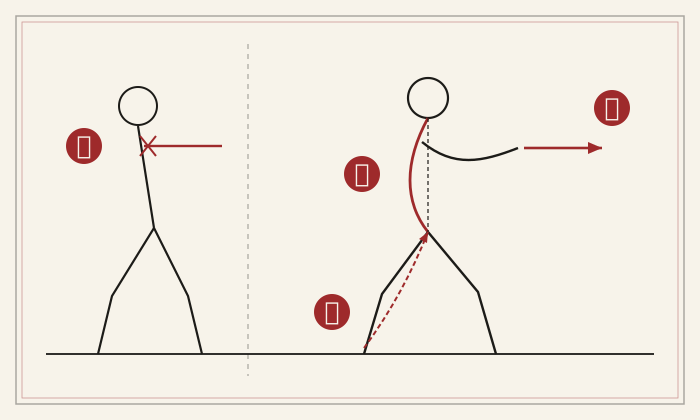
Classical diagram contrasting stiff shoulder pushing (Zhuoli) with Wudang Taijiquan elastic bow storage (Xujin), ground-to-waist power transmission, and short-range release (Fajin)

Stiff force (Zhuoli) vs. elastic bow storage and release (Xujin and Fajin) in the Taijiquan classics.

  1. ① Stiff Muscular Pushing (Zhuoli): Locked shoulder and elbow pushing in isolation, rebounding backward and uprooting the heels.
  2. ② Storing Like Drawing a Bow (Xujin Ru Zhanggong): Folding the hip creases (Kua), spinal arc, and elbows into a unified elastic bow.
  3. ③ Root-to-Waist Transmission: Ground reaction force rising from the rear sole through the legs and waist axle.
  4. ④ Issuing Like Loosing an Arrow (Fajin Ru Fangshi): Crisp, relaxed release along the centerline without leaning or locking joints.

3. The 'Five Bows' (Wugong): How the Body Stores Elastic Potential (Xujin)

In traditional Wudang internal training—as we saw in Bend the Bow to Shoot the Tiger (Wangong Shehu) and Deflect, Parry, and Punch (Banlanchui)—the body is trained as a set of five interconnected bows (Wugong 五弓): the main spinal bow running from the crown (Baihui) to the tailbone (Weilu), paired with the two arm bows (shoulder-to-wrist through the elbow) and the two leg bows (hip-to-ankle through the knee).

To 'store energy like drawing a bow' (Xujin), you do not pull your arms backward behind your torso. Instead, as you inhale or transition weight, you fold the inguinal hip crease (Kua), allow the chest to hollow slightly (Hanxiong) so the upper back rounds (Babei), and keep the elbows heavy. This creates a gentle, whole-body elastic compression across fascia and tendons—like a spring bamboo pole bent softly toward the earth.

4. Progressive Training Stages & Joint Safety Guidelines

In the Wudang curriculum, students progress through three patient stages described in Wang Zongyue's Taijiquan Lun: first, shedding stiffness (Huajiang 化僵) through slow, aligned solo form and Standing Post (Zhan Zhuang); second, learning to link the feet, waist, and hands into a single continuous wave (Mingjin 明劲 / whole-body connection); third, practicing short, relaxed releases at the end of posture transitions—such as the settling palm of An or the spiral punch of Banlanchui—always stopping with the elbow and knee slightly curved ('seeking straightness within curves') so no joint ever snaps into hyperextension.

Safety note: never snap the elbows, knees, or cervical spine to simulate explosive power, and never hold your breath sharply. This instructional guide is for educational martial arts and biomechanics study; beginners should prioritize slow, smooth coordination and consult a qualified instructor or healthcare professional if experiencing joint pain.

Seeker’s Q&A · Frequently Asked Questions

What is the core takeaway of Storing and Issuing Energy (Xujin and Fajin) vs. Stiff Force (Zhuoli) in Wudang Taijiquan?

Grounded in the Taijiquan classics ('Storing energy is like drawing a bow; issuing energy is like loosing an arrow'), learn how Wudang internal martial arts distinguish elastic whole-body Jin from stiff muscular force (Zhuoli).
