INTERNAL MARTIAL FOUNDATIONS · 内家拳筑基

Huang Zongxi's 1669 Epitaph for Wang Zhengnan and the Historical Foundations of Wudang Neijiaquan: Overcoming Movement with Stillness 黄宗羲《王征南墓志铭》与武当内家拳史考:“以静制动、后发先至”的拳理渊源

Examine the earliest dated primary sources of the Internal School (Neijiaquan) — Huang Zongxi's 1669 Epitaph for Wang Zhengnan and Huang Baijia's 1676 Neijia Quanfa — and how their core principle of 'overcoming movement with stillness' (Yi Jing Zhi Dong) defines Wudang martial arts.


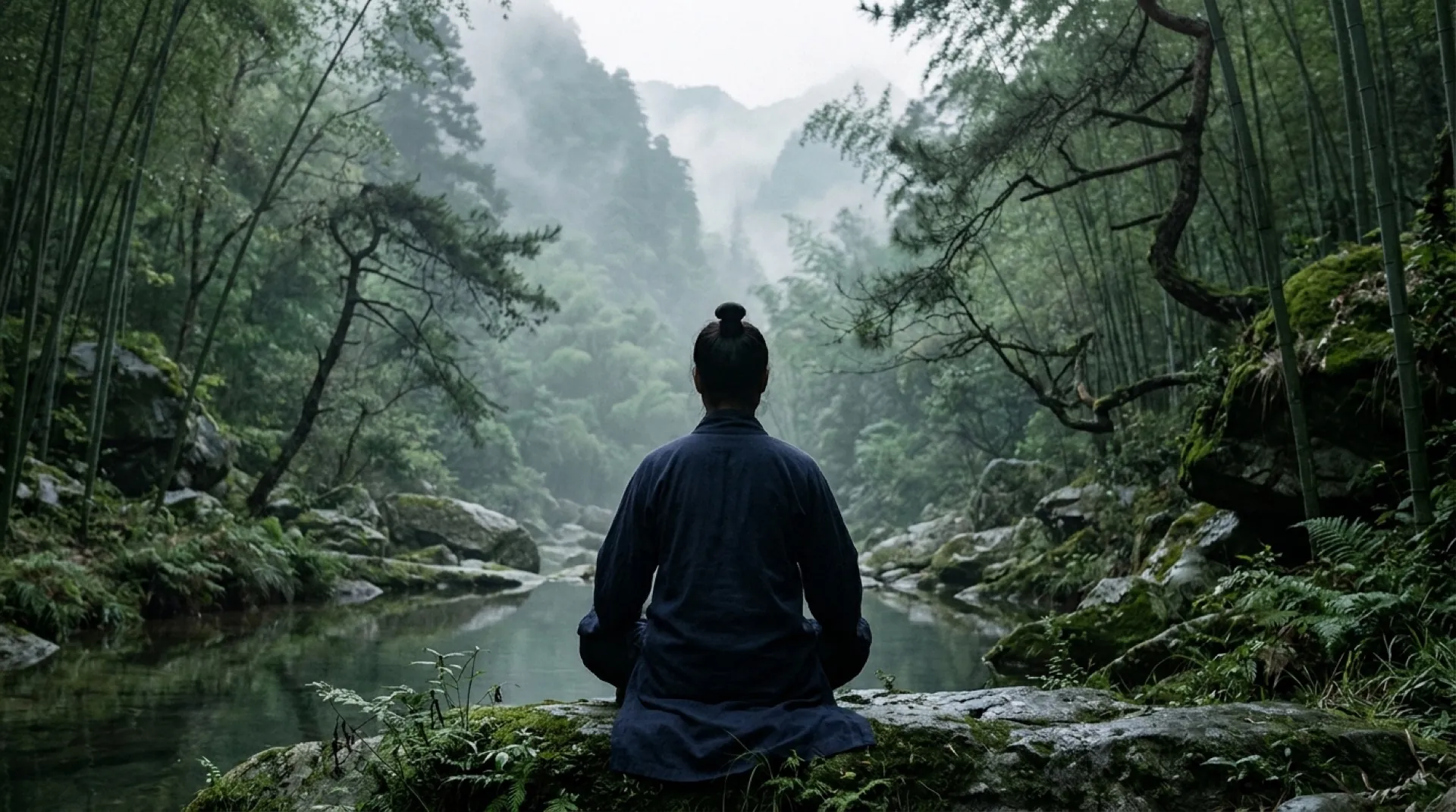
A figure in a dark robe with hair in a topknot, seen from behind, seated cross-legged on a mossy rock beside a still pool in a misty bamboo ravine.

1. Primary Historical Sources: Huang Zongxi's 1669 Epitaph and Huang Baijia's 1676 Manual

In any serious study of Chinese martial history (building on our comparison of Wudang vs. Shaolin: Internal and External Martial Traditions), scholars distinguish carefully between inspiring oral legends and dated historical texts. The earliest extant dated document to use the term Neijia (内家 — "Internal School") in explicit contrast to Waijia (外家 — "External School") is the Epitaph for Wang Zhengnan (Wang Zhengnan Muzhiming 《王征南墓志铭》), composed in 1669 (the eighth year of the Kangxi reign) by the eminent Ming-loyalist historian and philosopher Huang Zongxi (黄宗羲, 1610–1695) for his family friend and martial master Wang Laixian (Wang Zhengnan 王征南, 1617–1669).

Seven years later, in 1676, Huang Zongxi's son Huang Baijia (黄百家, 1643–1709) — who had personally studied under Wang Zhengnan — wrote the Neijia Quanfa (《内家拳法》, Methods of the Internal School of Boxing), recording the training methods, hand techniques, and tactical principles of the art in detail. Together, these two seventeenth-century texts provide our clearest historical window into how the concept of Wudang internal martial arts was articulated and practiced.

2. "Overcoming Movement with Stillness" (Yi Jing Zhi Dong): Reading the 1669 Epitaph

Huang Zongxi opens his 1669 Epitaph with a famous definition that has shaped Chinese martial philosophy for over three centuries: "Shaolin is famous under heaven for boxing; however, it emphasizes attacking the opponent, and one who attacks is easily seized/exploited by the other. There is another school called the Internal School (Neijia), which overcomes movement with stillness (yi jing zhi dong 以静制动); the attacker who errs falls at the touch of the hand (fanzhe yingshou jipu 犯者应手即仆). Thus Shaolin is distinguished as the External School. It originated with Zhang Sanfeng of the Song..." (少林以拳勇名天下,然主搏人,人亦得以乘之。有所谓内家者,以静制动,犯者应手即仆,故别少林为外家。盖起于宋之张三丰).

While modern historians note that Zhang Sanfeng's historical dates belong to the late Yuan and early Ming dynasties (honored in the imperial temple construction on Wudang Mountain) rather than the Song, Huang Zongxi's technical distinction between Waijia and Neijia is crystal clear. "External" does not mean shallow, and "Internal" does not mean mystical; rather, an approach that rushes out to overpower the opponent (zhu bo ren 主搏人) inevitably commits its center of gravity first, creating a gap (xi 隙) that a calm, centered practitioner can read and redirect.

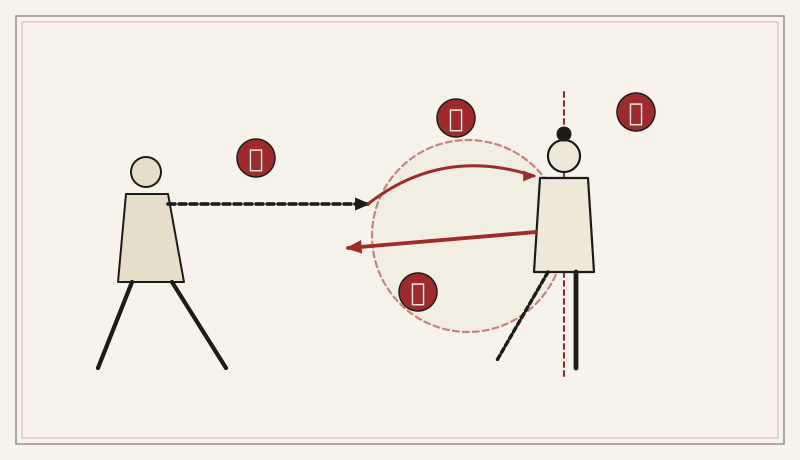
Classical ink-and-cinnabar diagram of Wudang Neijiaquan 'overcoming movement with stillness' (Yi Jing Zhi Dong) based on Huang Zongxi's 1669 Epitaph with four numbered markers (①–④).

Figure 1: The Classical Neijia Principle in Huang Zongxi's 1669 Epitaph for Wang Zhengnan — ① Over-extended linear attack of the external approach (Zhu Bo Yu Ren, Ren De Er Cheng Zhi); ② Unmoved central axis of the Internal School (Neijia Yi Jing Zhi Dong); ③ Tangent circular absorption and redirection of incoming momentum; ④ Starting second yet arriving first along the short chord (Hou Fa Xian Zhi, Fanzhe Yingshou Jipu).

  1. ① Over-Extended Attacking Vector (Zhu Bo Yu Ren 主搏于人): Committing weight and force forward first exposes one's center to being seized or borrowed.
  2. ② Overcoming Movement with Stillness (Yi Jing Zhi Dong 以静制动): Maintaining a quiet, rooted central axis in Cat or Bow Stance while observing the opponent's intention.
  3. ③ Tangent Redirection (Shunshi Jieli 顺势借力): Absorbing and deflecting the incoming force along a circular arc rather than colliding head-on.
  4. ④ Starting Second, Arriving First (Hou Fa Xian Zhi · Fanzhe Yingshou Jipu 后发先至·犯者应手即仆): Entering directly into the opponent's exposed structure the instant their old force is spent.

3. Huang Baijia's Neijia Quanfa: The Prohibitions Against Stiff Force and Starting Second to Arrive First

In his 1676 Neijia Quanfa, Huang Baijia records the tactical and structural rules he learned directly from Wang Zhengnan. Alongside compact stepping patterns (Liulu 六路) and conditioning sets (Shiduan Jin 十段锦), Huang Baijia emphasizes that the Internal School strictly forbids disconnected, reckless muscular exertion (jin liubing 禁六病 — prohibiting the "six faults" of sluggishness, floating, stiff collision, leaning, scattered spirit, and broken breath). Instead, every movement must coordinate the Six Harmonies (Liuhe) and the Eight Methods and Five Steps (Shisanshi).

How does "overcoming movement with stillness" work biomechanically? When an opponent launches a committed attack, their force travels along a long outer commitment path. By remaining as composed as the Wooden Rooster (Muji) in the Zhuangzi, the Neijia practitioner uses Listening Energy (Tingjin) to yield along the tangent and enter along the short straight chord toward the opponent's center — fulfilling the classical maxim Hou Fa Xian Zhi (后发先至 — "starting second, yet arriving first").

4. Practicing Yi Jing Zhi Dong Today in Solo Stances and Partner Tuishou

In the traditional training halls of Wudang Mountain and in our Singapore classes, we honor Huang Zongxi's and Huang Baijia's historical legacy by training stillness before movement in every session: 1) Stillness in Stance: Begin every practice with five minutes of Standing Post (Zhan Zhuang) or a quiet Empty Stance (Xubu) guard, ensuring your breathing is calm and your weight is settled in the rear root; 2) Stillness Within Movement: When practicing solo Taijiquan postures such as Grasp the Sparrow's Tail (Lanquewei), keep the heart-mind quiet even while the waist and limbs spiral; 3) Waiting for the Partner's Commitment in Tuishou: In Push Hands (Tuishou), resist the urge to shove first; wait until you clearly feel the direction and length of your partner's incoming push before folding and redirecting.

Approached with historical clarity and daily diligence, Wudang internal martial arts cultivate poise, joint health, and mental equanimity, and never replace professional medical care.

Seeker’s Q&A · Frequently Asked Questions

What is the core takeaway of Huang Zongxi's 1669 Epitaph for Wang Zhengnan and the Historical Foundations of Wudang Neijiaquan?

Examine the earliest dated primary sources of the Internal School (Neijiaquan) — Huang Zongxi's 1669 Epitaph for Wang Zhengnan and Huang Baijia's 1676 Neijia Quanfa — and how their core principle of 'overcoming movement with stillness' (Yi Jing Zhi Dong) defines Wudang martial arts.
