
INTERNAL MARTIAL FOUNDATIONS · 内家拳基础

The Five Steps (Wubu) of Wudang Taijiquan: Advancing, Retreating, Looking Left, Gazing Right, and Central Equilibrium (Zhongding) Explained 武当太极拳“五步(进步、退步、左顾、右盼、中定)”详解:五行步法与立身中定枢机

Explore the Five Steps (Wubu: Jinbu, Tuibu, Zuogu, Youpan, Zhongding) of Wudang Taijiquan, their correspondence with the Five Phases (Wuxing), and how Central Equilibrium governs every weight shift.


A winding stone-paved path leading through bamboo and pines toward misty blue mountains at dawn.

1. How the Five Steps Complete the Thirteen Postures (Shisanshi)

As we saw in our overview of The Thirteen Postures (Shisanshi): Eight Methods and Five Steps, classical Taijiquan unites eight upper-body expressions of energy (Bafa: Peng, Lu, Ji, An and Cai, Lie, Zhou, Kao) with Five Steps (Wubu 五步): Advancing (Jinbu 进步), Retreating (Tuibu 退步), Looking Left (Zuogu 左顾), Gazing Right (Youpan 右盼), and Central Equilibrium (Zhongding 中定).

In traditional Wudang theory, while the Eight Methods correspond to the Eight Trigrams (Bagua), the Five Steps correspond to the Five Phases (Wuxing 五行: Metal, Wood, Water, Fire, and Earth). Without the Five Steps underneath, the Eight Methods of the hands are like a tree without roots—easily toppled at the first shift of weight.

2. Advancing (Jinbu) and Retreating (Tuibu): Cat-Stepping Forward and Coiling Back

In Wudang solo form and partner practice, Jinbu (进步, Advancing) and Tuibu (退步, Retreating) obey the strict rule of distinguishing empty and full (Fen Qing Xu Shi). When advancing—as in Parting the Wild Horse's Mane or Brush Knee—the supporting leg first settles solidly into the ground while the advancing foot peels off the floor, extends forward without dragging the torso ahead, touches lightly with the heel, and only receives weight after the sole is flat and the knee is aligned with the toes.

When retreating—as in Repulse the Monkey (Daojuanhong)—the practitioner folds the front hip crease (Kua) and reaches the unweighted foot backward along a shoulder-width track, touching the ball of the foot first, then rolling smoothly down onto the heel as the waist turns.

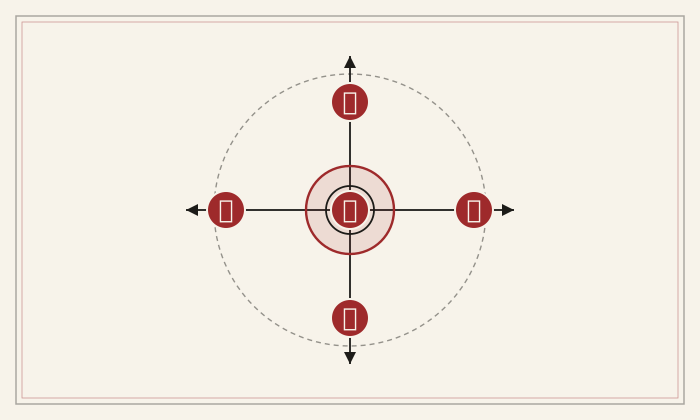
Classical five-direction diagram of Wudang Taijiquan's Five Steps (Wubu) showing Central Equilibrium (Zhongding) at the hub surrounded by Advancing (Jinbu), Retreating (Tuibu), Looking Left (Zuogu), and Gazing Right (Youpan)

The Five Steps (Wubu) of Wudang Taijiquan: Central Equilibrium (① Zhongding) anchoring Advancing (② Jinbu), Retreating (③ Tuibu), Looking Left (④ Zuogu), and Gazing Right (⑤ Youpan).

  1. ① Zhongding (Central Equilibrium · Earth): The upright spinal plumb line and rooted pelvic hub present inside every movement.
  2. ② Jinbu (Advancing Step): Rooted rear push and light, unweighted heel-first placement forward.
  3. ③ Tuibu (Retreating Step): Folding the front hip crease (Kua) and reaching backward with the ball of the foot.
  4. ④ Zuogu (Looking / Attending Left): Whole-body perceptual and weight-transfer readiness toward the left flank.
  5. ⑤ Youpan (Gazing / Attending Right): Whole-body perceptual and weight-transfer readiness toward the right flank.

3. Why 'Looking Left' (Zuogu) and 'Gazing Right' (Youpan) Mean More Than Turning the Eyes

Beginners often wonder why 'Looking Left' (Zuogu 左顾) and 'Gazing Right' (Youpan 右盼) are classified among the Five Steps rather than eye techniques. In classical Chinese martial terminology, Gu (顾, attending/caring for) and Pan (盼, observing/awaiting) describe 360-degree spatial awareness paired with lateral weight readiness—seen clearly in Cloud Hands (Yunshou) and Fair Lady Works at Shuttles (Yunü Chuansuo).

As Wang Zongyue's Taijiquan Lun explains: 'If the left is heavy, empty the left; if the right is heavy, empty the right' (zuo zhong ze zuo xu, you zhong ze you yao 左重则左虚,右重则右杳). Zuogu and Youpan train the hips, waist, and lateral ribs to yield or step to the left or right flank the instant pressure arrives, never getting trapped on a one-dimensional railroad track.

4. Central Equilibrium (Zhongding): The Earth Phase Present in Every Step

Among the Five Phases, Earth sits at the center and nourishes the four seasons; among the Five Steps, Zhongding (中定, Central Equilibrium) is not a separate fifth direction, but the vertical plumb line—from suspended crown (Baihui) through the lower dantian and perineum (Huiyin)—that must remain intact inside Advancing, Retreating, Looking Left, and Gazing Right.

You can train all Five Steps in a five-minute 'Five-Direction Cross Drill': stand in Zhongding at the center of four flagstones; step forward into a left bow stance (Jinbu) and return to center; step back into a retreat stance (Tuibu) and return; step laterally left (Zuogu) with Cloud Hands and return; step laterally right (Youpan) and return, checking that your head height never bobs and your spine never leans. Safety note: this instructional guide is for educational martial arts study; keep knees aligned with toes in all five directions.

Seeker’s Q&A · Frequently Asked Questions

What is the core takeaway of The Five Steps (Wubu) of Wudang Taijiquan?

Explore the Five Steps (Wubu: Jinbu, Tuibu, Zuogu, Youpan, Zhongding) of Wudang Taijiquan, their correspondence with the Five Phases (Wuxing), and how Central Equilibrium governs every weight shift.
