QIGONG & YANGSHENG · 气功与导引

Wudang Hip-Crease & Pelvic Releasing Daoyin (Songkua Yuandang): Unlocking Tight Hips for Sitting Meditation, Zhan Zhuang, and Taijiquan 武当“松胯圆裆”导引术:解开久坐髋部僵紧、贯通上下气血的筑基法门

Learn the Wudang Daoyin method of 'loosening the hip creases and rounding the arch of the pelvis' (Songkua Yuandang) to relieve prolonged sitting stiffness and connect upper-body stillness with lower-body root.


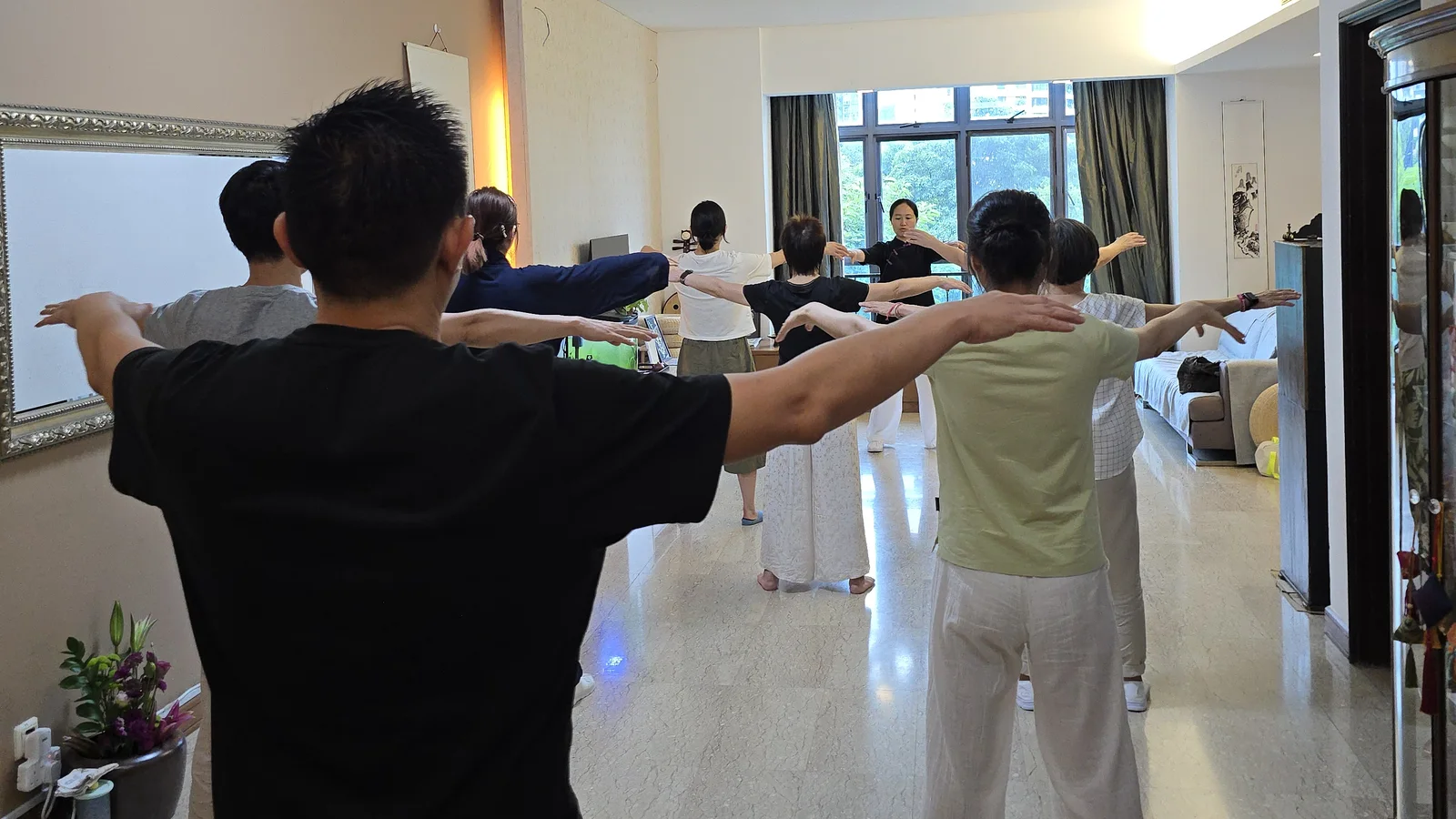
A standing qigong class in a sunlit room: students seen from behind hold both arms open at shoulder height in the same alignment, facing a teacher in dark clothing before a tall window with green trees outside.

1. Why Wudang Teachers Say 'To Loosen the Waist, First Loosen the Kua'

Across Wudang Taijiquan, Qigong, and seated meditation, students constantly hear the instruction 'loosen the waist' (Songyao 松腰). Yet when a beginner tries to relax the lower back directly while standing or moving, the pelvis often remains frozen like a solid block, forcing the lumbar vertebrae or the knees to twist in compensation. For this reason, Wudang oral transmission emphasizes a practical prerequisite: 'To loosen the waist, one must first loosen the hip creases' (yu song yao, bi xian song kua 欲松腰,必先松胯).

In traditional Chinese anatomical usage, the Kua (胯) refers specifically to the inguinal fold and hip joint where the head of the femur meets the pelvis, paired with Dang (裆), the arch between the two thighs. When hours of chair sitting shorten the hip flexors and stiffen the sacroiliac area, upper-body weight gets trapped in the lower back rather than draining down into the soles (as trained in our foot-arch and ankle rooting Daoyin guide).

2. Feeling the Inguinal Crease (Kua) and Rounding the Arch (Yuandang)

How do you locate and soften the Kua accurately without slumping? Stand with your feet shoulder-width apart and place the edges of both index fingers lightly into the diagonal creases at the front of your hips where your thighs meet your lower abdomen. Instead of pushing your knees forward over your toes, imagine the two inguinal creases folding softly inward and backward—as if sitting the very edge of your sit-bones onto a high wooden rail—while your tailbone (Weilu 尾闾) hangs heavy and neutral between your heels.

At the same time, maintain Yuandang (圆裆, 'rounding the pelvic arch'): imagine a small, buoyant sphere resting between the inner thighs so the knees neither collapse inward toward each other nor splay stiffly outward. This rounded arch protects the knee menisci in every stance from Standing Post (Zhan Zhuang) to low postures like Snake Creeps Down (Xiashi).

3. Three-Step Wudang Songkua Daoyin Routine (5 Minutes)

Practice this gentle five-minute hip-releasing sequence after long desk work or before Taijiquan and seated meditation:

1. Inguinal Crease Folding & Releasing (Kaikua Zuokua 开胯坐胯): Stand with feet shoulder-width apart and hands resting lightly in the hip creases. On a slow exhale, soften the hip creases backward and downward by two or three centimeters while keeping the kneecaps stationary over the mid-foot; on the inhale, allow the ground rebound from the soles to float the hips back up without locking the knees. Repeat nine slow cycles.

2. Horizontal Figure-Eight Pelvic Silk-Reeling (Huokua Chansi 活胯缠丝): Keeping the crown of the head quiet in the center and the feet flat, trace a small, slow horizontal figure-eight (∞) with the left and right hip joints—shifting weight into the left Kua as it folds slightly back, then gliding across the center into the right Kua as it folds back. Practice nine smooth loops in each direction.

3. Seated Butterfly & Sacral Warmth (Wenshen Huokua 温肾活胯): If preparing for Guarding the One (Shouyi) or Sitting in Forgetfulness (Zuowang), sit on the front edge of a firm cushion, bring the soles lightly together or cross the shins comfortably, and rock gently from sit-bone to sit-bone six times before settling in the center.

4. Breath Integration & Hip-Joint Safety Notes

As the Kua softens, you will notice that natural abdominal breathing deepens effortlessly because the pelvic floor and lower abdomen are no longer braced. Pair each hip-folding release with a long, unforced exhale.

Safety note: never force deep hip flexion, wide splits, or lotus sitting if you feel pinching in the front of the hip joint, sciatic radiating pain, or sacroiliac instability. Keep all movements small, supported, and pain-free; this traditional Daoyin guide is for educational movement wellness and does not replace orthopedic or physical therapy care.

Seeker’s Q&A · Frequently Asked Questions

What is the core takeaway of Wudang Hip-Crease & Pelvic Releasing Daoyin (Songkua Yuandang)?

Learn the Wudang Daoyin method of 'loosening the hip creases and rounding the arch of the pelvis' (Songkua Yuandang) to relieve prolonged sitting stiffness and connect upper-body stillness with lower-body root.
