
QIGONG & YANGSHENG · 气功与导引

Zhan Zhuang (Standing Meditation) for Beginners: Five-Point Alignment, Knee Safety and a 10-Minute Wudang Routine 零基础武当站桩入门:无极桩与混元桩身法要领、护膝铁律与每日十分钟次第

Why “standing still like a pine” is the shared foundation of Wudang Qigong and Taijiquan—and how to set your feet, knees, kua, shoulders, and breath without strain.

A standing qigong class in a sunlit room: students seen from behind hold both arms open at shoulder height in the same alignment, facing a teacher in dark clothing before a tall window with green trees outside.

In Wudang training halls, newcomers eager to learn sweeping Taijiquan forms or Qigong sequences are often surprised by their first instruction: stand quietly in one place for five minutes. A saying often repeated in internal-arts circles explains why: “A hundred movements are not as revealing as one stillness; a hundred drills are not as foundational as one standing posture” (百动不如一静,百练不如一站). When you stop moving across the floor, every hidden habit of tension—raised shoulders, locked knees, a hollowed lower back, or shallow chest-breathing—becomes unmistakable.

1. Classical Roots: “Standing Alone and Guarding the Spirit” (独立守神)

Standing meditation—known as Zhan Zhuang (站桩, “standing like a post”)—echoes the opening chapter of the medical classic Huangdi Neijing · Suwen (《黄帝内经·素问·上古天真论》): the ancient adepts “stood alone and guarded the spirit, while muscles and flesh remained as one” (提挈天地,把握阴阳,呼吸精气,独立守神,肌肉若一). In philosophical terms, it embodies Chapter 16 of the Tao Te Ching (Dao De Jing) (“returning to the root is called stillness,” 归根曰静) and the Huangting Jing’s quiet inward attention. For a broader overview of how standing fits into our wellness curriculum, see Standing Practice (Zhan Zhuang).

2. The Five-Point Alignment Checklist (Wuji & Hunyuan Stances)

Beginners start with two primary postures: Wuji Stance (无极桩), where the arms hang naturally beside the thighs, and Hunyuan / Holding-the-Sphere Stance (混元桩 / 抱球桩), where the arms curve gently in front of the chest as if cradling a light paper lantern. Walk through five checkpoints from top to bottom:

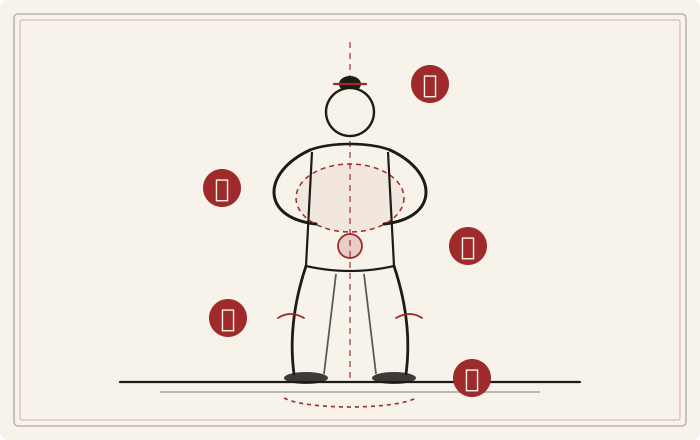
Classical ink-and-cinnabar diagram of Wudang Hunyuan Zhan Zhuang standing posture showing five structural checkpoints from crown to soles

Five structural checkpoints in Wudang Hunyuan Zhan Zhuang: aligning the vertical plumb-line so bones support weight while muscles soften.

  1. Gently suspended crown (虚领顶劲): chin slightly tucked, neck lengthened as if lifted by a silk thread
  2. Sunk shoulders, heavy elbows, and hollow chest (涵胸拔背,沉肩坠肘): arms curve smoothly below shoulder height
  3. Settled waist and folded kua (松腰落胯,气沉丹田): pelvis neutral as though perching lightly on a high stool
  4. Unlocked knees aligned with the toes (松膝合尖): micro-bend only; kneecaps never collapse inward or pass the toes
  5. Even three-point rooting of the feet (足底平铺,涌泉涵空): parallel shoulder-width stance with weight balanced across heel and forefoot

3. Three Common Beginner Mistakes—and How to Fix Them Immediately

  • Squatting Too Low Too Soon (贪低伤膝): Zhan Zhuang for health and internal rooting is not an isometric thigh-burning punishment. Start with a high stance—unlock your knees by just two or three centimetres so the hip creases (kua) soften and the weight drops straight through the shinbone into the centre of the foot.
  • Holding the Arms Up With Deltoid Tension (耸肩架肘): In Hunyuan stance, keep your hands between the navel and the collarbone—never higher than the shoulders—and let the elbows hang slightly lower than the wrists and shoulders (Softness and Vitality). If your shoulders tire after two minutes, lower your arms gracefully into Wuji stance rather than gritting your teeth.
  • Forcing the Breath or Staring Intensely (憋气瞪目): Keep a soft, level gaze toward the horizon or half-lower the eyelids (Guarding the One · Shouyi), and let nasal breathing lengthen naturally without counting forced seconds.
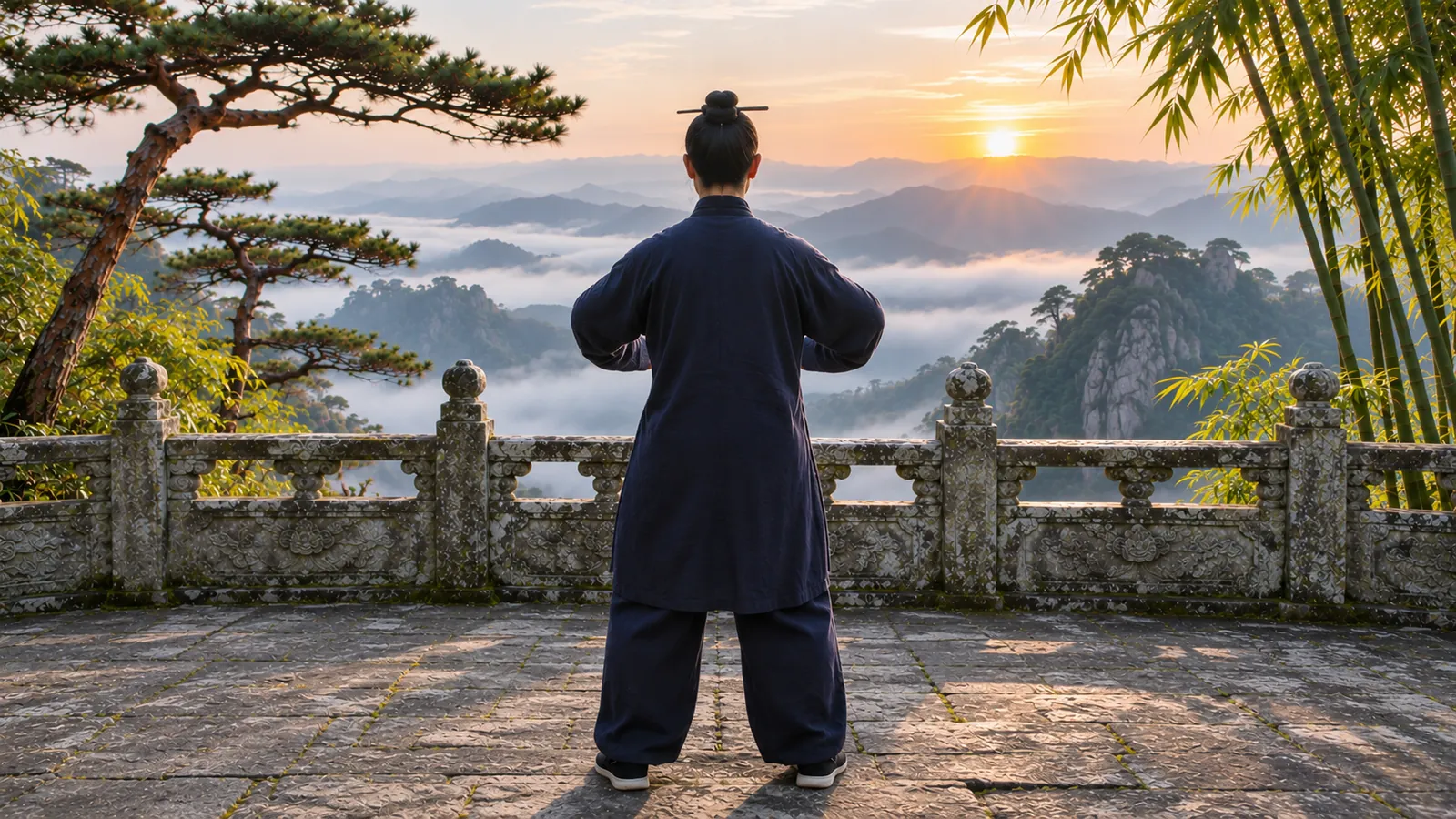
A practitioner in dark indigo Taoist robes seen from behind holding a rounded Hunyuan Zhan Zhuang standing posture on a stone mountain terrace above morning mist and Chinese red pines.

Hunyuan Zhan Zhuang at dawn: feet rooted shoulder-width apart, knees softly unlocked, and arms rounded without shoulder tension.

4. Your First 10-Minute Daily Routine (Wudang Mountain & Singapore)

  1. Minutes 1–2 (Loosening): Gently circle the ankles, hips, and shoulders, or practise two movements from Baduanjin (compare all four sets in Choosing Your First Qigong Set).
  2. Minutes 3–6 (Wuji Standing · 无极桩): Stand with arms resting naturally at your sides, checking each of the five points above as you exhale.
  3. Minutes 7–9 (Hunyuan Standing · 混元桩): Float the arms up in a soft circle before the lower chest; imagine resting your forearms on warm water.
  4. Minute 10 (Closing · 收功): Lower the palms over the lower abdomen (Dantian), take three quiet breaths, and walk slowly for thirty seconds before resuming daily tasks.

Whether you train among the UNESCO World Heritage ancient Taoist temples of Wudang Mountain or attend classes in Singapore, this ten-minute foundation prepares your body directly for Wudang Tai Chi for Beginners and Tingjin (Listening Energy). Visit Start Here or join our Singapore workshop to have an instructor check your alignment in person.

Safety & medical note: Standing meditation is a gentle postural and relaxation practice, not a medical treatment. If you have varicose veins, acute knee injury, or blood-pressure conditions, keep stances high, alternate with slow walking or seated meditation, and consult your physician.

Seeker’s Q&A · Frequently Asked Questions

What is the difference between Wuji Stance (无极桩) and Hunyuan Stance (混元桩)?

In Wuji Stance, the arms hang naturally beside the thighs to prioritize releasing shoulder and spinal tension; in Hunyuan Stance, the arms curve gently in front of the chest to cultivate whole-body structural rounding. Beginners should start each session with three to four minutes of Wuji Stance before raising the arms into Hunyuan Stance.


Why do my knees or lower back ache during Zhan Zhuang, and how do I fix it?

Knee ache usually comes from squatting too low or letting the kneecaps push past or inward of the toes; lower-back tightness comes from overarching the spine instead of folding the hip creases (kua). Stand higher (only a slight unlock in the knees) and imagine sitting lightly on the edge of a tall stool so weight drops vertically into the heels and midfoot.

Is 10 minutes of Zhan Zhuang a day enough for a beginner to feel benefits?

Yes. Ten calm, well-aligned minutes practised consistently every day is far more effective than an occasional thirty-minute session held with stiff shoulders and clenched teeth.
