TAOIST PHILOSOPHY · 道家哲学

The Valley Spirit Never Dies (Gushen Busi): Mysterious Female (Xuanpin) and Inexhaustible Quietude in Tao Te Ching Chapter 6 谷神不死与玄牝之门:《道德经》第六章的虚静生机与武当内功绵绵若存之道

Explore Chapter 6 of the Tao Te Ching (Dao De Jing)—'The Valley Spirit never dies; it is called the Mysterious Female (Xuanpin)'—and how Wudang inner cultivation preserves vitality through receptive stillness and unforced breathing.

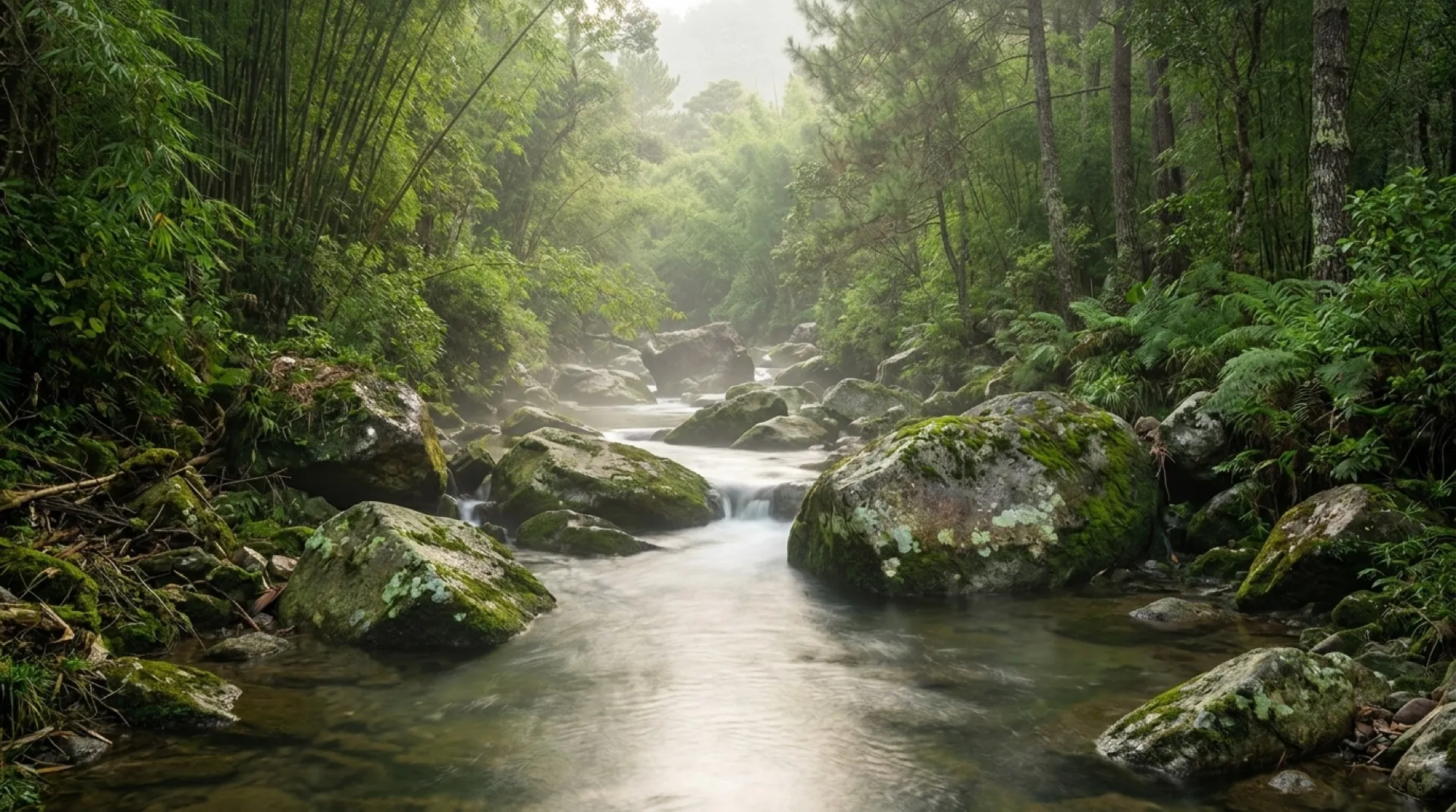
A clear mountain stream running between mossy boulders through bamboo and forest in soft morning light.

Classical Text & Core Meaning of Chapter 6

Chapter 6 of the Tao Te Ching (Dao De Jing) consists of just twenty-five Chinese characters, yet within Taoist contemplative and internal martial traditions it is revered as one of the foundational verses on breath, receptivity, and inexhaustible life force:

"The Valley Spirit never dies; it is called the Mysterious Female. The gateway of the Mysterious Female is called the Root of Heaven and Earth. Continuous and gossamer-like, it seems barely to exist; yet use it, and it never runs dry." (Gu shen bu si, shi wei xuan pin. Xuan pin zhi men, shi wei tian di gen. Mian mian ruo cun, yong zhi bu qin. 谷神不死,是谓玄牝。玄牝之门,是谓天地根。绵绵若存,用之不勤。)

Following the radical impartiality of Chapter 5's bellows metaphor (Tuoyue), Laozi shifts from cosmic mechanics to living physiology. A mountain valley (Gu 谷) is defined not by the mass of its surrounding granite cliffs, but by the open, low-lying hollow between them. Because the valley floor lies low and remains open, mountain streams, mist, echoes, and seeds naturally gather there. Shen (神) means spirit, numinous awareness, or living responsiveness. Joined together, Gushen (谷神, the Valley Spirit) names a quality of consciousness and vitality that endures precisely because it does not fill itself with rigid tension or egoic assertion.

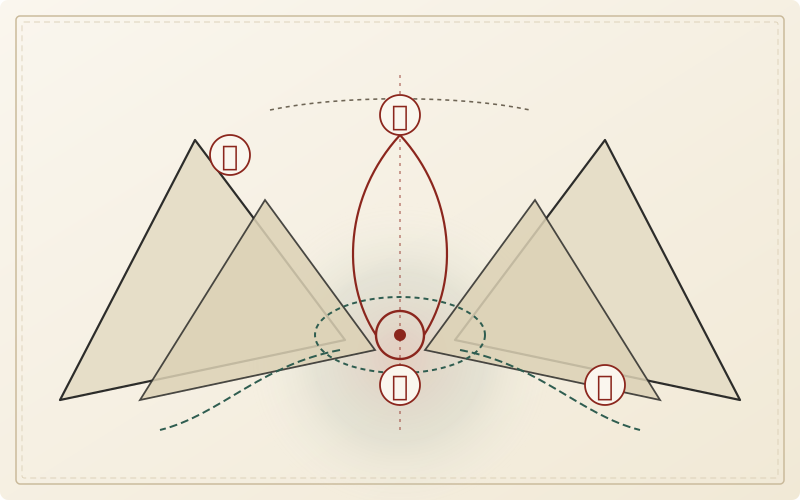
① Mountain ridges framing the hollow valley (Gu), ② Receptive emptiness at the valley floor generating the undying Valley Spirit (Gushen), ③ The gateway of the Mysterious Female (Xuanpin) where subtle breath rises and descends as the Root of Heaven and Earth, ④ Continuous thread-like breath (Mianmian Ruocun) nourishing vitality without exhaustion (Yong Zhi Bu Qin).

① Mountain ridges framing the hollow valley (Gu), ② Receptive emptiness at the valley floor generating the undying Valley Spirit (Gushen), ③ The gateway of the Mysterious Female (Xuanpin) where subtle breath rises and descends as the Root of Heaven and Earth, ④ Continuous thread-like breath (Mianmian Ruocun) nourishing vitality without exhaustion (Yong Zhi Bu Qin).

The Gateway of the Mysterious Female (Xuanpin Zhi Men) as the Root of Heaven and Earth

Laozi calls this undying valley awareness Xuanpin (玄牝)—the "Mysterious Female." In classical commentary (including Heshang Gong and Wang Bi), Xuan (dark, subtle, celestial) points toward the formless origin of Heaven, while Pin (receptive, maternal, generative) points toward the nourishing capacity of Earth. Where these two meet within a living being is Xuanpin Zhi Men (玄牝之门, the Gateway of the Mysterious Female).

In Wudang Taoist meditation (Zuowang and Cunxiang) and internal alchemy (Neidan), "the Root of Heaven and Earth" (Tiandi Gen 天地根) is not an abstract metaphysical speculation; it is experienced directly in the rhythmic interplay of inhalation and exhalation between the upper awareness (Shen) and the lower elixir field (Xia Dantian). Every inhalation draws clear heavenly Qi downward into the quiet abdominal valley, and every exhalation releases turbidity without strain. When the practitioner stops forcing the breath and allows the diaphragm and lower abdomen to become as open and unresisting as a mountain gorge, the gateway of Xuanpin opens naturally.

Continuous as Gossamer (Mianmian Ruocun): The Rhythm of Unforced Breath

The closing couplet—Mianmian ruocun, yong zhi bu qin (绵绵若存,用之不勤)—describes the exact texture of cultivated Taoist breathing and internal energy circulation:

  1. Unbroken Continuity (Mianmian 绵绵): Like a single silk thread spun continuously from a cocoon, the breath flows without jagged pauses, gasping, or abrupt holding. Transition from inhale to exhale happens like a tide turning in a sheltered cove.
  2. Subtle Presence (Ruocun 若存): The breath becomes so fine, quiet, and deep that it "seems barely to exist." Instead of heavy chest heaving, awareness rests lightly at the lower abdomen and the Mingmen lumbar gate.
  3. Inexhaustible Function (Yong Zhi Bu Qin 用之不勤): Qin (勤) here means to toil, wear out, or deplete. Forceful muscular effort quickly burns through stamina, whereas movement and stillness rooted in the quiet valley of the Dantian replenish energy even as it is used.

Embodied Practice in Wudang Standing, Qigong, and Taijiquan

Within the Wudang curriculum, Chapter 6 serves as a daily diagnostic for both stillness and motion:

  • Hollowing the Chest and Filling the Abdomen: In the Ten Essentials of Taijiquan (Taijiquan Shiyao), containing the chest (Hanxiong) creates a physical valley across the sternum so that breath and Qi sink effortlessly to the Dantian.
  • Yielding Rather Than Colliding: Just as a mountain valley absorbs a rushing torrent without cracking, a Taijiquan practitioner receives incoming force into a relaxed waist and hips, neutralizing momentum before returning it.
  • Conserving Spirit During Daily Activity: Whether practicing the closing postures of Eight Brocades (Baduanjin) or Wudang Five Animals Qigong (Wuxing Qigong), keeping the breath "continuous as gossamer" prevents the flaring of heart-fire and preserves the body's foundational vitality (Yuanqi).

Seeker’s Q&A · Frequently Asked Questions

What is the core takeaway of The Valley Spirit Never Dies (Gushen Busi)?

Explore Chapter 6 of the Tao Te Ching (Dao De Jing)—'The Valley Spirit never dies; it is called the Mysterious Female (Xuanpin)'—and how Wudang inner cultivation preserves vitality through receptive stillness and unforced breathing.
