WUDANG TAIJIQUAN · 武当太极拳

Distinguishing Empty and Full (Fen Qing Xu Shi) in Wudang Taijiquan: Cat-Walking (Maobu), Weight Transfer and Avoiding Double-Weighting 武当太极拳“分清虚实”与太极猫步详解:何谓双重之病、重心转换与步随身换

Why the Taijiquan Classics call “Distinguishing Empty and Full” the very first principle—and how to step like a cat so your knees stay light and your root never wobbles.

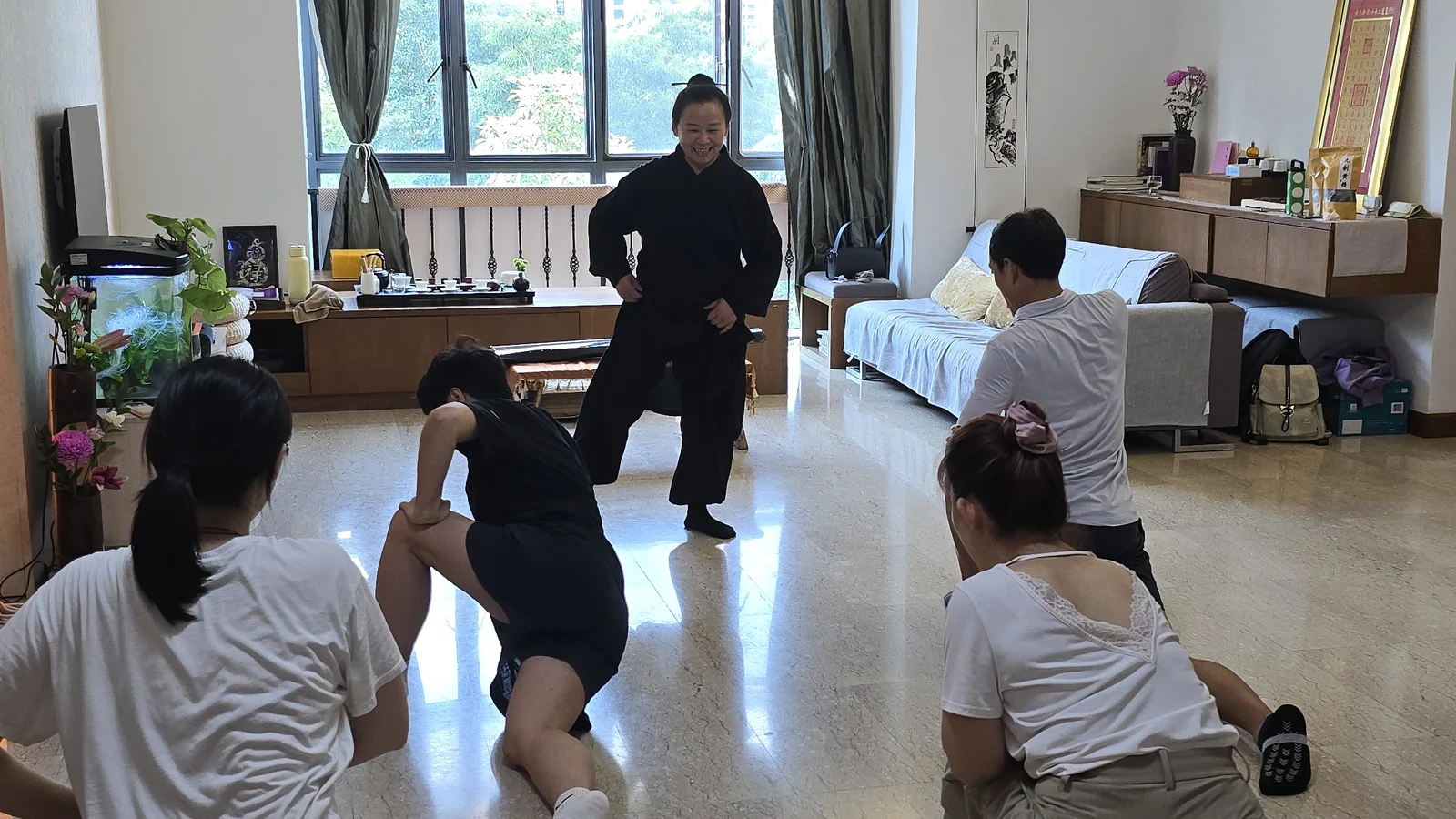
A Wudang taijiquan lesson in a sunlit room: students seen from behind kneel into deep lunges to open the hips while a teacher in black Taoist-style clothing stands in a wide stance, smiling, with an ink-painting scroll on the wall behind.

If you ask an experienced teacher what separates genuine Wudang Taijiquan from slow-motion calisthenics, the answer is almost always four characters: “Distinguish Empty and Full” (分清虚实, Fen Qing Xu Shi). In everyday walking, we habitually fall forward onto our front foot—letting gravity pull our weight into the heel with a dull thud before our hip has even arrived. In Taijiquan, that habit is replaced by deliberate, fluid weight modulation known as “stepping like a cat” (迈步如猫行, Maobu).

1. Why the Classics Call “Double-Weighting” (双重之病) the Root Flaw

In his foundational Taijiquan Treatise (《太极拳论》), Wang Zongyue identifies the single error that keeps dedicated students stuck for years:

“Everywhere there is one overarching principle: once you fail to distinguish Empty and Full, after years of study you still cannot neutralise incoming force and are easily controlled by others—this is the flaw of failing to understand double-weighting (双重之病). If you wish to avoid this flaw, you must understand Yin and Yang: where one side yields and sinks, the frame follows smoothly; where both sides press heavy at once, the frame stagnates (偏沉则随,双重则滞).”

What is double-weighting (双重, Shuangzhong)? On the physical level, it happens when your body weight is split 50/50 in dead, locked stiffness across both legs so neither foot can pivot or step without a preparatory lurch—or when you crash forward onto a stepping foot before testing the ground. On the partner level (Push Hands), it happens when you meet force with equal counter-force instead of yielding along a spiral (Wuji and Taiji).

2. The Four Phases of a Wudang Cat-Step (迈步如猫行)

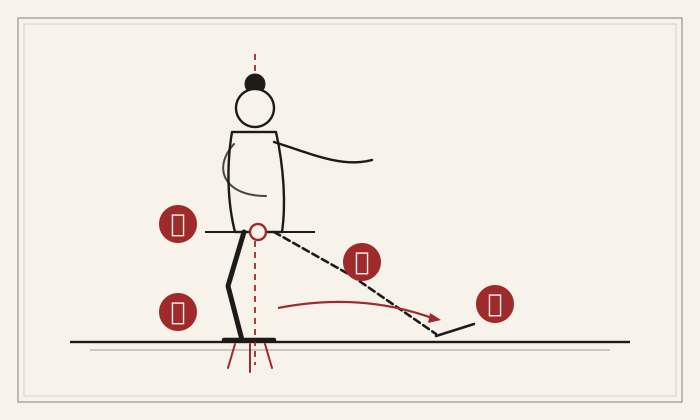
Watch a cat walk across a narrow stone wall: even if a tile under its front paw is loose, the cat never tumbles because 100% of its weight remains quietly settled on its rear supporting legs until the front paw has tested the surface.

Classical ink-and-cinnabar diagram of Wudang Taijiquan Empty and Full (Xu-Shi) Cat-Walking showing the rooted supporting leg, folded hip socket (kua) with level pelvis, empty front foot touching down heel-first without weight, and smooth weight transfer along a vertical axis

How Wudang Cat-Walking (太极猫步 · 分清虚实) separates supporting root from stepping foot so the body never lurches or falls into a step.

  1. Full Supporting Root (坐实主力腿 · 实中有虚): 100% of body weight settles cleanly through the supporting leg into the sole while the knee stays unlocked (Song and Rooting Jin)
  2. Folded Hip Socket & Level Pelvis (松胯平准 · 中定不摇): the supporting hip crease (kua) folds inward so the pelvis stays level like a balance scale (Central Equilibrium · Zhongding)
  3. Empty Foot Peeling & Touching Lightly (迈步如猫行 · 落脚似羽): the empty foot peels heel-to-toe off the floor and touches the new spot heel-first with zero weight—able to withdraw at any instant
  4. Gradual Pouring of Weight (虚实渐换 · 如水注器): only after the front foot is flat and aligned with the knee does weight pour smoothly from rear to front (Chansijin)

Notice the classical nuance: “Full is not dead-locked; Empty is not lifeless” (实非死实,虚非全无). Even when 70% of your weight rests in the front bow stance and 30% in the rear leg, both legs remain connected by elastic Six Harmonies structure, echoing Chapter 11 of the Tao Te Ching (Dao De Jing) on how solid form and empty space work together (You and Wu).

3. Three Common Stepping Mistakes—and How to Fix Them

  1. “Falling Step” (砸步 / 跌步): If you cannot pause for two full seconds with your front heel hovering one centimetre above the floor before touching down, you are falling into your step rather than placing your foot. Fix it by sinking the supporting hip crease (kua) deeper before extending the empty leg.
  2. “Bobbing Head” (忽高忽低): Rising up between postures and dropping down at the end tires the thighs without building internal root. Keep the crown gently suspended (虚领顶劲) at a consistent level as if gliding beneath a low ceiling.
  3. “Tightrope Walking” (一字步失衡): Stepping with both feet on a single tightrope line narrows your lateral base and twists the rear knee. Step on two parallel shoulder-width rails (川字步) so both hips can open comfortably.
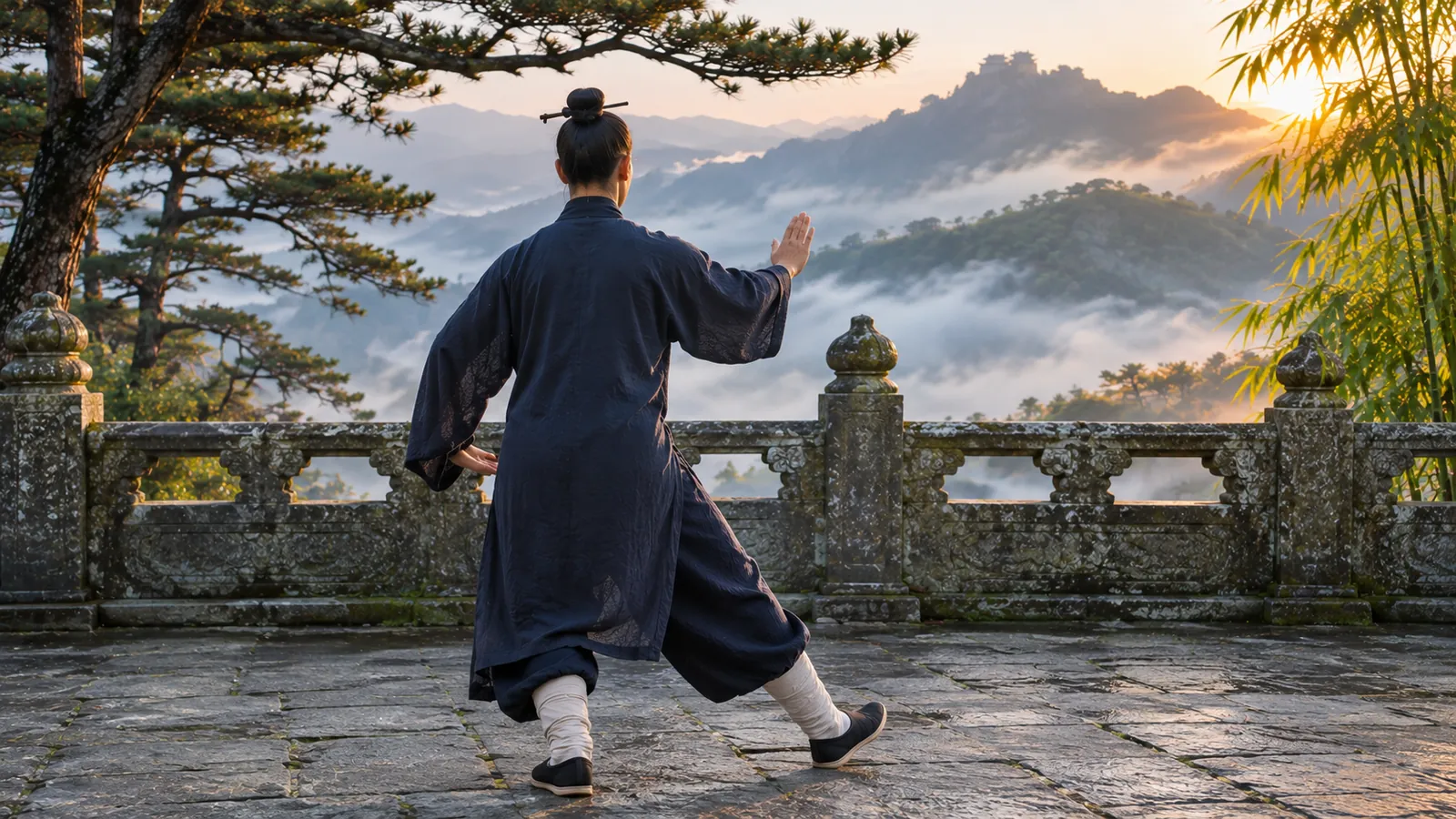
A practitioner in dark indigo Taoist robes and white cotton leg wraps seen from behind performing a Wudang Taijiquan Cat-Step (Maobu) on a stone mountain terrace above morning clouds.

Stepping like a cat (Maobu): 100% of the weight stays rooted in the rear supporting leg while the empty front foot touches the flagstones without a sound.

4. A 5-Minute Cat-Walking Drill Between Wudang Mountain and Singapore

Whether you practice on the stone flagstones near Wudang Mountain’s UNESCO World Heritage ancient Taoist temples or in a narrow hallway in Singapore, five minutes of slow Cat-Walking after Zhan Zhuang and a Morning Daoyin Warm-Up builds balance faster than rushing through a long form. See how stepping anchors Wudang Tai Chi for Beginners, map your study path on Start Here, or join our Singapore Tai Chi Retreat Camp.

Safety note: Choose a stance height where your supporting thigh feels warm and engaged without knee pain, and keep every kneecap pointed strictly in the direction of the toes; this cultural movement practice does not replace medical care.

Seeker’s Q&A · Frequently Asked Questions

What does “double-weighting” (Shuangzhong 双重) mean in Wudang Taijiquan?

Double-weighting means failing to separate Empty (Xu 虚) and Full (Shi 实): either locking body weight stiffly across both legs so you cannot step or pivot smoothly, or meeting a partner’s incoming force with stiff equal resistance instead of yielding.


How do you perform the Tai Chi Cat-Step (Maobu 猫步) correctly?

Settle 100% of your weight into the supporting leg and fold the hip crease (kua), peel the empty foot gently off the floor, touch the new spot heel-first with zero weight so it could still be lifted at any moment, and only then pour your weight smoothly forward.

Why should beginners step on two parallel rails (Chuanzibu 川字步) rather than a single line?

Stepping on two shoulder-width parallel tracks preserves lateral stability, allows both hip sockets (kua) to open and fold naturally, and prevents inward twisting torque on the rear knee.
